
A Handful of Thanks

I’ve been meaning to start this for awhile, luckily my buddy Megan Gelband keeps reminding me with her blog. Since Thanksgiving is sneaking up, what better time for recording a handful of the things I am thankful for?
1. Hugs from my husband – he reassures me that the world is not to explode, even when it feels like my heart will
2. The smell of clean laundry
3. New recipes to try. Tonight – Chicken Fajita Soup
4. Parents who buy tiny orange peppers for the above recipe
5. Big Bang Theory Season 3, Disc 1 — in the mail today
6. Gobs and gobs of crunchy leaves ready to step on
7. 17 months of dating my favorite person
8. Encouraging friends who call or e-mail at just the right time
9. Warm blankets to wrap up in
10. Ending sentence fragments in prepositions
What are you thankful for?
Read more from Jennifer at her blog.
Katrina Recollections: Kenny Rauch (audio)

Kenny worked with my dad at Wand Rubber Stamp Works, Inc. For a while, my dad and Mr. Sal were business partners and co-owned Wand. Kenny and “Little” Sal (Mr. Sal’s son) worked at Wand for as long as I can remember. Kenny still works at Wand, as does “Little” Sal, who now owns the business after his father’s passing.
My first memory of Kenny was when I was five years old. He came over to our house in Metairie and started a snowball fight with me; that means it was 1973 – the only time it snowed in New Orleans during the eighteen years that I lived there.
Kenny and I sat down in an office at Wand, and he shared his experiences during and after Hurricane Katrina; he also added some post-Katrina thoughts on the 2009 New Orleans Saints.
 QuickTime and the QuickTime Logo are trademarks of Apple Inc., registered in the U.S. and other countries. The Get QuickTime Badge is a trademark of Apple Inc., used with permission.
In Defense of Thanksgiving

This week a local radio station made its annual switch to all Christmas music, all the time. For me, it’s just too early. Black Friday (the day after Thanksgiving) is traditionally the start of the Christmas shopping season, and the first Sunday of Advent is the Sunday after Thanksgiving. Isn’t that soon enough to start hanging lights, erecting trees and listening to “You’re a Mean One, Mr. Grinch?”
Thanksgiving is a perfectly good holiday. And while it’s not explicitly a religious holiday, it’s hard to find a religious tradition that doesn’t see thankfulness as a virtue. In fact, I’d argue that gratitude is underrated in American culture. We spend so much of our time wanting, getting, striving and working, that we easily forget that life, our talents, our relationships — these are all gifts. And to not recognize a gift is rather rude and unkind (at least that’s what my Mom always said). A thankful spirit would do us well throughout the year, and yet, it seems that the one holiday focused on gratitude looks fairly anemic beside the Christmas season.
Other holidays don’t have this sort of trouble defending their turf. Valentine’s Day doesn’t have to worry about the greenery of St. Patrick’s Day overlapping the red flowers and boxes of candies. Independence Day isn’t in danger of being overwhelmed by Labor Day. But humble Thanksgiving is forced to listen to Christmas music for a full two weeks before its big day.
Don’t get me wrong. I love Advent. I enjoy hearing and singing Christmas music. The parties, the gift-giving, the pumpkin pie (especially the pumpkin pie) — it’s all wonderful.
All I’m asking is that we give Thanksgiving it’s space. Let it have it’s time in the spotlight. Recognize that we are better people when we are grateful.
If your year has been anything like mine, it’s been crazy. We’ve had serious illness, economic stress, job transition, and a chaotic world. And yet, I’m still here — enjoying what I do, surrounded by a wonderful family, great friends, and a terrific church.
And for that reason, my radio will avoid the Christmas station a few days more, so I can remember and give thanks.
Bigotry Anonymous

Hello. My name is Diana — and I’m a bigot.
I wish that it weren’t true. I like to think that I’m a bigot well into recovery, but I’ve had relapses along the way, and I’m really not sure how far I’ve come. I’m not going to confess the targets of my various prejudices. That wouldn’t serve any real purpose. And I wish journalist Juan Williams hadn’t passed up an excellent chance to keep his thoughts to himself when he said, “…when I get on a plane, I got to tell you, if I see people who are in Muslim garb and I think, you know, they are identifying themselves first and foremost as Muslims, I get worried. I get nervous.”
He said these words just after assuring Bill O’Reilly he wasn’t a bigot, but his confession of pre-judging people based on their choice to dress in a way that identifies themselves as Muslims negates his denial with breathtaking effectiveness. (Incidentally, if I wear a cross or another Christian symbol around my neck, or pray before my meal on a plane or in a restaurant, what does it say about me? Does my identification “first and foremost” as a Christian make people nervous?)
To make matters worse, O’Reilly claimed that it wasn’t just a few individuals, but “whole nations” that were against us (Americans, I suppose). I wish anyone who harbors that opinion could visit with my Iranian American friends who are proud to be citizens of this country, and the Iraqi refugees I visit who are working hard and happily building new lives for themselves here.
My final words on this most recent brouhaha are that NPR shouldn’t have fired Juan Williams, no one should try to de-fund NPR, and Fox News has no room to accuse other news outlets of being biased.
This story will blow over and I hope it won’t do too much damage before it falls off the front pages. But in an era of instant communication, I wonder if it’s still true that actions speak louder than words. In the long run, they probably still do, but grace-filled actions are like Redwoods that grow quietly and take a while to be noticed while misinformed or hateful words are more like stink weeds–or stink bombs. They’re lobbed from the internet to cable news to a seemingly infinite number of blogs.
I don’t know if Mr. Williams planned to make the comment he did or if it was an off-the-cuff remark, but he and all the rest of us need to come to terms with our inner bigots and find a good Twelve Step program–and less public venues for our confessions.
Internet Nightmare

It was late when Karen came over from next door with her cell phone. On the line was Emily, a young school teacher who moved here with her husband to be part of our fellowship, and who has been especially good to Jamilla, an against-the-odds teenager on her block. Karen put Emily on speaker, and suddenly we were all together in the middle of a post-modern teenage nightmare.
With part of her disability check, Jamilla had gotten herself a high-status cell phone that connects with internet, and recently she had been experimenting with ‘Urban Chat,’ a sleazy local website where teenagers flirt with each other online. A few hours earlier, an attractive guy from that site had convinced her to send him a nude photograph. Now he was telling her that unless she paid him $60, he was going to forward that photo to every kid he knew at her school. According to Emily, Jamilla was frantic, embarrassed, and very much afraid.
The ensuing conversation ranged from the new dangers of technology to the old vulnerabilities of adolescent insecurity to the unique blind spots of kids in poverty, but it kept coming back to the problem at hand: What should Emily tell Jamilla to do? For good reasons, Jamilla was terrified to tell her family, and it didn’t take much research to discover she could get into big trouble for sending the photo in the first place. In the end, we told her to agree to pay off her blackmailer the next morning, in person, on the campus of the University of Cincinnati. Of course, we had another plan in mind.
Jamilla and I parked near the meeting place early. She walked there alone, while I stood across the street, pretending to talk on my cell phone. Both of us nervously scanned the face of every young man on the sidewalk, looking for the bad guy. When he finally showed up, he walked towards Jamilla with a confident smile. Before he could say a word, I stepped between them.
“My name is Bart Campolo and I’m Jamilla’s pastor,” I said calmly, as his smile disappeared. “I’ve spoken with our lawyer and also with a police officer in our fellowship, and both of them tell me you’re not in any real trouble yet.” I paused for a moment, hoping he wouldn’t run, but he was frozen in place. “Now first of all, I need to watch you delete that photograph from your cell phone.” Wordlessly, he complied.
“Of course,” I continued, “you might have a copy of that photo on your computer, but I’m here to tell you that if it goes anywhere, I will personally see to it that you go to jail for at least a year and that your family pays out a great deal of money. Do you understand me?” He nodded, as I held up my camera and pushed the button. “Now I have your photograph and your telephone number and I know where you go to school. Son, what you did to Jamilla was ugly and cruel, but I’m going to let you walk away from it. But I promise you, if we ever hear from you again, the wrath of God will come down on you. Again, do you understand me?” He looked me in the eye for the first time. “Yes sir,” he said. I stepped back. “All right then. You may go.”
As he walked away, I put my arm around Jamilla, who still looked very afraid. Honestly, I was a little bit weak in the knees myself. I’m not a natural tough guy, after all. “Do you really think it’s over?” she asked quietly.
“Yes I do,” I replied. “That boy is terrified, and he ought to be. Do you know why?”
“No.”
“Because I wasn’t bluffing. I meant every word I said.”
“Really?”
“Really.”
On our way to her high school, I gave Jamilla just the kind of fatherly talking to you would expect, about trust and men and self-respect, and Jamilla gave me just the kind of relieved, grateful attention you would expect after an ordeal like that. Over and over, I tried to communicate to her just how precious she is to us. Jamilla teared up, and told me how much it meant to have a caring grown-up friend on her block. Without Emily, she said, she didn’t know where she would be.
After I dropped her off, I called Emily and Karen and Marty, so they could stop worrying. Then I gave thanks for women like them, who live out their love in the most natural ways, and make safe havens for girls in trouble. And then I treated myself to a greasy diner breakfast, during which I reflected at some length on the peculiar exhilaration of utterly overpowering a mean, abusive person in the name of Jesus.
It doesn’t happen nearly often enough, but I do love the smell of justice in the morning!
Keep the faith,
Bart
Bart Campolo is minister at Walnut Hills Fellowship in Cincinnati Ohio. Read this post and others at his blog.
A Friend of Nes Ammim

In that day, the stock of Jesse that has remained standing shall become a standard to peoples – nations shall seek his counsel and his abode shall be honored. -Isaiah 11:10
As you drive north from Acco towards Nahariyah you pass a large strip mall at the entrance to Moshav Regba. Branching off just before the gate of Regba is a narrow road that winds for a few miles through the avocado orchards that are characteristic of the Galilee coast, and ends at the gate of Nes Ammim. You enter a green and calm community, with large expanses of grass and well tended flower beds and shrubs along the paths and around the homes and public buildings. Nes Ammim was founded in the 60s by Dutch and German Christians seeking a place where they could get a deeper understanding of Judaism and Israel, and facilitate reconciliation among people of all faiths. “Nes Ammim” means “a standard to peoples,” from the verse quoted above from Isaiah. In the early years there was some opposition from local Jews to the establishment of a European Christian community in the neighborhood, but the rabbi of Nahariyah and several other public figures came to their support.
Originally they operated as a sort of quasi-kibbutz, with several businesses owned by the community and operated by the members – flower hothouses, avocado orchards, a carpentry shop, and a hotel. However, if real kibbutzim have had a hard time surviving, this community, which remained quite small (under a hundred inhabitants even in the best of times), and which never really had a full-time, long-term population, has struggled to make it economically. Generally, the “members” consist of families and individuals coming to spend anywhere from a few months to a few years here, mostly from Europe but with a smattering of Americans. They come to experience Israel, to volunteer in the community, to learn about Judaism. Today, the only business remaining is the hotel. There are about 40 residents, mostly young volunteers. The community continues to receive support from “Friends of Nes Ammim” groups in several European countries. Their “House of Prayer and Study” is a graceful, simple structure, a non-denominational chapel/community center where the residents meet to pray and study, and events are held for the wider community.
I have gotten to know and appreciate Nes Ammim over the years, as a participant in various events held there (e.g., Kristallnacht commemorations and interfaith conferences), and as a guest lecturer on Jewish topics for their volunteers’ study program and for visiting groups from abroad. I have gotten to know them better in the past year, as a member of their board in Holland is also involved in a youth circus there, and he has actively encouraged Nes Ammim to serve as a point of contact between our Jewish-Arab youth circus and its Dutch counterpart. Now we have a German college student who coached for the Dutch circus, doing a year-long internship with our circus, living at Nes Ammim.
I have found it fascinating and humbling to get to know, over the years, Nes Ammimers and other western Christian groups and individuals living in Israel – including a number of Franciscans and Carmelites stationed at monasteries around the Galilee. Not Crusaders, not missionaries, not waiting for Armageddon, but thoughtful people for whom this is place is special, holy – and who want to be in some way part of the project. They are “insider-outsiders,” seeing us close-up and sympathetically, smiling at our embarrassing behavior. Trying to see ourselves as they see us is a useful exercise in self-criticism and keeping things in proportion.
Rabbi Marc J. Rosenstein is executive director at the Galilee Foundation for Value Education, Shorashim, Israel. Learn more at www.eng.makom-bagalil.org.il
Katrina Recollections: Troy Lowry
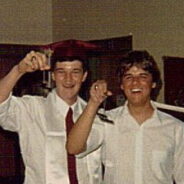
Troy Lowry (left) and Bert Montgomery holding their ZZ Top keychains. Destrehan High School, Destrehan, LA. May, 1986Editor’s note: Since last fall (2009) Bert Montgomery, a native of New Orleans and the River Parishes, has been collecting stories from his childhood friends, classmates, neighbors and church family about their experiences during after Hurricane Katrina. FaithLab is working with Bert to produce a book (both traditional print and e-book formats) and an interactive website to honor his friends and their experiences.
Throughout this fall – five years after Katrina – FaithLab is posting excerpts leading up to the book’s publication.
Troy and I graduated together — DHS, class of 1986. We probably met my first day of school at DHS, when I started there my sophomore year. We had almost every class together, and in those classes where we were assigned seats alphabetically, we were always sitting close to each other (sometimes right next to each other – which made for some fun in class). Troy and I always talked about Hulk Hogan, Andre the Giant, Captain Lou Albano, and the other stars of the mid-eighties’ World Wrestling Federation. And, he was as big of a ZZ Top fan as I was.
Once, in Mrs. Chaisson’s Honors English class, we were assigned to write our own epitaph for a homework quiz grade. First class – homeroom – the next morning, Mrs. Chaission starts collecting everyone’s brief assignment. Both Troy and I forgot to do it. “Oh well,” I said, “… just a quiz grade.” Troy took out a piece of paper and in less than a minute had written
“I’ve been bad; I’ve been good;
Dallas, Texas; Hollywood.
Here lies Troy Lowry.”
He turned that in and got a full quiz-grade credit for plagiarizing ZZ Top lyrics; I was sitting there with a big fat zero.
Troy grew up in Norco and lived in St. Charles Parish for twenty-six years. He lived for five years in Texas, but now makes his home in the town of Prairieville (Ascension Parish). At the time of Hurricane Katrina, Troy and his family (wife, daughter, and a new-born son) were living in League City, Texas.
Tell me about the week leading up to Hurricane Katrina: What were you hearing on the news and from family/friends? What were your initial thoughts?
News out of the Houston area was gloom and doom for the New Orleans region. The first minutes of each news broadcast focused on the oncoming hurricane. Some on the local radio talk shows kept mentioning that the news media were using scare tactics. My family and friends were scared, and most of them were planning to leave town.
Initially I thought as I always did growing up in that area – that the hurricane would miss the region, and it would be nothing more than a rain/wind event with some flooding in the low-lying areas. I felt helpless (watching all the reports), but still I did not believe it would be a direct hit.
Soon we were housing my mother-in-law, and my wife’s friend, friend’s son, and friend’s mom and dad.
You were watching from your house in Texas. Katrina makes landfall, passes over, then levees break . . .
I felt totally helpless, and I must say that for the first time I could recall, I cried openly watching the news. At work that Monday morning all I could do was glean what I could from the local news, radio and internet. I was pretty much addicted to the news 24/7.
My mother-in-law was frantic because of all the reported flooding in her region (Kenner). I was able to find aerial photos posted on WWL-TV’s website and show her that her fence was down, the roof had some damage but that she didn’t flood. I’ll never forget the pictures of the pools with brown water. Pools closest to her home were still blue, and based on that and the debris line being about one foot from her door, I was able to determine that her house did not flood (and, it didn’t). Kudos to WWL-TV for posting those photos!
I was thoroughly disgusted with people calling the local talk radio in Houston. They called to request the radio station play “When the Levee Breaks” by Led Zeppelin. It was also amazing to hear the stories on the Houston news and national reports about why New Orleans should not be rebuilt. San Antonio openly courted and wanted the Saints; Galveston wanted Mardi Gras; Houston wanted Jazz Fest. It made me feel resentful to that region, and I still hold some of that resentment today. My Louisiana blood boiled over big time, and I never felt prouder to call Louisiana my home as I did then. To kick someone when they are down is one thing but to steal that which is ours … NEVER!
Evacuees (“Katricians” as they were affectionately called in Houston) were blamed for all sorts of problems in Houston. If a crime was committed in the Houston area by someone who fled New Orleans, the headlines were “Katrina evacuee wanted….”
The year Katrina hit, the Saints were displaced for their whole season, then the next year came back and got to the NFC championship. Is it possible to talk about the Saints of the last five years (especially winning the Super Bowl this year) without talking about Katrina? Why or why not?
I cannot imagine talking about the Saints and not thinking/talking about Katrina. I vividly recall New Orleans after Katrina, and keeping the Saints was right up there with repairing New Orleans. Sadly, I never was a big Saints fan growing up (I liked the Cowboys) and was only a casual fan up until Katrina.
Katrina changed that as my New Orleans pride swelled over when they reached the NFC championship game. I became a fan and even bought my first Saints shirt and hat. I have several hats and shirts now … but the numbers pale in comparison to my purple and gold collection (laughing).
What did the Saints’ Super Bowl season mean to you?
It put a lot of smiles on the faces of fans in and around the Gulf Coast. It also made me pause to remember lost loved ones who were ardent Saints fans but did not live to see the boys win it all. A dear friend passed away in July of 2009, and she was one of the biggest Saints fans I knew. I’m sure she was wearing her black and gold and leading the second line procession in Heaven after the game. I also will never forget my five-year-old singing “black and gold in the Super Bowl” every time he saw Saints memorabilia in a store.
Did you attend any games this past year and/or the victory parades? How did the Saints win affect Mardi Gras?
I did not attend any games and was unable to attend the victory parade (although I watched it on TV and cried like a big baby). We partied harder for Mardi Gras, and I never saw so many Saints jerseys gathered in one big party!!!!
© Bert Montgomery, 2010
Making a Fashion Statement


“Your husband should be the one wearing that shirt.”
I blink and look down. “This is what a preacher looks like.” I pause, wondering how to respond. The woman speaking to me is a friend, complimenting my husband’s recent sermon. The thing is, I agree with all of her praise – Allyn is wonderful and a fantastic preacher. Is that all she was saying, or was this statement implying something deeper – “only men can preach…” or maybe more cutting, “you just don’t have the giftedness, sweetheart?” I assumed the best. “Wasn’t he great? But this is a Baptist Women in Ministry shirt.”
A recent Associated Baptist Press opinion piece pointed out that we don’t have time to worry about the opinions of others when it comes to women in ministry. As much as I agree and want to follow, I’m just not there. It hurts to know that a significant number of Christians think I’m not qualified to be a pastor simply because I am a woman.
And I wonder about my job options. I don’t know of a single Baptist church in Missouri that has a female lead pastor. Yesterday, I was contacted by a woman moving to Missouri who wants to attend a Baptist church that is friendly to women in leadership. I had to admit that there just isn’t one in her area. I keep hearing about how far women ministers have come, and I am truly thankful for women and men who have fought for the opportunities that exist today… but as I look at the job market, I get discouraged at how far there still is to go.
My husband asked yesterday, “what is plan B?” I sighed and stated I’d turn to a different denomination. I admitted that my involvement in BWIM-Missouri – that my desires there – are an attempt to fight for my place in the denomination that raised me. If I have to turn elsewhere, I want to make sure that the next generation of women called to ministry has a place. I want theirs to be an easy battle. So I continue proudly wearing my “This is What a Preacher Looks Like” T-shirt. Maybe next time I’ll be a bit braver in conversation.
Read more from Jennifer at her blog.
Turning Lies into Truth

“I’m not sure what to do,” my friend lamented to me. “If I respond, I may just stir things up even more. On the other hand, if I remain quiet, people are likely think I have something to hide.”
My friend is a public servant, working in one of those jobs that no matter what he does he creates detractors, if not right out enemies. I asked him once why he did it. He looked at me like I had just arrived from an alien world and then told me. “I do it for the same reason you do what you do. It’s who I am and what I was put here to do.” Ouch!
What do you do when someone is spreading false tales about you? My friend and I continued our conversation. Sometimes one has to take a stand. When no one else is telling the truth, doesn’t the situation demand that you do so? Yet, sometimes remaining quiet is the way to still the storm. I ventured to remind him that those of us who knew him knew the truth and were not going to be swayed by lies. For several minutes we bounced such ideas around. We both knew that the decision as to what to do was his and that I was not going to tell him what he should do. His last word that day was, “I know what is being said is not true, but if a lie is told often enough it can come to be heard as truth.”
In the days since that discussion, I’ve thought of and prayed for my friend. I suspect that he will “lose” no matter what he does. Most days, I think if I were him I would remain quiet . . . but his last words haunt me. If a lie is told often enough it can come to be heard as truth.
I thought of those words as I read Jesus’ story about two men who went to pray. Like most “good” readers, I’ve usually identified with the tax collector—the good guy. I’ve always seen the other guy as a pompous hypocrite who played a role he knew to be false. Now I wonder. Did he know the role he played was false or did he believe he was the man he portrayed himself to be?
If a lie is told often enough it can come to be heard as truth, my friend had said. If a lie is lived long enough the one living it may come to believe it is real. Jesus said of the other guy that he left the hour of prayer no different than when he came—not justified.
When we read that story today, I fear we are so busy applauding the justified sinner that we miss the real tragedy of the story: that the other guy left unjustified and didn’t even know it. He couldn’t know it . . . couldn’t know it because he had lived the lie so long he had come to believe it. The man he pretended to be came to be the only man he could see.
Two men went up to pray. The one who did was the one who was who he was and who knew God was other.
The Brad Hibbs Effect

I realize that this sounds like a great name for an 80’s Prog Rock band, but this is actually a Leadership phenomenon that I have encountered, and one you might do well to be aware of.
First, an explanation. Brad Hibbs is a guy I knew in college, who I believe currently does civil engineering for North Carolina hiways. Please give him a shout out for me if you see him. When we were in school together, I wasn’t as good a friend to him as I should have been, but he was a great guy to know, and someone you could really depend on. I coached intramural basketball one year, and we put together a team that was pretty good. We weren’t great, but we held our own.
Brad was on the team, and to be honest, a pretty good player. His main liability as a player was that he was too nice, too agreeable, and too supportive. As a result, other players who badgered me for playing time got to play a lot more than he did, and I’m sure that we would have won another game or two had I just been willing to play him more. I was willing, but I knew that he wouldn’t hassle me about being on the bench, so I didn’t play him enough. To be fair, I didn’t play myself enough either, but I felt bad about leaving him out so others would be more cooperative.
I think that all of us have a tendency, when leading people, to act that way. Sometimes, people can be harsh and demanding. They may openly question you or your policies and, in so doing, make life difficult. At times like that, it often seems much easier to cater to such people, while passing over your supporters, however well-qualified they might be. In honor of Brad, I’ve called this phenomenon “The Brad Hibbs Effect,” and I’m defining it as “the tendency to disregard supportive people, regardless of their qualifications, in order to protect one’s self from criticism.” Yes, it looks like a failure of courage, or at least a conflict-avoidance mechanism, and it might even be a defense from charges of favoritism, at times,but I believe that it is something with which every leader has to struggle. We don’t want to unnecessarily favor one person over others, but is it really fair to exclude folks because they are supportive?
So, the next time you have to make a choice about who to rely upon; who to use for a particular job; whose perspective you need to show extra attention to, lest you offend; you might want to look deeply at yourself and those people who surround you and ask, “am I giving in to the Brad Hibbs effect?” Sorry, Brad. I wish it hadn’t taken me so long to understand this.
Follow Us!