
Ascending Descending

Ascending
Descending
Truly,
The One Who Is
is in this place
and I
I did not know it.
Forming Light
Creating Darkness
In the light
the bright revealing clarity of day
In the darkness
the dim obscuring shades of night
The Breath of Life sighs
In birth
In death
The crying new born
The family gathered together
in joy
celebration
The baby dying with birth
still born
The arms of comfort
family
friends
The silent sharing of pain
the community of tears
The Eternal enfolds.
In health
In sickness
The young woman strives
against herself
Dazzling
gilded in sweat and sunlight
pushing the limit of what she can do
flying above the track in her speed.
The young woman strives
against herself
Burning
soaked in sweat and pain
she struggles to walk
though disease has caused her body
to fight herself
her spirit flying above her infirmity
The Sustainer Of All supports
In acceptance
In defiance
The old man
dying
knowing death approaches
sighs in wise knowledge
death comes to all
patiently awaiting the inevitable
The old man
dying
refusing to believe death must come
not today!
Not me!
Fighting with every once of strength
not in fear
with a fierce love of life
The Holy One stands with each in his choice.
In triumph
In tragedy
The dam is finished
the crop brought in
the disease cured
the vaccine is found
all gather in celebration
the clasping of hands
dancing
The cancer is still there
the frost came early
the levees have failed
the earthquake shakes a building down
people come to comfort
feed
rescue
dig
reach out a hand
The Father of Compassion, The Wombed Father is there
In solitude
In communion
beneath the stars
singing their radio songs
breath misting in the cold
answering tendrils rising from the pond
obscuring the sleeping cattle from my sight
I have a fleeting sense
that
I
we
all there is
is in G-D
and I
I did not know it.
Here we go…

I have never been “a’wassailing” to my knowledge, but I really love Christmas songs and have meandered about neighborhoods singing them while sober. In fact, a quick perusal of my rather large music collection will reveal that I have more Christmas CDs than any other kind. My collection of Christmas music is so large that it is almost impossible for me to listen to all of it between the first Sunday of Advent and the end of the Christmas season on January 6 – even though it’s the only music I listen to and I keep it going all day. Because of this, I feel qualified to open a conversation about some standards I tend to adhere to and other observations, in hopes that others might share their own:
1. I will not sit through any renditions of “Angels We Have Heard On High” where the singer cannot pronounce “In Excelsis Deo.” It becomes like nails on a chalkboard, so I’m not going through that if I can avoid it.
2. No elevator music. This is pretty much a universal standard, but it doubly applies to Christmas music, where such treatment sucks all the life out of the song in an effort to make me buy something.
3. I’m not too keen on “The Little Drummer Boy.” Everyone covers it. No one does it well.
4. Andy Williams would be a destitute unknown lounge singer if not for Christmas music.
5. Any Christmas songs sung by Bing, Johnny Mathis, or Elvis are approved for all listening purposes because they’re Bing, Johnny Mathis, and Elvis.
6. Most modern “singers” are incapable of holding one note for more than a beat. I really can’t tolerate someone singing the word “Jesus” with more than 7 syllables, much less the 12 or more that Mariah Carey insists on using.
7.”We Three Kings” is rather ponderous and its use as the theme song for Epiphany might indicate that people are generally weary of the holiday season by then.
8. Humorous and novelty Christmas songs can be a lot of fun, but like any good joke, they start to grate if you share them too often. For “Grandma Got Run Over…” once is too often.
9. People who make “hardcore techno” Christmas songs should be held accountable for their crimes. They prove beyond a doubt that some musicians have no business getting anywhere near a Christmas song.
10. If you have recorded any Christmas music in the last 12 years, there is a high probability that you did a cover of “Adult Christmas Wish.” It’s still a good song, though.
Those are some of my observations. In the interests of fairness, you should know that I have a strong preference for groups of people, singing in harmony, Christmas carols, instead of just Christmas songs. If it is in THE Baptist Hymnal of 1956, it will thrill and inspire me every time, and I still count among my more significant Christmas memories hearing a lone tenor from a gay men’s choir sing “In the Bleak Midwinter” with tears in his eyes and voice because it was the first time a church allowed him to sing in a very long time and the choir behind me singing “Still, Still, Still” as we conducted a midnight Christmas Eve service. So what have you noticed about your music this Christmas?
Season of Pain?
Allyn and I will be sharing a two-month preaching gig starting January 1. The church is a First Baptist — a historical place that is apparently very proud of their conservative values. I suppose this means that this church will have quite a few differences from us. I’ve been told there may be some folks with strong opinions about women in ministry (in the “um, that shouldn’t happen” category). I’m honored to be perhaps the first regularly appearing woman preacher there. And I am floored at the opportunity to serve these people for a short time. I have wondered again and again if I have anything to share with a group of people who perhaps aren’t sure what they think about someone of my gender in a ministry role — and who may approach the Bible completely differently than I do, sometimes in ways that I find incredibly harmful.
Muriel, the area minister, said something incredibly wise, though. “We don’t get to choose who we minister to, we are just called to minister.” That is perhaps not an exact quote, but I think the idea is there. A person doesn’t have to look like me or think like me in order for me to minister to him/her. This church has been without a pastor a long time and, like any church in that position, bears some scars. I know how to love — and isn’t that what every minister is really called to? To love God’s people, wherever they may be found?
I’m finding that thinking about ministry during this holiday season is rough. People all around are hurting. At church on Sunday, I heard story after story of people facing all kinds of deeply painful things. This morning, I heard that a friend lost her father. At the same time, I’ve been meeting the newborn children of other friends. We spent a weekend of class with my dear friends Chad and Becki and their two-month-old Evie. This weekend, we met the not yet week-old baby of friends and Allyn’s coworkers Randy and Hannah. Joy and pain co-mingled in this season.
Pastor Samuel preached about that on Sunday. How Mary’s story wasn’t a fairy tale — in the midst of excitement over the coming child — God’s child — was an awful lot of pain. A not-yet-married woman pregnant? Scandalous! She couldn’t have been treated well — perhaps even by those who had been close friends. God came in the midst of loss, in the midst of pain. I trust that God will still do that today. That God will be among us not just in our joy, but in our pain. I trust that God can use two youngish seminarians to remind a conservative historical church that God is with them. And I trust that God can use that same church to remind me that God is often found in the most unexpected places. This season, may God’s peace abound in our hopes, our joys and our pains.
When Love Comes to Town

In the beginning was the Word, and the Word was with God, and the Word was God … And the Word became flesh and lived among us (John 1:1-2, 14a).
Or, as Eugene Peterson puts it, “The Word became flesh and blood, and moved into the neighborhood” (The Message).
Eighteen years ago this Christmas day, my son Rob was born. Eighteen years ago, life presented itself to my wife and me in all of its messy and glorious wonder. Christmas will always be a time for Jency and me to remember that life has come.
Christmas is a time to celebrate life. You will be together with your mothers, fathers, sisters, brothers, spouse, children … and you will be filled with joy and wonder at all the life that surrounds you. You will be reminded that life has come.
Twenty-six years ago this Christmas day, on a one-lane, pine-covered Mississippi back road, my cousin Jeff died in a car wreck. At age twenty-three, Jeff was my oldest cousin, and I admired him deeply. Twenty-six years ago, death presented itself to me in all of its ugliness and unfairness, in all of its deep sorrow and pain.
One Christmas, life came to Jency and me in the form of our firstborn child. Another Christmas, death came to my Aunt Myra and Uncle Butch and took away their firstborn child.
Christmas always reminds us that death has come. This Christmas you will be without a mother, father, sister, brother, spouse, child … and you will be confronted with the grief, sorrow, pain and confusion that remain with you when death has come.
Some two thousand years ago our Lord Jesus Christ was born. Christmas always reminds us that God Himself has come to us in the form of a little baby.
I once heard a musician, Michael Bridges of Lost and Found, say, “God spoke a word of Love, whose name was Jesus.” Using a bit of liberty with Scripture, and keeping this wonderful thought in our mind—God spoke a word of Love, whose name was Jesus—listen again to John’s Gospel:
In the beginning was Love, and Love was with God, and Love was God. Love was in the beginning with God. And Love became flesh and lived among us.
Or … Love became flesh and blood, and moved into the neighborhood.
Here we have the wonder-full, awe-filled, mysterious beauty of Christmas: Here with us where life has come in all of its messiness and glorious wonder, and here with us where death has come with all of its ugliness and pain, Love has taken human form and moved into the neighborhood! And when Love comes to town, all sorts of strange, remarkable, and unbelievable things begin to happen.
When Love comes to town …
every valley is filled in;
every mountain and hill are made low;
the crooked roads are made straight;
the rough ways are made smooth;
and humanity sees the salvation of God (Luke 3:5-6),
When Love comes to town …
good news is preached to the poor;
freedom is proclaimed to the prisoners;
sight is recovered for the blind;
release is granted to the oppressed;
and the year of the Lord’s favor is proclaimed (Luke 4:18-19).
When Love comes to town …
the wonder of life is increased;
the joy of life is magnified to its fullest;
and the awe and mystery of life blossom forth at every turn.
When Love comes to town …
the ugliness and pain of death are eased;
the sting of death is taken away;
the power and finality of death cease to be.
And when Love comes to town …
the deeply dug chasm between the created and the Creator is filled in;
and God reconciles women and men to Himself.
Another musician, Bono, puts it this way in his song “When Love Comes to Town”:
I was there when they crucified my Lord
I held the scabbard when the soldier drew his sword
I threw the dice when they pierced his side
But I’ve seen Love conquer the great divide!
Yes, we still live with the glory and the messiness of life in our neighborhood; yes, we still live with the grief and unfairness of death in our neighborhood; but at Christmas, we are reminded that all is not just life and death.
In the midst of the life and death that will be with you this Christmas day, hear the good news: Love has come to town and moved into your neighborhood!
NOTE: This is an excerpt from Bert’s first book Elvis, Willie, Jesus & Me (Smyth & Helwys Publishing)
Finding the Peace In Advent

It is Advent — the time of year I love more than any other. I love the lights (both in stringed form and in the individual candle form), I love the greenery, I love the emphasis on peace and hope and mystery and goodness, I love the music. I. Love. Advent.
I tracked down an Advent guide for weeks (thanks, Lia!). I was thrilled — THRILLED — when someone announced that instead of Sunday School, we’d be making Advent wreaths at church.
But I’m disappointed every year that outside of my home and church, there is very little Advent. There is plenty of waiting — but it is waiting filled with worry, not hope. There is the rush to get the perfect gift, to attend the right number of extra events (all of which seem to require gifts). There is shoving and pepper spraying and a lack of the things that I adore about Advent.
The church where I work is participating in the Advent Conspiracy this year. I’ve seen this video hundreds of times (it has been around for several years — I’m pretty sure hundreds is not exaggerating), but continue to flock to it every year.
[AC] Promo 2011 from Advent Conspiracy on Vimeo.
Every year when I watch it, I try to come up with ways to make the season better. Here’s what I do — I’d love your ideas:
1. Give to water.org. This year I think I’m going to give a certain small amount (50 cents to a dollar) for every Christmas gift I purchase. Want to join me? I’ve started a fundraiser here. If we reach my fundraising goal, TWENTY people will have clean water for life.
2. Give less. Allyn and I have decided not to buy things for each other this year. Instead, we are giving to our favorite organizations (see #1 for what mine is!) and spending time with one another. there are lots of alternative giving catalogs. World Vision and Heifer International are known for theirs.
3. Make gifts. It seems every year someone mentions the Christmas that my parents, aunts, uncles and grandparents decided to make gifts for one another. Usually the mentioning is done in the form of a complaint — but they all remember it, what they made (or paid someone else to make…) and what they received. I don’t hear any other Christmas mentioned in the same way. Feeling uncreative? This site has lots of fun ideas. Or peruse pinterest — there is all KINDS of stuff there.
4. Buy other people’s handmade gifts. I am lucky to live in an artist community, so I know lots of folks I can buy things from. If you don’t, check etsy.
5. Buy fair trade. Fair trade means that the farmers/crafters/etc were paid a fair price for the item. Often the cost is not much higher than non-fair trade, because the sellers work directly with the producers. Ten Thousand Villages is a wonderful site — they have stores all over (for those in St. Louis, Plowsharing Crafts is such a store — and is a ministry of the church I’ve been attending). Have coffee drinkers in the family? Three Avocados is excellent fair trade coffee (and I’m picky) AND 100 percent of proceeds to provide clean water in Uganda.
6. Buy used. Craigslist and thrift stores are a great way to recycle items and spend less. Suzannah has a great post on making your dollars count here. OccupyAdvent is another great site.
What do you do to find peace and joy in the season?
What Good is Advent?

Christmas is coming, the geese are getting fat
Please put a penny in the old man’s hat.
We are all up to our ears in Christmas preparations. Our holiday planning lists a long and detailed because we know what needs to be done. It is Advent, after all. Are we not supposed to be preparing? In the Gospel, John the Baptist declares to us:
“I am the voice of one crying out in the wilderness, `Prepare Ye the way of the Lord,'”
And so we do at home and at church. The choir knows what music is coming down the pike, and the clergy know what the Christmas liturgy will be. We all know what scriptures will be read and what stories will be told. Children and youth across the land know pretty much how the pageant will go and what it takes to get ready. We prepare, all right, and we bring to the preparation task all of our accumulated skills of management to prepare for all that we see coming.
But we really have a particular problem with responding to John’s call to prepare. Our preparing is not the same as it would have been for those hearers of John’s preaching. Our problem with both John the Baptist and the annual season of Advent comes from the fact that we have already read the end of the book and have already seen the end of the movie. We already know that for which we are preparing. It’s the baby Jesus in a manger with the angels and the shepherds and Herod and all of that. Its friends and family and all the expectations and desires that come with them. Why bother to build a straight road in the wilderness when you already know that the destination is Bethlehem and Nazareth? What good is getting ready for the unexpected when you in a already know what to expect?
But John the Baptist comes claiming no answers and knowing no details. He does not know when this shall be, how it will look or where it will manifest. He came only saying, “I am just a voice in the same wilderness you are, simply crying out, “Prepare a straight road.” We simply do not get much preparation help from John. John can tell us to make a straight path, but he cannot tell us what is going to come down it when we get it built.
What Good is Advent?
What good is Advent when Christmas is the real game? Is not our true task to put our skills and talents into preparing for the real event? Advent just provides a little breathing room to get ready.
But what if we did not have all this foreknowledge about what Christmas is about? What if, in the Advent season, we really knew nothing about what Christmas should be like at our house – we only knew it was coming and that is was something we didn’t want to miss? We wouldn’t know whether to dress up the house to make someone feel honored or dress it down to make them comfortable. We wouldn’t know whether to prepare for feasting or fasting. What if the choir knew only that a moment was coming when they would have to perform – but didn’t know what the the music was to be? They only knew they needed to be ready. How would they prepare? What would we do? John proclaims:
“Among you stands one whom you do not know, the one who is coming after me; I am not worthy to untie the thong of his sandal.”
That readiness that John calls for is really hard for us to do now since we are really chock full of Christmas traditions. We know what the music is, what the liturgy is, and what the celebrations are. We really don’t need to make our best, straightest path for whatever will be coming. We already know what is coming and we work really hard to ensure it comes in the way we have planned. We prepare all right, but not in the way John is calling us to. They didn’t know what was coming. They had to make their best path for whatever would come.
The Way of Open Preparing
Have you ever had a wise friend, counselor or therapist who was with you in a time of crisis; perhaps working with you at a real crossroads or fork in your road of life? You were needing answers and assurance and clarity; and they, in their wisdom, were refusing to provide them to you. They knew that at this crucial time only the truest answer would do; and such truth could only come from within your own heart, and not from their thinking or from your attempts to rationalize, dodge, duck and excuse. So try as you might, they would not solve your pain for you. Plead as you might, they would not point out a direction to you. Your only choice was to open your heart, find your courage, and prepare for the unknown, the unseen and the uncontrolled.
That is a wholly different kind of preparation, isn’t it? It is a preparation not of our management skills but of our listening skills. For that, what needs preparing is not the strength of our arm, but the integrity of our heart.
Here we find the nature of advent waiting. Since we cannot control that which we cannot predict and we cannot manage by the rules without the rule book, all we can do is be our own best selves and prepare to listen as best we can. All we can do in such a season is be the most truthful, authentic and awake selves we can be — and then face what or who is coming.
This is the essence of making a straight path in the wilderness. It is a path free of pretense and false ego. It is a path not of our best accomplishments but of our own truth and purity of heart.
What good is Advent? It is a good season to be open to that which we do not expect, that which may different and that which may be new. It is a good season to be open to that which we thought we were closed to and to learning that which we already know. It is a good season to let God come in whatever package God chooses. In other words, in our own wilderness, it is a good season to make a straight path.
Where Do You See Jesus?

Matthew 25:31-46
Allyn and I recently moved into downtown St. Louis. Prior to that, we lived in the county, in a house owned by the Missouri Baptist Children’s Home. On one side our neighbor was the St. Louis Baptist Association Office. Across the street was Fee Fee Baptist Church. Only one of our immediate neighbors was not a Baptist institution and that neighbor—Larry—was a music producer. Apparently a good one, as he told stories of traveling the country to produce various records. On the other side of Larry was a house that was listed as “for sale or rent” the entire time we lived in the house. And that was our block. Like most surburban neighborhoods, we were self-contained and isolated from whatever people and needs existed around us.
A move into the downtown of a city can change all of that. We now live in a neighborhood where wealth and poverty are elbow-to-elbow. Giant loft buildings with elaborately-decorated entrances stand next to a homeless shelter. The streets we drive and the sidewalks we walk are busy with people from all portions of the socio-economic spectrum. Everywhere we go, we are reminded that the hungry, thirsty, the naked and sick, the stranger and prisoner—or at least recently released prisoners—are in our midst.
Today we often judge those whom Jesus called “the least of these,” as lazy or immoral. Certainly we expect that most prisoners are guilty of the charges that landed them in prison. As for our culture’s thoughts on the poor, we just have to look to the discussion taking place as a result of the Occupy Wall Street Movement. While reports show that most of the protestors have jobs, those who are against the movement have labeled the protestors greedy bums and suggest—sometimes not so kindly—that they should get jobs. I have seen many online postings from Christians who suggest that those who are poor or unemployed must be lazy, prideful or both because surely anyone who really wanted to care for their family would take any job possible and not consider themselves “too good” for certain kinds of work.
I say all of this, because I don’t think our culture’s perceptions of the hungry, thirsty, naked, sick, stranger and prisoner are particularly different from the perceptions of the 1st century world. Most of the beggars we find in the New Testament have some sort of handicap. We find stories of the blind and lame. In a time before desk jobs, such ailments meant you had very few options for work. So we find the blind, deaf and lame asking for alms.
In John chapter 9, we find Jesus and his disciples having a conversation about a man who was born blind. The disciples ask “who sinned, this man or his parents, that he was born blind?” The common thought was that if something terrible had happened to you, it must be punishment for sin. We see the same idea in the book of Job – Job’s friends keep insisting that Job must have some sort of sin in his life – why else would so many things have gone wrong? And, of course, both Jesus and the book of Job reveal that God doesn’t work that way. Bad things can happen whether we sin or not.
But the disciples’ attitudes—like the attitudes of the Christians posting online—show that we aren’t too good at remembering that bad things happen to good people when those bad things aren’t happening to us. We like to believe that good, moral, Christian people will be blessed, will always have the things that we need.
And because we believe that, Jesus’s words in our passage today are shocking. He isn’t just telling us to care for the least of these. He is telling us that he IS the least of these. Jesus is present as the hungry, thirsty, stranger, naked, and imprisoned. Jesus is the single mother who can’t make enough money to feed her kids. Jesus is the man who has spent the last 9 years behind bars. Jesus is the drunk stumbling around on the corner. Jesus is the sort of person we try to avoid – the person who enrages us – the person who may even disgust us. This from a king?
Today in the church calendar year it is Reign of Christ or Christ the King Sunday. Our text today says that it is the King – the Son of Man – Jesus – who will divide the people. It is the King who is associating with the least of these. Doesn’t it seem like a plot from Aladdin? The King grew bored behind the palace walls, so he decides to dress like a commoner. Since all of his needs are usually provided, he has no money and is caught accidentally stealing lunch, not realizing the way things work.
Except this King is not separate from the world. This King participated in the creation of the world. This King was then born into the world with no place to stay but a barn. As an infant, this King had to flee with his parents to avoid being killed. This King knows how the world works because this King choose to be part of the world from the beginning.
So why wouldn’t he affiliate with someone…else? Someone better?
And perhaps that’s just it. This King’s kingdom isn’t like the rest of the world. It’s an upside-down sort of system where those who seem to have everything lose their importance. It is the sort of system where the greatest are the servants – where the last shall be first and the first shall be last. It is the sort of kingdom where children have full access to the King.
The kind of kingdom where the King can be homeless or in prison. And if we are the King’s servants, we will care for him.
Perhaps most troubling is that if we truly recognize Jesus in “the least of these,” giving money or a coat or a meal isn’t really good enough, is it? We’ll have to get to know him, too.
On Friday morning, Allyn and I were in Kansas City for a class at Central Seminary. As we were driving to campus, we were stopped at a red light about to drive under the highway. A man was standing there next to the road holding a sign that said he was hungry. I panicked. I knew I was preaching this passage, knew that Jesus was standing next to our car, knew that I should do something—but I was lost as to what that something should be. I tried to make eye contact in a way that would state that I saw him and recognized his value but didn’t have anything in the car to give him. And, of course, you can’t really communicate all of that with a look – or at least I can’t, so mostly I just looked down in shame.
His wife was at the same intersection on Saturday morning. Or at least I’m assuming it was his wife, because while we were sitting at the red light – again – he walked over to her and kissed her before continuing down the road. It was the first time I considered that he might have family. Someone a little more human walked away. Someone with a story beyond a sign.
If we claim to be servants of the King, we will get to know his story. We will stop seeing a sign and instead we will see a person who is valuable in the Kingdom of God. It is hard, but it is essential to our faith.
If we are to believe the Gospel of Matthew, we will not truly enter God’s Kingdom until we spot and care for the King. And perhaps that is troubling – after all, don’t we believe in a system of grace where believing in Jesus is enough? But if we pause to think about it, maybe it makes sense – how will we ever know we are in the kingdom if we can’t identify the King?
Where do you see Jesus? Do you recognize him on the street? He is hungry and waiting to welcome you into the upside-down kingdom.
OF MICE AND MIN…ISTERS (An Ode to Advent and Axl Rose)

I’ve heard it said that Guns N’ Roses frontman Axl Rose was, and still is, an angry, angry man. I have no reason to doubt it.
There simply is no denying that they literally burst forth into the nation’s consciousness with a vengeance in late 1987, and for the next five-to-six years, until their utter implosion in 1993, they were perhaps the most important, exciting, terrifyingly self-destructive and unpredictable rock and roll band ever (sure, Axl has a bunch of guys playing with him today in a band he still calls “Guns N’ Roses,” but that’s like Paul McCartney hiring all new musicians and insisting it’s still “the Beatles”).
Guns N’ Roses has been on my mind a lot recently, and for an obvious reason – we Christians are celebrating the season of Advent. And honestly, nothing says “Advent” and “Incarnation” better than Guns N’ Roses uncensored and at high volume. Don’t believe me? Just listen to what should be the international anthem of Advent, “Welcome to the Jungle.”
This epiphany occurred to me during a recent stay at an inexpensive motel chain in a small city. To save money, and because I’m just a sucker for Tom Bodet’s voice, I reserved a room online with the motel chain; I did not see the location of said motel, nor any pictures to tell if it was a well-kept establishment.
Because the Mississippi State University semester was winding down and all that was left were final exams, at one o’clock in the morning I was sitting up in the bed with my macbook in my lap calculating attendance grades and semester averages, when I saw the unexpected visitor walk right into my room.
Now the door was bolted and locked, of course, but being the cheapest motel in town – this side of getting a run-down Norman Bates by-the-hour room – there was at least a three-quarter-inch gap where the bottom of the door was supposed to meet the floor.
My uninvited guest, who just strolled on in as if it was his house, was a mouse – a rather large mouse.
He stopped in the middle of the floor, looked and me and I looked at him; he continued coming toward the bed, then disappeared. Disappeared under (or into?) the bed.
I couldn’t find him and I never saw him again. But, I did notice a few openings in the box springs and in the wall behind the bed that this very well could be his home and that I was the un-welcomed company.
I almost called the front desk; but what good would that do?
I paid $33 for a room at an old run-down motel; a motel with a questionable nightclub right behind it; a motel that left its light on for all God’s living creatures. Should I have expected the Memphis Peabody?
I noticed that the people outside my room (between 1:00 and 3:00 am there were a lot of people outside my room and there was a lot of activity going on) had that hard, wear-and-tear look about them caused by years of hard-laboring and/or hard-living. And, many seemed to be laboring pretty hard that night to make a little extra cash in some not-so-admirable ways.
And, here I was worried about a little mouse in my room? (Though, again, it was a rather big mouse). At that moment, I really wished I had coughed up the extra dough for a nicer, cleaner, middle-class hotel room. Clean. Comfortable. And, typically mouse-free (or at least the mice are kind enough to stay inside the walls, thus “out-of-sight-out-of-mind”).
Many of us grew up in and assumed a middle-class image of Christian faith. It’s comfortable.
It’s nice and cozy and familiar. It’s organized and neat and presentable and respectable and relatively mouse-free (or at least, everything is kept “out-of-sight” and therefore “out-of-mind”).
Advent, though, forces us to acknowledge that there’s nothing comfortable or nice or cozy or organized or neat or respectable about the coming of our Lord.
It’s dangerous. It’s dirty. It’s smelly. Mice roam freely.
It occurs among people who live hard lives and who work hard unglorified jobs (sometimes in less-than legal ways), and they have the visible scars, stains, anger and pain to show for it.
It’s into this real and harsh world – which many of us in the Church wish we could keep out of our sight and out of our mind – that the Christ-child is born. Why? Because it’s the real world filled with the real people whom God so loves.
So this Advent season, as I welcome the Christ-child, I can’t stop hearing the angry and threatening greeting from a world I’d rather pretend doesn’t exist: “welcome to the jungle; watch it bring you to your knees; I want to watch you bleed!”
And by the grace of our Lord Jesus Christ, may the Church be as committed to living among and loving the real people in the real world as is the God we proclaim to serve.
I wonder if Axl is free to sing in Church this Sunday …
“Twas the Night Before”
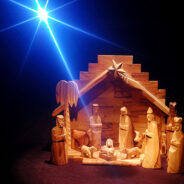
“‘Twas the night before Christmas, when all through the house not a creature was stirring, not even a mouse.” Clement Clarke Moore’s poem never ceases to move me. It awakens memories of Christmases past and hopes for Christmas present.
Christmas Eve in my childhood home was a grand time. Our decorated Christmas tree would have beneath it a scattering of wrapped presents, but my sister and I knew that come Christmas morning, those few presents would be dwarfed by the many that would be left by Santa Claus.
Getting us nestled all snug in our beds was no easy task for Mom and Dad. The house was filled with the smells of Christmas baking, fresh fruit, and a heightened sense of expectation of what was yet to be. Our parents’ final effort to get us nestled into bed was to help us put out a plate of treats for Santa—fresh baked cookies, a glass of milk, an apple, and an orange. On Christmas morning, we would find the plate empty except for cookie crumbs. For some reason, Santa always took the apple and the orange with him. At least we assumed he did because he never left the apple core or the orange peels behind.
Sleep did not come easily for either of us, and probably not for Mom and Dad either; and Christmas morning came early. While some years were leaner than others, we were always blessed with more presents than our behavior warranted.
I miss the joy and wonder of those magical years that passed too quickly. As an adult, I miss something else even more. I miss the wonder of the mystery that is Christmas. I am not a Christian who wants to separate Santa Claus from Christmas. There is much that is good about Old Saint Nick. It’s just that he is not the Wonder of Christmas.
We live in a time when Christmas is bracketed between Black Friday and the after-Christmas sales. This merchandizing mania threatens to do what many fight against—to take Christ out of Christmas. However, if Christ is missing from Christmas, it is not the fault of the retail world. It is the fault of Christians. In our efforts to assure that those we love get all their wishes fulfilled, we max out our credit cards and push our family budgets into the red. Is it any wonder that by Christmas morn the Babe in the Manger is all but forgotten?
The Wonder of Christmas is found in words more ancient than those of Clement Clarke Moore. According to Luke’s Gospel, they were spoken by an angel to shepherds keeping watch over their flock: “Fear not: for, behold, I bring you good tidings of great joy, which shall be to all people. For unto you is born this day in the city of David a Saviour, which is Christ the Lord” (Luke 2:10-11 KJV).
The Good News this Christmas is the same as it was on that day long ago. A Saviour is born. In Jesus the Christ, God has come down to dwell with us and to draw us unto Himself. Jesus is the Gift of all time, and the Gift is for you and for me. The Gift comes not because we’ve been nice rather than naughty, but that we may be all we can be. Come Christmas morn, let’s follow the shepherds lead: “Let us . . . go . . . and see this thing which is come to pass. . .” (Luke 2:15 KJV). It is the only way by which we can keep Christ in Christmas.
Jacob’s Mirror

Tomorrow, our Bat Mitzvah will tell us the heart-rending story of how our father, Jacob, stole his brother Esau’s blessing. Although the Rabbis produce many exculpatory midrashiim, it was a despicable act. Yes, Jacob was pushed by his mother to do the job, none-the-less, it was Jacob’s decision and he broke both his father’s and his brother’s heart.
Yet, some how Jacob becomes an upright man. He is successful and forthright in his business practices and gathers about himself many people. He deeply, if unwisely, loves his children and is wrenched apart by the death of his favorite wife. How did this come about? What led to the transformation of Jacob from a selfish, pampered boy of the tents to the man who deals honestly and can care for his large family? A man who is worthy to be called Israel? I propose that Jacob had an excellent teacher. Jacob was schooled by his father-in-law, Laban.
What! Laban! Laban who switched brides on Jacob? Laban, who after promising Jacob the spotted and striped of his flock as payment, had those very same animals taken off three days’ journey? Laban, the double dealer? Laban, who the traditional Haggadah says was worse than the Pharaoh of the Exodus? Yes, that Laban.
We read in this week’s portion: On hearing the news of his sister’s son Jacob, Laban ran to greet him; he embraced him and kissed him, and took him into his house. He told Laban all that had happened, and Laban said to him, “You are truly my flesh and bone.” (Genesis 29:12-14).
Uncle, Uncle, I tricked my own twin brother out of his blessing and completely fooled my father! Well, well, my boy! You’ll fit in just fine; you got that from my side of the family!
Geh! Have you ever done something and then wondered if it was right because of the people who thought you did the right thing? Laban was an example for Jacob; a bad example. Laban became Jacob’s mirror. As injustice and trickery were practiced on Jacob by his charming father-in-law, Jacob saw himself and did not like what he saw. When Jacob awakes the morning after his wedding with the wrong sister, how could he not remember his father blessing the wrong brother?
Some how, Hillel’s dictum, “what is hateful to you do not do to others” took hold. Not perfectly to be sure, Jacob still made his father’s mistake of choosing favorites; favorite sons, favorite wives, and so on, but Jacob changed. He saw the evil Laban did and learned to not do it. He was forthright with his wives about the need to move back to Canaan. He made a fair deal with his father-in-law about his payment in sheep and goats, and, most importantly, he faced his brother and asked for forgiveness.
Jacob wrested with himself long before he met with an angel.
In our own lives, we can make use of both positive and negative examples and of mirrors.
Follow Us!