
Stranger in the Night
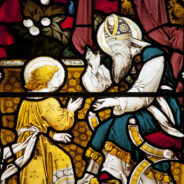
*yawn* I am SO tired.
Oh, I’m sorry. Mr. Eli keeps telling I’m supposed to cover my mouth when I yawn, but I always forget. I’m sure you all know Mr. Eli, the priest. EVERYONE knows him. I’ve lived here with him since I was about a year old. My name’s Sam.
My Mom was really sad that she had no kids, so she made a promise to the Lord, that if the Lord would give her a son – that’s me! – she would give him to the Lord as a… oh, what’s that word? Na… Nazir… oh yeah, a Nazirite, which basically means that I can’t eat or drink anything made from grapes, and I can’t cut my hair. Can you imagine how long it will be when I’m old? I’ll be like Rapunzel!
Living here in the temple can be fun. I get to help Mr. Eli keep the temple clean. He says that when Moses built the place, it was made of mostly curtains, but now we even have some walls. The place takes FOREVER to clean. And now that I’m getting older and Mr. Eli is mostly blind, I have to fetch stuff for him. But he can walk all over the temple without running into things. Sometimes, when no one is around, I try walking with my eyes closed – nowhere near the Ark of the Lord, of course – but I run into things. I guess Mr. Eli has been here so long that he knows where all the turns are.
I try to stay away from Mr. Eli’s sons. They are bad news. Really bad news. They would steal the meat that people came to give as an offering to the Lord. They were also causing problems with the women who served at the entrance of the tent. Every time I would try to figure out what was going on, I was told that it wasn’t for little kids to worry about. But there are lots of whispers. Anyway, I try to stay away from them.
*yawn*
Do you want to know why I’m so tired? Are you even listening to me? Ha! That’s actually what my story is about. I was deep asleep by the Ark of God. I like it there because that’s where the Lamp of God is – oh, do you not have one here? The Lamp of God is this oil lamp that is lit in the evening and stays lit until morning – God commanded it. It is never dark in there – not that I’m scared or anything. I’m not scared of the dark – I just don’t like it, okay?
So anyway, I’m sleeping and all of a sudden, I hear someone calling my name. So I jump up, run into Mr. Eli’s room and ask what he needs. I couldn’t see the look on his face, because it was dark in his room, but I’m guessing it scrunched up, because he sounded like he didn’t know what I was talking about and sent me back to bed.
So I lay back down and fell asleep and was having the coolest dream that I was flying and could see ALL of Israel when I heard my name again. So I climbed back up and walked back to Mr. Eli’s room. And I ask what I can do for him, and again he says that he didn’t call me.
I knew it had to be the sons trying to mess with me. Those bullies always think they can pick on me because I’m littler than them. But I was didn’t want to get into trouble and wanted to get back to my dream and maybe fly over my mother’s house. Or the Dead Sea.
So I went back to where I was sleeping and am almost to sleep when I hear it again. This time I leap up, knowing I’ll catch Mr. Eli’s sons, but I don’t see anyone. I went back to Mr. Eli’s room and said “Here I am, you called me?”
And this time Mr. Eli told me that it must be the Lord calling me. Isn’t that crazy? The Lord calling ME? I’m just a kid – I didn’t even know the Lord yet. But I trust Mr. Eli, so I did what he said. I went back to the place I had been sleeping and waited. Then I heard it! “Sam, Sam.” The Lord was standing there in front of me, calling my name. I think Mr. Eli’s sons would have been scared – but not me! I did as Mr. Eli told me and said “Speak, for your servant is listening.”
The Lord started with something really funny – the Lord said “I’m about to do something that will make both ears of anyone who hears it tingle.” The Lord is going around tingling ears – that’s a good one! I got so excited, I had to know what it was.
But…what the Lord said next wasn’t funny. It wasn’t even good. The Lord said that Mr. Eli had been warned that his house was about to be punished because of the terrible things his sons did – and because Mr. Eli hadn’t stopped them. The Lord said that the wickedness of Mr. Eli’s family would not be made right with sacrifice or offering forever.
After that, I couldn’t get back to sleep. I knew I was supposed to tell Mr. Eli – but I just couldn’t. What would he do? Would he be mad? Would I get in trouble? Would the sons get in trouble? Or worse – would he cry?
I’m just a kid, I can’t tell a grown up something like that. I’m supposed to be quiet and listen to what the grown ups say to me. That’s what they always tell me. But this was a message from the Lord.
In the morning, I opened the doors to the temple and tried to stay hidden. But Mr. Eli knew I was there and called me to him.
I think he knew that I was afraid and that I had bad news, because he called me son and told me not to be afraid. He even asked that God curse me if I didn’t tell him everything that the Lord had said.
So I took a deep breath. And I told. I spoke so fast trying to get it all out that I don’t know how he actually heard me, but he did. I closed my eyes hard and waited for the reaction. What was going to happen? A few seconds had passed and I didn’t hear a thing. So I cracked one eye open just a little bit to peak and see if it was safe – or if Mr. Eli had suddenly been frozen or melted or just plain disappeared.
But Mr. Eli was just standing there, looking at me – or at least looking in my direction. It is always hard to tell what he can see and what he can’t. After what seemed like YEARS he said “It is the Lord; let the Lord do what seems good.”
I about fell over backwards – but good thing I didn’t, I would have pulled a whole row of curtains down. He was okay with this? His family was going to be destroyed, but he was okay?
I always like Mr. Eli, but I always just thought of him as the old man who took care of me and the temple. I see why everyone comes to him – he is really brave.
I don’t know anything about God, but Mr. Eli seems to trust God with everything. Even now, he is preparing the altar for the day’s offerings. If Mr. Eli can trust, even after the news I gave him, maybe, just maybe the Lord is okay. After all, the Lord did see just how mean those sons are and isn’t gonna let them get away with it. Maybe the Lord really cares about how people are treated and looks out even for little guys like me. I kinda hope the Lord will wake me up and talk to me again. *yawn* but maybe not tonight. I’m still tired.
Read more from Jennifer at her blog.
Photo Credit
It’s Better to Receive Than to Give
“Do you hear something?” my wife asked.
She was just beginning to accelerate from the on-ramp onto I-75 as we headed home from the Bengals’ game.
“No…I…” I said.
“Because I think I hear something, and the guy behind me is flashing his lights” she said, as she turned the radio down from the post-game show.
Then I heard it, the “Thump…Thump…Thump.”
“Oh crap…pull over and let me take a look,” I said.
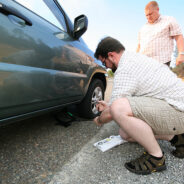
She pulled our silver Rav 4 to the edge of the ramp and I hopped out to take a look at what I already knew was coming; the left rear tire was indeed completely flat.
“So what should we do?” she asked.
I said “Well, we need to get off this ramp. It’s not safe to try to change the tire here. Let’s try to get it to an exit.”
I climbed back into the passenger seat and we limped along a couple of miles to the next exit and pulled into the parking lot of a small convenience store. All the way my mind raced as I planned out the next course of action.
I was not upset about the tire. First of all, it’s only a tire. Nothing serious. Secondly, this set of tires had almost 60,000 miles on them and was already scheduled to be replaced.
I did, however, realize I had owned this vehicle since 2001 and had never changed a tire on it. In fact, I had probably not changed ANY tire for twenty years. I wasn’t even sure where the tools were. On top of that, it was bitterly cold and spitting rain. I had brought no coat, no gloves, no warm head protection, and was only wearing a fleece Bengals’ sweatshirt covered by a $1 saran wrap raincoat. I braced myself for the task ahead.
We stopped, climbed out of the vehicle and my wife set the emergency brake as I opened the back of the truck to search for the tools. There I found several hidden compartments, some empty, some with pieces of tools that together were supposedly designed to extricate us from our situation. Some of the tools were unrecognizable to me and others were missing. I had to go to the manual to find the other parts scattered throughout the vehicle. Jack? Under the front seat. Jack handle? In a side compartment. Wrench for the lug nuts? Under the carpet in the back. Geez! Where were the real tools?
Truth is, in modern cars there are no real tools. Sometime, in recent years, auto manufacturers made the decision it was more important to streamline and lighten their vehicles than to give customers real tools they could use. So we are all stuck with “Tonka toys” that taunt you as they question your manhood. The lug-nut wrench doubles as a miniature jack handle (and also can be used as a mouse trap and cheese grater.)
I laid out the tiny tools, removed the fiberglass shell from the spare tire, loosened the lug nuts from it and easily slid it off the back. So far, so good.
Then, I positioned the jack at the safety groove just in front of the left rear tire and begin rotating the swivel to slowly meet the body of the truck. The jack was clumsy and slow but at least it worked. I jacked it up part way and then began the process of trying to remove the lug nuts. This was where I was to meet my Waterloo. The handle on the wrench/mousetrap/cheese grater was too short for me to get any leverage and though I pushed it as hard as I could, the only thing giving way was my back. I pushed, pulled, and stomped on the wrench to no avail. I had also worked up a good sweat and now was beginning to shiver from the cold drizzle. I was rapidly running out of ideas.
My rescuer would not be a knight in shining armor riding a white horse. He would instead be a dirty disheveled thirty-something in need of serious dental work driving a beat up small brown sedan with a mismatched door. His thirty-something wife had long stringy brown hair and had a cigarette dangling precariously from her mouth. The right sleeve of her light blue windbreaker clung to her dirty jacket by threads.
Taking note of my predicament, he yelled over to us, “Looks like you could use some better tools,” and immediately went into the trunk of his junker for a real jack and a four-way lug nut wrench. Without my even asking for help, he patiently began to work on the wheel, leaning over far enough in his ill fitting jeans for me to catch a glimpse…not of the working man’s clichéd butt-crack…but instead revealing a pair of black and orange “Scooby-Doo” briefs. He worked quickly and effortlessly, and soon the task was done. We could be on our way.
I thanked him, shook his hand and reached into my wallet for a twenty. When I tried to give it to him, he refused. I insisted. He shook his head, refused again and got back in his car. I ran around to the driver’s side and tried to hand it to his wife, but she too would hear nothing of it. They said, “Drive safely,” and in an instant they were gone.
I was stunned. I couldn’t believe people who obviously needed the money more than I did wouldn’t take it. I thought that was probably why they had helped.
How judgmental of me!
Of course I would have refused to take money for helping, but how could they? Couldn’t they have used the money for cigarettes, beer, or maybe even for more Scooby-Doo underwear?
Would I have stopped to help someone who looked the way they did?
Probably not.
My wife and I got back in the truck and headed home. I felt a little depressed. This man was not supposed to help me and expect nothing in return. I wish he had taken the money. It would have made me feel good to know that I had helped somebody. It always makes me feel good to help others in need.
Do I think I am driven by a higher moral calling than he is?
My wife, noticing the look on my face looked puzzled.
She said “Do you still hear something?”
I said “Yes, I think I do. I think I hear the sound of a guy smiling.”
Joe Hall is a storyteller, writer, one-time stand-up comedian, retired government employee (where do you think he got some of his best material?), and a southern church drop-out (where do you think he got his very best material?). A confessing agnostic, the honesty in his stories speak deeply of a Mystery that exists beyond the walls of the neatly organized, controlled, and sometimes treacherous buildings we think of as “church.” We look forward to Joe visiting us again!
Of Jaws, Fishing for Men, and the Kingdom of God (Or, We’re Gonna Need a Bigger Boat!)

Quint the fisherman, played to perfection by the scene-stealing Robert Shaw in the 1975 Steven Spielberg masterpiece, Jaws, was a rugged, thick-skinned, and independent man who played by his own rules and offered to hunt, kill, and bring back to shore the shark that was terrorizing a small coastal town – for the right price, of course.
I’ve met some fishermen like Mr. Quint down on Louisiana’s Gulf Coast. You’d have to be tough and unlikable to some degree to choose to live alone or in small groups out on the open waters, far from shore, with little or no shelter from the terrible storms.
“Come, follow me!” says Jesus to some Quint-like fishermen along the Sea of Galilee.
“Come, follow me, and I will make you fishers of men!” Mark’s Gospel simply records that two sets of brothers dropped what they were doing and walked away from their boats to follow Jesus.
Perhaps Mark writes so matter-of-factly because he dare not record the salty language of the future disciples, nor the extra-salty language of their families and co-fishermen as the they watched promising young men throwing their nets, as well as their lives, away.
“Come, follow me, and I will make you fishers of men!”
And there we have it.
A powerful image of the mission of God has become some two-thousand years later little more than a slick marketing scheme.
It was inevitable, really. The slow,generation-after-generation-after-generation evolutionary growth of individualism coinciding with the growth of crass commercialism, consumerism, and salesmanship, has altered not only our world economies and our habits of buying-and-selling, but also our very relationships with each other and with God.
Quite naturally then, the general “popular” understanding of this Scripture has been, in light of our American marketing DNA, individualistic and consumeristic.
Consumeristic? … Consumerist? …. Whatever.
“Fishing for men” has come to mean delivering a hard sales pitch and pressing to meet a salvation/baptism quota.
So many of our churches and denominations and campus ministries and such have made the Good News of the Kingdom of God into not much more than a wiggling worm impaled on a fishing hook.
Like the fancy money-back-guaranteed lures in the sport of recreational fishing, the sport of Christian evangelism has evolved from the simple-yet-effective sales pitch – “if you got hit by a bus when you walked out of here this morning” – to the hi-tech lures of smoke and fog machines, rock music, free pizza parties (“free” meaning there’s a catch – usually a guilt-hurling evangelist), and hell-houses (as opposed to haunted houses at Halloween).
You can insert your own joke and/or personal story of preachers and used-car salesmen here…
The whole idea of fishing with lures as an example of Christian witness is appalling. Maybe it’s because I still have the hook scars in my cheeks from having bitten many a time in my youth; let alone having gone through more than one form of the “proper training” to be an effective salesman (errrr … evangelist).
Jesus doesn’t mention lures and bait, nor people – like fish – being tricked into biting a line … swallowing hook, line, and sinker.
Being “fishers of men” is not about getting people to take our bait. It’s about casting huge nets of grace and bringing all the people within our reaches along with us into the current of God’s Kingdom as it manifests itself on earth as it is in heaven.
Like Mr. Quint and folks who fish on their boats off Grand Isle, Louisiana, this kind of fishing Jesus talked about isn’t very clean, nor very easy, nor easily measurable by bookkeeping standards.
Casting wide nets and bringing people along in the grace of God is not for the faint of heart. It can be dangerous, and many of Jesus’ grace fishermen have met the same fate of Mr. Quint in Jaws. Think Abraham Lincoln. Think Dietrich Bonhoeffer. Think Martin Luther King, Jr. Oh, and think Jesus himself.
But one thing is for sure, these little vessels (errrr… church buildings) we’ve constructed – no matter how big or how small or how mega-sized – tend to be designed for sporting evangelism.
If we’re going to follow Jesus and cast His deep and wide net of God’s grace, we’re “gonna need a bigger boat.”
God’s Kingdom is a boat more than big enough to carry you, and me, and them, and those other folks, and even those folks over there, and the ones we love, and the ones we don’t love …
Please excuse me; it’s time for my devotional – now, where’s my Jaws DVD …
Mev Puleo, Friend of the Poor, One Who Lived A Life “Crammed With Meaning”

Mev Puleo didn’t want you to have the opportunity to look away from the unpleasant. One of her many passions was art and her medium was photography.With a point, a click, and some strange alchemy of chemicals and paper she was able to grasp the face of a child or the body racked by poverty and make a statement that could not be ignored. With the permanence of the photographic image, she was able to convict the hearts and minds of many people who would much rather simply wait a moment and forget all about the plight of the less fortunate. Mev couldn’t look away from the passion that for the poor and disenfranchised and so she didn’t want you to do so, either.
Mev had first been awakened to this calling after having been a Christian for several years. At the age of fourteen, she went on a trip with her parents to Brazil. While they were in Rio de Janeiro and seeing the sites as tourists, they decided to go up and see the “Christ Redeemer” atop Mt. Corcovado. As their bus made the trip up they circled the mountain a few times. On one side, Mev could overlook the homes of the wealthy and respectable. Their homes were brilliantly designed and ostentatiously expensive. In those homes lived a class of people who had little fear for their daily bread. As they came to the other side of the mountain, though, they saw shacks and dilapidated buildings that housed a different class of people. These people were the poor of Brazil and many of their waking thoughts were consumed with fear for their lack of daily bread and anxiety over how to change their circumstances. Mev found herself increasingly uncomfortable with her comfort–she wanted to look away but she couldn’t. Suddenly, the chair was too soft, the air conditioning was too pleasant, and the scenery too breathtaking.Her eyes glanced upward to see Jesus standing with his arms stretched wide in the gap between comfort and fear. She feared that though Jesus had been lifted above both sides, it seemed that he had only become a convenient way to avoid looking at the needs of the poor from the comfort of affluence. So, Mev made a decision that day: she decided to change the world.
Mev became an outspoken activist and artist who shared powerful convictions and words about the ability of the Church to bridge the gap between rich and poor–between have and have not. She endeavored to increase awareness about poverty as she struggled to end it personally. Her pictures and her speeches refused to give into the temptation to overlook or forget the suffering of so many. Thankfully and gloriously, Mev wouldn’t stop pestering the Church about its obligations to all people. Yet, her great benevolence was no insurance against tragedy and suffering. In 1994, a malignant tumor was discovered in her brain–she was given six months to live.

Words from the journal she kept in college came calling back to her. She had written that she would rather live a short but meaningful life–a life “crammed with meaning”–then to live long and securely without meaning. Mev ended up living almost two more years after her diagnosis and spent every day of it in service to the God who had called her to change the world. The priest eulogized over her at her funeral: “She had wanted to give the poor a face, a voice. She always wanted to be identified with them. And so it came to pass: by the time of her last days you could see them all in her face–the poor of Bosnia, the hungry of Haiti, the powerless of Brazil. She who gave them voice, lost hers. She who helped us see their faces, could finally see no more….She became the poor she loved.” Mev was thirty-two years old when she passed on to rest with Christ her Redeemer.
Read more from Joshua at his personal website and the website of Grace and Main Fellowship, the non-traditional community he ministers with.
Unanimous, For Once

Last week, the Supreme Court of the United States unanimously held that religious organizations could practice discrimination in their employment practices. I’ll admit that the previous summary was extremely terse and doesn’t deal with any of the nuances of the case, but it’s not any more terse than referring to the controversial and wrong-headed split decision on “Citizens United” as the day the Court determined that corporations are people.
There are some good points made in the article, but I have a couple of issues with it as well. First, the article rightly decries those who use religion for their own ends and shares a fear that our current situation negatively impacts both the image and the finances of religious institutions. But, is changing our laws truly a good prescription for this situation? The First Amendment is very clear that “Congress shall make no law respecting an establishment of religion,” and is that really something that should be changed, without regard to its impact on ALL religions practiced in this country? There is a significant amount of protection for religious freedom embedded in that amendment, and I’m not so sure that the potential benefit for dropping this comes remotely close to the potential for damage – especially when considering minority (non – “Christian”) religions. I’m also not very comfortable with the idea that positions on religious issues should lead to legislation. I’ll admit to, as a principle, being against abortion, but I am outright opposed to the evils that come with making such opposition a law, rather than a moral precept. Issues like that, not to mention the move to legally decide who can marry who, leave me VERY uncomfortable with the idea of changing laws in order to make the church-state relationship “work better.”
The more serious issue I have with this perspective, however, comes from my belief that religion has to stand or fail on its own merits. Even without a First Amendment, I’m going to believe as I choose. If religion is failing, falling into disrepute, or otherwise having problems, those solutions need to come from within the religious community itself. I’ll go a bit further: when I look at the state of faith communities and religion in general, I do see a lot of people and organizations clinging to what they have with an increasing sense of desperation. I also see a lot of people and organizations determined to resist change and progress, even when it means their extinction. We have created this static sense of faith as unchanging and unchangeable, and when we run into a situation where things are not the way we like them, we STILL have this tendency to want to shape the world (or in this case, its laws) to fit our perceptions, rather than change those perceptions. For all that, some denominations say things like “God is still speaking.” And we have an endless supply of people who reply “but God better not say anything new around here.” If we truly fear being “irrelevant,” why are we not pushing to reinvent ourselves; adapt; and become more relevant? Why do we, as the article would suggest, fear others getting a piece of our money pie to the extent that we are willing to change the Constitution? I always thought that having a faith meant standing for something, regardless of what everyone else is doing. Sure, having laws that protect my right to do that makes it more convenient, but I’m not about to ask others to give up their freedoms because that “convenience” is no longer working out to my advantage.
So that’s pretty much my bottom line. If religion is taking a beating because things aren’t as easy as they once were, and we are facing increased competition and problems, bring ‘em on! Those things that are worthy of survival will do so, and I think that they can accomplish this without excessive political change. Besides, who is to say that religion, as a concept, is what we need today, anyhow. This case brings to mind a button I used to wear: “God favors no person or group. Only religions do that.” The Supreme Court has ruled, unanimously, that religions can do what religions do. If you have a problem with that, don’t change the laws. Change your faith. Or, better still, bring together others and change the nature of faith in our society. We will all be a lot better off.
by David Adams
A Prayer for Martin Luther King, Jr. Day.

The sages teach:
At the Sea of Reeds, Moses thrust out his staff; nothing happened.
Then Nachshon ben Aminadav of the tribe of Judah, in his courage and faith, stepped into the sea, the waves pushing him back. He stepped up to his knees, his waist, his neck. A small step and the water surged just below his nostrils, one more step to immerse entirely and, behold! The sea split and Nachshon led the people across to the other side.
There is in front of us a sea of injustice. Martin Luther King, Jr., in his faith and courage, marched into that sea. Unlike Nachson, Dr. King did not survive his righteous action. None-the-less, Dr. King pushed back the surging dark waters mightily and so blessed us all.
Chei Olamim, Life of All Worlds, help us to not be blind to the roiling waters of injustice and those being smothered by them. Strengthen us in our faith and our courage so that we might have the strength to step forward to do the right even though we do not know how deep the sea may be or if we will ever reach land again.
A Burger in Jackson

The year was 1967. The place was Jackson, Tennessee. I was a college freshman about to learn a lesson.
The campus of Union University was not overly crowded on the weekends back in 1967. By the way, this was the old campus, the one that looked like a place of learning. I lived in Adams Hall, a dorm in which the ground floor rooms were reserved for the basketball players. On any given weekend, the dorm would be vacated by most of the students, leaving only the basketball players and a few of us who lived too far away to drive home for the weekend.
Jackson was a great college town . . . if you were a parent. It wasn’t very large, there wasn’t a lot to do, and there were very few places in which one could get into real trouble. As a result, most of us who stayed on campus over a weekend stayed on campus.
Late one night, the few of us in Adams Hall who didn’t have dates were huddled around the one TV set in the lounge. Cafeteria fare on the weekends was not even fair. Around 10 p.m., I called out to the gathered group of TV watchers, “I’m hungry. Anyone want a burger?” Lonnie replied. “I do.” Lonnie was a basketball player and had on occasion shared my room when his bed was needed for a hot recruit who was being wined (grape juiced . . . it was a Baptist school) and dined. He was one of the good guys. He didn’t drink. He didn’t sneak girls into his room. He didn’t cuss. He didn’t even get into fights on the basketball court. He was one good basketball player.
Lonnie and I jumped in my 1963 Ford Fairlane 500 and headed out to the Burger Chef. It was crowded. Apparently, lots of folks in Jackson had a late-night yen for a burger. We parked and walked in. From the size of the crowd, I suspected we would be in line for several minutes. We weren’t.
As the water parted at the Red Sea for Moses, the crowd parted for Lonnie and me and the sound of laughter and talking ceased. Before us lay a clear path to the counter. Hey, I thought, these folks must all be Union basketball fans, and they’ve given us a chance to go first. I stepped to the counter, willing to take advantage of the fans’ generosity. “Two burgers, two fries, and two cokes,” I told the guy behind the counter.
“You want two cokes?” the guy asked.
“Yes. One for me and one for my friend.”
“We don’t serve his kind,” I was told, and the silence grew louder.
It was the South and it was 1967 and there was unrest in lots of places. Dr. Martin Luther King was making a lot of noise, though that would be stopped a few months later in Memphis, which was just 80 miles away. I should have known. I didn’t. I had played football with Suggs. I had been with my father as he looked after Aunt Marie. Southeast Missouri in the sixties was not prejudiced-free, but somehow I had escaped both becoming prejudiced and understanding that I was supposed to feel different about people whose skin was a different color than mine.
On any given night during basketball season, Lonnie was a star who could bring a whole gymnasium of spectators to their feet cheering. On a non-basketball night outside the gymnasium, my friend was not welcome.
I was ready for my first fight for racial equality. We had a right to be there and to order our food. Lonnie laid a hand on my shoulder and whispered, “Let’s get out here.” I started to protest. Lonnie pulled me out of the door and toward the car.
“That’s not right, man!” I shouted at Lonnie as we sat in the car, the eyes of those inside the Burger Chef still staring at us.
“Tell me about it; but I don’t want to die tonight,” Lonnie replied. “You still want something to eat?”
“Of course, I do.”
“Follow my directions and I’ll take you where we can get a real hamburger.”
A few minutes later, Lonnie and his white friend were seated in a dimly lit restaurant eating the tastiest burgers I’d ever eaten. The place was full of people and noise, and I was the only white person there. The music and the talking never stopped. No one questioned my right to be there. They knew Lonnie and I was Lonnie’s friend. That was enough to make me welcome.
That was the night I lost my innocence . . . the night the blinders came off . . . the night I saw the darkness in “my” people and in myself. I’ve been working on increasing the light ever since. It’s still not as bright as it needs to be.
If You Wanna Get to Heaven, You Might Wanna Listen to the Ozark Mountain Daredevils (Ode to Dale and Mary)

Dale and I became fast friends a few years ago because of our love for the music of that Missouri band of rural hippie farmers known as the Ozark Mountain Daredevils. Their song “Beauty in the River” is one of my favorite all-time hymns (of the “not-actually-a-hymn” variety).
there’s a beauty in the river
there’s a beauty in the stream
there’s a beauty in the forest at night
when the lonely nightbird screams
Dale and his wife, Mary, loved the song “Beauty in the River” so much that the lyrics were printed on the back of their 1979 wedding program. He and his groomsmen even sang it after the ceremony.
there’s a truth in the eyes of my woman
that no mortal ever knew
she lights my way like the coming of the day
when the sun shines on the dew
Dale told me he always joked with Mary that since he sang to her at their wedding, he’d also sing at her funeral if he got the chance …
and there’s so much time for livin’
and so much time to die
there’s so much time for laughin’
and so much time to cry
Dale lost Mary and one of their daughters in a car wreck the day after Christmas in 2005; the lyrics to “Beauty in the River” were printed in Mary’s funeral bulletin. Dale did his best to sing it at her visitation; “It was probably one of the hardest, most emotional, and coolest things I ever did.”
we must all stand in the water
we must find it when we roam
it don’t matter what is said
we can wake up from the dead
and roll away the stone
Words from the Ozark Mountain Daredevils are forever treasured in Dale’s heart. They don’t explain the death of his wife and daughter, and I doubt they ease the pain much, but for Dale they are far, far more than song lyrics … they reach down, down, down into the mystery of his soul where words and understanding cease to exist; where his spirit speaks mysteriously with the Spirit of God; where somehow someway Dale senses his wife and daughter aren’t really lost to him after all.
From the same band that gives us the foot-stompin’ anthem “If You Wanna Get to Heaven” (according to the Ozarks, “if you wanna get to heaven, you gotta” … well, you know) and the always exciting “Chicken Train” (sing along if you know the words: “laser beam, in my dream”) we also get the worshipful “Beauty in the River” (as I said earlier, it’s one of my favorite hymns of the “not-actually-a-hymn” variety).
we must all stand in the water
we must find it when we roam
it don’t matter what is said
we can wake up from the dead
and roll away the stone
I love the Ozark Mountain Daredevils, and I’m thankful God doesn’t rely solely on respectable, proper, seminary-trained professional clergy to speak to us (as a seminary-trained sort-of professional clergy myself, I confess the Daredevils are just a whole lot more fun).
For Dale, there’s a connection with the Daredevils that goes beyond a catchy tune and great lyrics. It’s a connection that is at once book-ends marking the physical beginning and the end of a stage of his journey, and at the same time a connection with the Eternal which transcends time, space, understanding, and even life and death.
You can say what you want about God and the Ozark Mountain Daredevils, but I trust Dale.
You can say what you want, but as Dale himself will tell you …
it don’t matter what is said
we can wake up from the dead
and roll away the stone …
Hallelujah!
Jesus and Bro. Johnson: An Incarnation
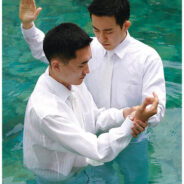
Bro. Glenn Johnson stood at the base of the steps leading up to the baptistery of the First Southern Baptist Church of Tallapoosa, Missouri. He was about to baptize three young believers. Prior to this baptism, he had conducted most of his baptisms in nearby streams or in baptisteries of nearby churches. The First Southern Baptist Church of Tallapoosa, Missouri had a long name but it didn’t have its own baptismal pool. Some older members may have wondered if the church really needed one. After all, if a stream was good enough for Jesus . . . . Having been stung by wasps while watching an earlier baptism and having seen snakes in the streams, I was glad we finally had a baptistery.
I don’t really remember much about the baptism itself. I remember the Sunday I walked down the aisle and “gave my heart to Jesus.” I remember feeling proud that I had done this good thing. I remember feeling Bro. Johnson’s kind hands on my shoulders as he presented me to the congregation. My friend Mike Littell made his decision that same day. Mike and I spent the afternoon together, much of it talking about what it meant to be a follower of Jesus. I wish I could recall what those two nine year-old boys said about that. It was probably more profound that most adults would have thought possible.
My baptism took place at night. In our little church, two of the more important events in worship—Baptism and Communion—seemed always to take place at night. I’m not sure why baptisms were at night, but Communion was always at night because . . . well . . . it was the Lord’s Supper. I’m glad that, in our church, both of these have moved into the light of day. Baptism is our public declaration of faith and ought to be witnessed by saints and sinners (more often than not, the same people). Communion is the declaration of the Gospel. As such, can it ever be a hidden event or one from which some are excluded? Not if I’m at the Table.
Well, I have diverged from the main point. Baptism was about to happen and I was one of the ones to be baptized. Bro. Johnson, standing at the base of the steps, spoke to us. “I’m so very proud of you. What you’re doing tonight is very important. You’re saying to all who watch you that from this point on you belong to Jesus and that you are going to follow him. Tonight you become a child of God.” One by one, we made our way into the water. I recall the feel of Bro. Johnson’s strong hands, one on my back and the other covering my mouth and nose. I felt safe—safe in the arms of Jesus, arms that felt amazingly like Bro. Johnson’s arms. On that night, they were one and the same.
The Incarnation happened only once, but incarnation happens again and again. A young boy began anew, set his face in a new direction, because Jesus touched him through the hands and arms of his pastor. Would I have found Jesus without Bro. Johnson? I’m sure I would have. For one thing, I suspect I was and am more found by Jesus than Jesus was or is found by me. What matters is that I didn’t come to faith apart from Bro. Johnson. I came to faith, in part, through the Jesus I met in him.
Baptism is a new beginning, and it is almost always a new beginning that has a human agent behind it—a human agent that manages the miraculous act of becoming an incarnation of Jesus and his love.
No one stands alone in the Christian faith. The Jesus we know we first meet in the flesh of another.
Epiphany–The Great Revealing
In the time when a corrupt governor ruled like there was no other power in the world, a little boy named Jesus was born in a backwater town. Powerful and important people–the kind who didn’t spend much time with illegitimate children in backwater towns–came looking for him.They went to the big city nearby because they assumed he had to be there and asked the governor where they could find the one who was going to take his place. “We heard that this one is going to be really special,” they said, “and we want to take the time to offer our respects to this one.” When the governor heard that, he was wounded at the thought that he wasn’t important enough and he got scared. “What if it’s true?” he asked himself when nobody was around.So, he asked the men to wait a moment while he talked to his advisers about it.
His advisers checked their books and said, “Oh! They must mean this little passage. I guess it kind of suggests that it will be in Bethlehem.” “But surely, no ruler can be better than you,” they lied to save their necks. So, the governor called for those dignitaries and pumped them for information before telling them to go and look in Bethlehem.
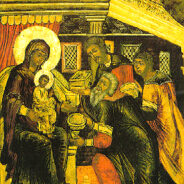
“And if you find him,” he remarked coyly as if he had just now thought of it, “why don’t you come on back and tell me where he is so I can offer my respects, too.” So, the men left the governor’s mansion and went to the little town without a stoplight. They followed the signs that had led them this far and were glad to see the leading coming to an end and the finding finally starting. They arrived at the little shack and wiped their expensive shoes on the rag that passed for a welcome-mat before entering in to find a teenage girl with her child. Somehow–perhaps it had something to do with the long journey–they knew this was the one and they stood in shocked silence before a little boy. Something amazing had been revealed to them–the birth of God in human flesh–and they could not take it in. So, they offered gifts to express their worship and respect: stock options, a bible with his name embossed on the cover, and–perhaps most shocking to his mother–a cemetery plot near thecity. As they were leaving, they felt compelled not to return to the governor and so they caught the early flight out.
As they often do, years passed and things changed. The boy grew into a man and grew into his calling.

Jesus’ cousin John had been spending time out in the woods preaching to anybody who would come near enough to hear his frantic yelling. He preached: “Y’all need to get right cause the kingdom of heaven is right around the corner.” He was forever talking about his cousin and how people should pay more attention to Jesus and less to John. John truly was a voice crying in the wilderness: “Get ready for something new from God! Prepare yourselves for God’s appearance.” Of course, it’s no big surprise that people couldn’t stop looking at John. He wore clothes that he had stitched himself that had been made out of fur. He ate bugs and honey (when he could find it). So, he was an oddity and got lots of attention. With the attentive crowds came some people who were listening and were preparing themselves for God’s big thing–God’s Great Revealing.
But attentive crowds aren’t always attentive because they like you or agree with you. Often, John would see some of the members of the local ministerial council hanging out in the crowd and would greet them in his own special way:
“You sons of snakes! Who gave you a clue and told you about the storm that’s brewing–I know you didn’t see it for yourselves. You came out to hear me? Well, get to changing yourself because your name and your reputation aren’t going to do anything for you. Your titles and influence are worthless here. Even now, the chainsaw is gassed up and waiting to be picked up to cut down the trees that don’t produce good fruit. And what do you do with bad wood? You burn it up because it’s useless. I’m out here baptizing with water because of repentance but there’s one coming after me who can do you a sight better–shoot, I’m not even worthy to shine his shoes–and he’ll baptize you in the Holy Spirit and fire. Oh, and don’t kid yourselves…God’s judgment is right around the corner. He’s going to sort out the good from the bad real quick.”
 One day, Jesus came to John to be baptized in the creek where John preached. When Jesus took off his shoes and waded in, John shook his head and said, “If anybody should be doing the baptizing it ought to be you and not me.You should baptize me, Jesus.”
But, Jesus smiled and said, “No, John, you’re doing right. This is the way it’s supposed to start. This is the way God’s great revelation begins.” So, John agreed begrudgingly and baptized Jesus in the creek. When Jesus came up out of the water, he looked up and the skies were torn apart before him. The barriers between God and humans had been broken and cast aside and the Spirit of God came down and a voice was heard saying, “This is my boy. I love him and I’m proud of him.”
It was on those two days–the revelation of God to the wise men and at Jesus’ baptism–that we see God choosing to self-reveal to the world. The obstacles have been dismissed and the way has been paved. The paths are being made straight. The Kingdom of God has arrived and is arriving.
Follow Us!