
Bless Them and Keep Them, We Pray
A Homily given to St. Charles Avenue Baptist Church
This is my first chance to speak in front of the whole church since our little Logan came into our family. I have truly been overwhelmed, in the most positive sense of the word, by the generosity of my church family. The number of meals that you all brought to us caused me to be one of the few women who actually gained weight on maternity leave. This baby will not be without diapers for a few more months and will not be without clothes for at least a year. I was so happy when we dedicated both Annie and Logan here three weeks ago because I knew that this church would be such a large part of the foundation of their faith. With all sincerity I say, “thank you.”
The other day, I was talking to my dad on the phone and telling him that since we stopped getting cable television at the apartment I have found myself watching more and more PBS shows. “PBS has really improved their programming, Dad” I said to him. His reply to me, “maybe you’re just getting older.” My mind briefly thought of arguing and then I confessed, “I’ve been listening to NPR too and watching the Dick Van Dyke show at 9:30 PM…from my bed because I’m already in bed at 9:30!” He offered no comfort, just a knowing, “Mmm hmm.”
Distraught, and yet not too embarrassed, I realized that my life had changed. I noticed this too walking around campus the other day. I was pushing a double stroller, my attire only thought out in terms of what could easily be washed and what would be comfortable, even to the sandals on my feet. I have to this point, refrained from wearing socks with my sandals, but probably on a cold day, I would be tempted. Surely, hopefully, shame will keep me from participating in that particular fashion statement.
Life has changed. I am in a new realm. My days are no longer my own. I am tired all the time, I never leave home without having to run back in at least once because I’ve forgotten something, and my dreams are now of watching a full television show and my nightmares are now about the piles of laundry turning into attacking monsters. I have a husband but I haven’t seen him in a while. Between his schoolwork and the need to often “divide and conquer” to make evenings go more smoothly, we are lucky if we can squeeze in a “hello, how are you, fine”-type conversation.
I am a mother. Life has changed.
On Thursday evenings, I have discovered a bit of an oasis. It’s called PJ’s coffee on Maple Street. It’s not my order that changes my perspective—I have to get hot chocolate because I can no longer drink caffeine after lunch, and it’s not the proximal company of the college students who I sit near—their backpacks and textbooks are a decade-old memory. But one by one, a high school student comes in, sits next to me, and starts talking about school and music and all things modern. It could be intimidating, but luckily, each one that comes in has great patience with me. They make me smile, they make me laugh, and they give me energy. Maybe it’s because they aren’t my children.
Yet, they are my children.
I am a minister to youth and to children. Life is exciting.
My first theology class in seminary focused on finding theological themes in artwork, cinema, and any number of other productions. For a long time after the class ended I couldn’t watch a TV show or movie without breaking it down theologically. I thought I saw theological themes and Christ images everywhere. It was both a curse and a blessing. I had to accept the fact that the lens through which I observed and interpreted life had changed.
Again I find myself with a new lens. Motherhood, whether I am consciously using that lens or not, has changed the way I view the world as well as the way I operate in the world. This occurs in the mundane parts of life—grocery buying, for instance—and the more moral aspects too—such as violence in commercials on television. And of course, this lens has changed the way I read scripture. I just can’t help it. Luckily, I picked the right day to preach. As I sit more and more with this role of minister to youth and children, I have found that my motherhood lens is only broadened and strengthened.
My brain reads this passage from John and knows that this is a prayer from Jesus for his disciples, but I can’t read these verses and not hear a parental tone, a loving tone, in his words. Jesus knows that he is about to die on the cross, but he isn’t thinking about himself. Much like a parent, he is thinking outside of himself, concerned about those he loves, concerned for their safety, and concerned for their everlasting relationship with God.
Read with me a few verses from chapter 17:
Verse 6: “I have made your name known to those whom you gave me from the world. They were yours, and you gave them to me, and they have kept your word.”
Verse 11: “And now I am no longer in the world, but they are in the world, and I am coming to you. Holy Father, protect them in your name that you have given me, so that they may be one, as we are one. While I was with them, I protected them in your name that you have given me. I guarded them, and not one of them was lost except the one destined to be lost, so that the scripture might be fulfilled. But now I am coming to you, and I speak these things in the world so that they may have my joy made complete in themselves.”
Verse 15: “…I ask you to protect them from the evil one.”
Verse 17: “Sanctify them in the truth; your word is truth.”
Verse 20: “I ask not only on behalf of these, but also on behalf of those who will believe in me through their word, that they may all be one.”
It’s a prayer that we would have said and will say again for our children—those we have birthed and those whom we love regardless of their biological beginnings. We pray for our children because they are part of the church and because they will be the church. We pray thanksgiving for our children because they give us a space for our love.
I pray this prayer for my children because it rings true. You pray this prayer for my children because you are the church—you are doing what the church should be doing. And that, I think, is the heart of this prayer of Jesus for his disciples and the heart of Jesus’ message for the church.
Jesus Christ, the teacher through word and illustration is doing so to his very end. Pray, he says. Be sanctified, be made holy, be set apart in and because of the truth of God’s love. Pray to God as I taught you to pray. Pray to God for each other as I pray for you to God.
When the body of Christ, the church, prays that its children become one, we are praying that we, the body of Christ, become one. And in that unity, we take part in the active miracle that is God’s love through Jesus Christ. We are active participants in the completion of the circle that goes from God to Christ to Creation. Hear that in verse 26: “I made your name known to them, and I will make it known, so that the love with which you have loved me may be in them, and I in them.”
What more does a mother want for her child but for that child to know that she is loved, that he is loved? What more does a mother want but for her child to know that the love of Christ resides within his or her own heart? But I have to tell you that while those are my desires for my children, I want nothing more for these youth, who are not, but who are, my children to know the very same things. And I don’t know that that desire comes solely from me being a mom or a minister; I think that the desire comes mostly from me being a member in the body of Christ. Why is that? I believe it’s because of my beginnings, my foundation in the church. Love has always been a part of the lesson. Love has always been the story. Blessed be the tie that binds our hearts in Christian love.
And so today, I pray, for the youth and children:
Our God, creator of every hair on their heads, I pray that we have made your name known to these, your children. You have shared them with us and we are thankful for their presence. Holy Lord, protect them. Holy Lord, guide them. Holy Lord, make them one and make us one. Give them joy and be with them when they cry. Consecrate them, bless them, and keep them in your truth. Most of all, let them know that they are loved and let them feel the love of Christ that has resided in them from their beginning. Grant them the strength and the courage to pass it on.
Giver of Life, we praise your name. Amen.
Read more from Stephanie Little Coyne at her blog.
“When Mother’s Day is Not a Hallmark Moment”
A sermon based on Mark 3:31-35 and John 19: 25b-27
Did you go to the grocery store this week? The smell of flower bouquets hit my nose when I walked in the door, and the card rack was a mile long. Did you try to make a restaurant reservation this weekend? When I called on Monday, the 7 o’clock hour was already full. If you can’t get a connection with your cell phone today, it may be because the network is busy. Today is the peak day of the year for long-distance phone calls. Long lines at the mall this week? Today falls only behind Christmas as the highest gift-giving holiday.
The signs are obvious even here at church – women wearing corsages, grown children home to visit, carnations at the door– today is Mother’s Day. While not officially a church holiday, it ranks right up there behind Easter and Christmas Eve.
This day began to remember and pray for mothers and their children at war has developed into a “Hallmark Holiday” – one of those days capitalized on by florists and malls and card manufacturers to make a profit. One could argue that Mother’s Day has become over-sentimentalized and commercialized. Even the founder of Mother’s Day, Anna Reeves Jarvis, was so disappointed in what the day became that she sued to stop a Mother’s Day event and was arrested for disturbing the peace when she protested against its commercialization. Before she died, she said that she wished she would have “never started the holiday because it became so out of control.”
Sometimes our celebrations of Mother’s Day don’t give us a real, true to life picture of what motherhood and family is really all about. There is another side of Mother’s Day that Hallmark doesn’t write about, and that we really don’t acknowledge or talk about very much ourselves. The other side of Mother’s Day is that it can be a really hard day. Mother’s Day conjures up painful memories for those who have lost their mothers, or for those whose relationship with their mother is not all that it could be. Mother’s Day is a day of grief for those who have desperately wanted a child and could not have one and those who have deeply loved a child that they have lost. For some, the ideals of motherhood have been shattered by disappointment and stress. And those who never became mothers, either by choice or for other reasons, are often made to feel like second class citizens on this day. For a lot of people, Mother’s Day is hard!
A friend of mine in seminary had a disparaging nickname for Valentine’s Day. He called it “Single Awareness Day.” For some of us, Mother’s Day could be nicknamed “Dysfunctional Family Day” or “Family Imperfection Awareness Day.” Mother’s Day is not always a Hallmark moment, because families are not perfect, and life is not idealistic.
I think Jesus realized that. Jesus did not fall into the Hallmark trap of sentimentalizing family. In the two Biblical stories we’ve heard today, Jesus affirms family, but he also redefines what family looks like.
In the first story from the gospel of Mark, Jesus’ mother and brothers came to check up on him. They seemed concerned about his reputation as he was making quite a name for himself as a teacher and healer. When the disciples told Jesus his family was there to see him, he replied, “Who are my mother and brothers? Those who do the will of God.”
Jesus’ response seems a little harsh if we take it at face value. Was he being disrespectful to his mama and brothers? There was a tension in Jesus’ life between his loyalty to his physical family and to his spiritual one. But Jesus was not really indifferent to his family. In fact, he was deeply devoted to his family. He found in that moment a way to affirm the role of family but also make clear his first devotion to doing the will of God.
The second story takes place at the foot of Jesus’ cross. Mary is there, along with some other women and Jesus’ beloved disciple. In those days, a women’s children were her pension and Social Security and Medicare. What would happen to Mary when Jesus was gone? She would belong to no one. So Jesus looked down from his cross in the last moments of his life, and he gave Mary a new son and John a new mother. Her welfare and safe-keeping were among the last thoughts he ever had.
In these two images, Jesus shows us what family looks like. Jesus uses the sacred symbols of mother and brother and sister to tell all the world that spiritual kinship is stronger than biological kinship. Love is thicker than blood. Family, for Jesus, is a picture of adoption. He adopted as brothers and sisters all who do the will of God, and he charged John and Mary to adopt one another in love.
Jesus did not reject his family but he didn’t sentimentalize it, either. He did redefine it. As preacher Barbara Brown Taylor put it, “For him, family was not a matter of whose chromosomes you carry around inside of you but whose image you are created in. It was not a matter of who has the same last name or lives at the same address but who serves the same God…. There was no family tree in his Holy Bible. As much as his ancestors may have mattered to him, it was more like a family forest he walked around in, with relatives collected from all over the place – some from one family and some from another – all of them gathered in one place because of their allegiance to one father.” Jesus makes family bigger. He stretches out the circle to pull in the wider family, the family of God, and he teaches us that our families can be bigger, too.
Now, embracing this kind of Jesus family doesn’t make our own personal family’s problems go away. Adopting new brothers and sisters and parents and children does not bring our lost ones back. And building new bridges does not make the choking smoke of the bridges burned any easier to swallow. But adopting Jesus’ kind of family does help us with something. By stretching our circles, we can resist the temptation to be defined by what we lack. We can move forward with the hope of what we have together so that we won’t miss other chances to experience love.
So how do we face the other side of Mother’s Day? How can we be family to one another when our lives are imperfect and people disappoint? Where can we find redemption on Mother’s Day if we feel sad or guilty or lonely or abused? We can redeem Mother’s Day if we find a way to offer a blessing.
Chuck Poole has a great sermon in his book The Tug of Home entitled “Will Someone Say the Blessing?”. In the sermon, Chuck tells the sad story of Esau. If you remember, Esau was cheated out of his father Isaac’s blessing by his conniving mother Rebekah and brother Jacob. Esau’s cry to his father is pitiful: “Have you only one blessing, Father? Bless me, too!” Chuck says, “Esau’s voice has found its echo in every generation. Nobody wants to live an unblessed life. Everybody yearns to hear someone say the blessing to them, for them and about them ….’I love you, I delight in you, and I am proud of you, not because of what you have done, but because of who you are’….The hunger to be blessed is the common yearning of every heart. Whether or not that hunger is satisfied is one of the most critical factors in every person’s life. Our lives are shaped and colored by the presence, or absence, of ‘the blessing.’”
Jesus, in the agony of the cross, where the salvation of the world hung in the balance, thought of the loneliness of his mother in the days ahead, and in his last moments offered his mother a blessing. What if we spent this Mother’s Day offering a blessing to those who have mothered us?
This Mother’s Day, I have a newfound appreciation for my mother. After carrying a child and giving birth and now experiencing the joys and the frustrations of motherhood, I have a deeper respect for the gifts and the blessings that my mother has given me. So this year for Mother’s Day, I decided to offer her a blessing. I wrote her a letter of love and appreciation not only for all that she has done for me and provided for me, but for who she has been to me.
But there are others who have mothered me, who have stretched their circle of family like Jesus did to include me. Libby Allen has loved me like a mother. When I was finishing my last year of seminary, my husband Jody’s father was dying of cancer. A cancer survivor herself, Libby, who worked at the seminary, faithfully and regularly asked about how he and we were doing. She could speak the language of treatments and options and stats with us. When he’d get a bad report or have a rough day, Libby’s office became a refuge for me to talk and to cry and to wrestle. Libby mothered me through that experience, and she blessed me.
We can bless those who have given their gifts of love to us – male or female, blood kin or not, older or younger. If you can’t bless your own mother on this Mother’s Day, you can bless someone who has loved you or nurtured your growth like the best of mothers do. Author Frederick Buechner says, “Our mothers, like our fathers, are to be honored, the Good Book says. But if Jesus is to be our guide, honoring them does not mean either idealizing them or idolizing them. It means seeing them both for who they are and for who they are not. It means speaking the truth to them. It means the best way of repaying them for their love is to love God and our neighbor as faithfully and selflessly as at their best our parents have tried to love us.”
How can we repay those who have blessed us? We can bless them with our gratitude and our memories and our forgiveness. Or, as Buechner says, we can bless them by loving others the way they have tried to love us.
In her book, Letter to my Daughter, Maya Angelou tells the story of giving birth to her son. Young and unwed, Maya had hidden her pregnancy from her mother until her eighth month. But her mother was there with her, helping her deliver her child. After he was born, she offered Maya her blessing. Maya writes, “She was so proud of her grandson and proud of me…so I became proud of myself.” From her mother’s blessing, Maya found the confidence to raise her son and to become a woman. In fact, that blessing inspired her to bless others. The book is entitled Letter to My Daughter, but that son was the only child she ever gave birth to. In the introduction to the book, she writes: “I gave birth to one child, a son, but I have thousands of daughters. You are Black and White, Jewish and Muslim, Asian, Spanish-speaking, Native American and Aleut. You are fat and thin and pretty and plain, gay and straight, educated and unlettered, and I am speaking to you all. Here is my offering to you.”
Today my 11-week-old daughter Merrill is wearing a special dress. It’s her “Miss Jessie” dress. Many of you who were born into this church or have had a child in this church over the last few decades know what I am talking about. For years, Mrs. Jessie Patton, a beloved mother of this church, made handmade smocked dresses and outfits for all the new babies born into the church. Some of you still have yours. I can’t imagine the countless hours Mrs. Jessie sat at her sewing machine, gathering material and stitching hems and monograms. It has been a labor of love for her, and it is a tangible blessing of each new child and new parent who has received one. Merrill is wearing her dress today, on Mother’s Day, because as her mother, I am grateful for all of the mothers and fathers she will have, in this church and beyond, who will love her and nurture her and bless her, like Mrs. Jessie has.
Shortly after I gave birth to Merrill, a seminary friend posted a quote on my Facebook wall from one of our favorite seminary professors, John Claypool. Claypool said: “The most important task of a parent is to delight in her child.” In other words, the best gift that we can offer – as parents, brothers or sisters, biological or adopted Jesus-style – is to bless one another. Not for our accomplishments or what we’ve done right and good – but simply for being who we are.
Being family is not the stuff of Hallmark cards. Being family is not always a sentimental feeling. It is the commitment of getting up for 3 am feedings or of poring over algebra homework every night until he gets it or of sitting by one’s side at the chemo clinic. It is about recognizing the blessings that we have received from those who have shaped our lives and making the conscious effort to offer those gifts to others.
Will somebody say the blessing? Amen.
Insight From Isaac (And the Wild Kittens)

Since Isaac the dog & I adopted each other, I wish I had a dollar for every time someone has said to me, “Are you walking that dog, or is the dog walking you?” Anyone for a mile could see that 60-pound Isaac needed leash training. I signed him up for obedience lessons to cut back on the asking of this question–and to ease the pain in my sore shoulders and back!
The training has been working, slowly but surely, and one morning this week I was especially proud of the pup. We were walking at a leisurely pace with very little pulling from him. I was listening to praise & worship music. The temperature was not too cold, not too hot. I was able to have some good prayer time as the dog and I walked side by side. All seemed right with the world.
As we passed the halfway mark of our journey, Isaac began to slow down. I assumed he was tired but hoped he was being overly obedient. “Come on; let’s go,” I said enthusiastically. He’d speed up only to slow down again. “What’s up with him?” I asked myself. I kept prodding him forward as sounds of “Praise the Lord!” played from my earbuds. How could he be acting so strange on such a lovely morning?
Then, as we turned a corner, out from the bushes came two kittens. “No big deal,” I said to myself. Isaac and I encounter cats all the time, and they always run away from him. I gripped the leash more tightly and called him to come on.
He wouldn’t budge. His tail sunk between his back legs.
The kittens drew their claws forward. Their teeth appeared. They hissed.
And the peacefulness of the morning suddenly changed. These were not like the other cats. Their behavior was unusual. Then I realized: Isaac and I had trespassed on the property of two wild kittens.
I tried every trick I knew. I stayed calm and firmly told Isaac to leave them. I got between Isaac and the cats, only to get tangled up in the leash. I told the cats to “scat,” but their hissing only made me want to “scat.” I pulled him along. The kittens followed. Isaac came out of his collar. I began to cry as I reattached it, afraid that my pup would run away from me. Once the leash was back on, I decided to let him get a little closer to them, and maybe he’d scare them off.
Wrong idea. Out came the kittens’ teeth and claws again. Isaac was frozen. I also wondered what would happen if he bit at them. Fear of rabies and cat’s scratches and feline homicide entered my mind. I pulled out the phone to call for help, shortened his leash, and began dragging him down the street. By the time help arrived, the kittens had followed us for half a mile. As we rode to the safety of home, I couldn’t understand how an encounter with these two creatures, one-tenth the size of Isaac, could change the entire mood of the morning.
As I reflected on Isaac and the wild kittens, what I remember most vividly were those moments leading up to the kittens’ entrance. Isaac had seen the kittens and sensed the unease long before I did. His slowing down was a sign that something was amiss, but I was not sensitive. I was so caught up in my own world, and how well things were going, that I missed a warning sign.
When life seems to be going well, it’s easy for us to forget that there is evil in the world. It’s easy for us to slip into sin & give in to temptation. Please understand, especially you cat lovers, that I am not calling cats evil. Those two kittens are part of God’s creation, as are all animals. What is evil is how the devil uses circumstances to disturb our peace and steal our joy. The writer of Ephesians reminds us in chapter six that we struggle daily against “cosmic powers of this present darkness” and “spiritual forces of evil” (6:12). We don’t need to be afraid of the temptations and disruptions that sneak up on us. But we do need to stay alert to the reality that we need God’s protection at all times. We need the guidance of the Holy Spirit to make wise decisions. Like Isaac, we need to pay attention to what’s around us.
May we all remember, that no matter where we go, that “we dwell in the secret place of the Most High” (Psalm 91:1). Be not afraid, but rather go into the day with joy and peace that is untouched by the circumstances that life brings. And if you do find yourself rattled by wild kittens, may it be an opportunity to learn the powerful protection of a God who neither leaves us nor forsakes us.
all good things to each of you,
Pastor Darian (and Isaac)
Read more from Darian Duckworth at her blog.
The Myth of Inerrancy
Perhaps it is a bad idea to write about something that one feels needs to begin with a defense, but I’m going to do it anyway.
Before I talk about why I think the idea of biblical inerrancy has limited the gift of scripture for us, I want to go on record as saying that I believe the Bible is Holy Scripture. I believe that the Bible speaks to me as an individual about how to live my life. I believe that the Bible is important for our faith communities as we seek to find our way in this world. I believe that the Bible points me to God, and I believe that it has the power to point others to God. The Bible is the sacred book that I trust to point me to the Truth which saves my life every single day.
What is biblical inerrancy? Basically, people who say they believe that Bible is inerrant believe that it is without error. Now, there are certainly all levels of belief around this particular doctrine. Some claim that a particular version is the inerrant version while others would claim that only the original manuscripts are without error (never mind the fact that the original manuscripts no longer exist). Whatever particulars one believes about this, the basic doctrine leads us down a tricky path.
You see, if we pay attention when we read scripture, we discover that there are somethings that don’t alway add up. Stories that are told more than once have different details. Many of these details may seem inconsequential at first, but open the door to ask the question, if these stories don’t agree on what happened, which one is correct? For example, in
2 Samuel 24:1, God incites David to take a census of the people of Israel, but when the story is retold in 1 Chronicle 21:1, Satan is the one who incites David. In 1 Samuel 17:50, we read the familiar story of David killing Goliath, but in 2 Samuel 21:19, we are told that a man named Elhanan killed Goliath. As we look in the first 2 Chapter of Genesis we read two stories of creation. In the first one, humanity is the last piece of God’s creation, but in 2:4-25, we read the God created the man, then God made the trees, and plants, and animals. And finally, God created the woman. There are certainly more examples, but you get the picture — there are stories in scripture that don’t agree with one another, leaving us to wonder what to do with them.
Many of the differences don’t make a big difference in how we understand who God is or what the gospel message is. However, if you are someone who holds tightly to the belief that creation happened as we read in Genesis 1, looking at Genesis 2 for what it is, another account of creation, can create cognitive dissonance.
In the end, why does this matter. Some people believe in inerrancy and others push against the idea. So what? Since we are called to think aloud in this blog setting, my thoughts around the subject have to do with what we are able to take from scripture.
So often, the claim that the Bible is inerrant, comes with a whole other host of ideas that are problematic. First, many who claim the Bible is inerrant will also claim that it is the word of God. This belief is in direct contradiction to what we read in the Bible itself. John 1:1 says, “In the beginning was the Word, and the Word was with God, and the Word was God.” The Bible is not the Word of God, Jesus is the Word of God.
Second, claims that the Bible is in errant also comes with belief that the Bible is the final word on God. However, in John 14:25ff, Jesus tells his disciples that he will send the Advocate, the Holy Spirit, who will continue to teach them, to help them as they continue to grow and understand all that they have seen and experienced. To claim that the Bible is the end all, be all, is to deny that the Holy Spirit will continue to work among us.
Finally, advocates of Biblical inerrancy tell us that if it’s not in the Bible, it is not of God. When we say this, we reduce the revelation of God to scripture, and in doing so, we create our own idol. It is not possible for us to fully receive the essence of any human being, much less God’s essence. Why would be believe that all of God’s essence can be captured in static words on a page? We are not called to worship a book, we are called to worship God.
Ultimately, I believe that the claim of Biblical inerrancy, is made to make reading scripture easier. If there are no errors, then there is no reason to ask questions. When we don’t ask questions, we don’t face difficult answer or worse, questions that don’t have answers. All of this means, that we get to control how others read scripture, which is controlling how others understand God. And since our understanding of who God is, is how we know God, then we ultimately are able to control God.
However, when we open ourselves to the idea that human beings wrote this book, and they may have used various forms of writing, including narrative, poetry, myth, and many more, to convey their understanding of God, we open ourselves up to hard questions about the text, and ultimately, hard questions about God and how God relates to us.
It’s kind of like the difference between looking at pictures of a lion in a book and seeing a lion out in the wild. In the picture, the lion is safe — it cannot hurt us. At the same time, we have no way of seeing how it really moves, and runs, and hunts, and interacts with other lions. Encountering a lion in the wild can certainly be a scary thing — dangerous even. At the same time, it will also allow us to understand more about the lion, when we can see how it moves, hunts, and lives.
Reducing God to words on a page, makes God safe; but it also keeps us from seeing how God moves among us, how God is interacting with our fellow human beings in new ways. It may even keep us from seeing how God interacted with humans in scripture when we cling tightly to certain held beliefs.
If we claim that scripture is inerrant, and if we hold tightly to that belief and all the other ideas that come along with it, we end up worshipping the Bible, rather than worship the God that it points us too. And worse, we often end up worshipping our own set ideas of what scripture says, rather than remaining open to the idea that it may be challenging us to move beyond those ideas.
Perhaps, if we take scripture off the pedestal on which we place it – if we simply allow it to be a book that points us to God, rather than a book that we treat as if it is God, then it will elevate us as human beings to a place in which we are more near to what God intends for us.
I said it at the beginning and I’ll say it again — I believe the Bible is Holy Scripture and when I sit down to read it, I do so with the fundamental belief that it will point me toward Truth, even if not everything is factually true.
This blog was first posted on A Blog of Bears.
The Sign and Signs
On a recent Monday morning, one of Donna’s friends stopped by the house to pick her up. They were headed to Paducah for the annual quilt show that is held in that city. I helped Donna load her luggage into her friend’s car and waved them off.
After they had pulled onto highway, I walked to our garage to retrieve an item from my car. Walking back to the house, I saw a dark colored Buick Lucerne pass the house traveling north toward downtown Eminence. My plan for the day began with a trip to Louisville to see a church member who was in a rehabilitation center.
A siren sounded in the distance. Glancing out the window, I saw the Eminence Fire Chief pass our house headed toward town.
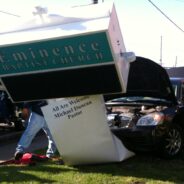
Five minutes later, my phone rang. The caller advised me that I needed to come to church and shut off the power to our new digital church sign. An auto had hit it. When I arrived, I saw the dark colored Buick Lucerne that had passed our home just minutes before. The sign lay at a 45-degree angle. The car’s front end was crumpled.
When we started shopping for a new church sign, several companies assured us that an attractive, digital sign would bring more people to our church. We never expected it to bring an automobile, as well. Before the car struck our sign, it passed between our sanctuary and a utility pole—a narrow squeeze. Neither the auto nor the sign fared well. Thankfully, the driver and her grandchild were not injured.
The sign probably kept the occupants and others from injury. Had the sign not been there, the auto would have gone into the front of the Post Office. Had this happened, the car’s occupants and patrons in the Post Office would have been at greater risk of injury.
All of this got me to thinking about plans and signs. We all have plans—things we intend to do and may set out to do. All those plans are subject to change, sometimes by accidents and sometimes because of the signs we see and heed or not heed.
The book of Daniel includes several stories about King Nebuchadnezzar in which he receives signs through either dreams or visions. Had he taken the full measure of the earlier signs, the last one—handwriting on the wall (Dan. 5)—might not have occurred. Through Daniel, Nebuchadnezzar benefitted from his earlier dreams. He benefitted but he didn’t draw closer to God who had provided the dreams. He remained a man committed to his own way. It cost him his life.
Church signs, like ours, provide information but they do more. They invite people to a new life experience, to new life in Christ. Our sign also provides those passing by with the time and temperature. Too many people “benefit” from the minor message but ignore the more important one. Doing so will prove costly.
The sign is a tool. The message is “Come unto me, all you that are weary and are carrying heavy burdens, and I will give you rest” (Matthew 11:28 NRSV).
Photo taken by Michael Duncan
Christians, Muslims and the Boston Marathon

In the hours and days since the bombings at the Boston Marathon, I’ve seen many graphic images. I’ve seen the bomb exploding, knocking a runner to the ground while others duck or raise their hands as if they are being shot. People without limbs. And, a heroic man clamping the artery of a wounded man as they make their way down the street to medical help. Perhaps the most vivid and the most graphic image was on Facebook.
I have a diverse group of friends ranging from far left to far right. Still, I wasn’t prepared for the glaring image that was on my newsfeed. It was a picture of a billboard edited to show an image of the bombing of the marathon. Blood was splattered everywhere and emergency workers were assisting the wounded. The quote said, “Upset by Muslims setting off bombs in public places? Maybe now you understand why Israel put up a fence to keep them out.” This was before we even knew who the bombers were, what their religion was and what might have motivated such a horrendous crime. Since then, the inflammatory and outrageous images have continued. Just today, I came across a picture that showed men of Middle Eastern background with torches, burning a car and protesting. The quote said, “How dare people make fun of our peaceful religion?”
The first time I met a Muslim was a few years after September 11, 2001. I was in seminary and the Cooperative Baptist Fellowship initiated the 11 on 11 projects. Groups were working that day to do 11 acts of service on September 11th in an effort to promote love and unity on that awful anniversary. A group of Baptists coupled with a group of Muslims to help others in the Lexington community. We never shared our individual beliefs as we worked side by side. I will tell you I saw compassion and hearts of service in my Islamic brothers and sisters. No torches, no animosity, only kindness. The second time I encountered a Muslim was at the mall. My young son was in the play area. He and a beautifully tan little boy were playing, climbing and giggling. Elijah went a little too high and started to slip. That’s when an angel stepped in to rescue him. She didn’t have wings, but wore a hijab (traditional headscarf worn by Muslim women). She helped him to his feet by the time I had reached them. She, through heavy accent, apologized; I guess for touching my child. I, in turn, thanked her for helping. There was a moment of grace and understanding that passed between us as we looked in each other’s eyes. We were united as mothers; any differences didn’t matter.
So my limited experience with Muslims has been one of caring and compassion, not of hatred. That’s not to say that there aren’t Muslims out there that would treat me as such, but there are Christians who would do the same. There are Christians who have.
I’ve been teased, abused, stalked and even raped by a Christian. I’ve been judged and even been called “unbiblical” by other Christians. Are any of those actions congruent with the teachings of Jesus? Are any of our actions as Christians when we judge a whole group of people based on a few indicative of Christ who came and died for us? Before we point a finger, we might ought to go back to those first four books of the New Testament known as the Gospels. Jesus says in Matthew 22:37-40 states, “‘Love the Lord your God with all your heart and with all your soul and with all your mind.’ This is the first and greatest commandment. And the second is like it: ‘Love your neighbor as yourself.’ All the Law and the Prophets hang on these two commandments.”
The bottom line is love. Even in the midst of hate, even in the darkness, even as the sulfur and smoke enshroud us and cause us to fear. Dare to love, dare to hope, dare to look at that person who is so different whether they spout hate or peace and love them. That is our challenge and that is our command.
Photo Credit
The Gospel According to “Ladder 49”
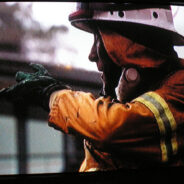
On Monday, when I heard about the Boston Marathon bombing, like many of us I went to the computer to read about what had happened and to watch videos from news programs. The first video that I opened was from The Boston Globe of the first explosion. What drew me in to keep watching was not the anger, disbelief, or fear that accompany such a tragedy.
Instead, I kept watching because of the people running towards the explosion: the policemen, EMTS, and bystanders who rushed to help those who were hurting. In the aftermath of 9/11, a resurgence of appreciation occurred for emergency responders. The same has happened in Boston: a deep gratitude for those who choose to run towards the chaos, often without a second thought.
In 2004, the movie, Ladder 49, told the story of a group of firemen in Baltimore, Maryland. Captain Kennedy, played by John Travolta, summarizes what we observed in light of these bombings: “People are always asking me how is it that firefighters run into a burning building when everyone else is running out. Courage is the answer.” *
Indeed, courage is the answer, not just in such times of tragedy but in our everyday spiritual lives. According to the New Revised Standard Version of the Bible, the word, “courage,” appears 42 times, many of them in commands to “take courage.” There is a choice involved in this command–a choice either to cower in fear or to step forward in faith. We all experience times of panic with our work, families, and relationships. We all will encounter “explosions” and times of fear. How do we respond? With fear that we can’t fix anything on our own? Or with courage that God can help us to assist those who are hurting?
I did not “want” to see Ladder 49 any more than I wanted to watch the reports of the Boston Marathon bombing. But I knew that I needed to do both, not because of my own desires but because it was not about me. I remember listening to the late Roger Ebert’s review of Ladder 49 on his weekly TV show. He said, and later wrote in the Chicago Sun-Times, ” … I was surprisingly affected by the film. After I left the screening, I walked a while by the river, and sat and thought, and was happy not to have anything that had to be done right away.” **
This week, let us pause to pray regularly for all affected by these bombings, including the first responders. Let us all take a moment to walk by the river, to sit, to think, and not to have anything to do right away. And let us reflect in gratitude on those who are courageous. Let us pray for such courage for ourselves. And let us be humbled by the One who ran towards us to the point of death on the cross so that we might be eternally rescued.
all good things to each of you,
Pastor Darian
Read more from Darian Duckworth at her blog.
* http://www.imdb.com/title/tt0349710/trivia?tab=qt
** http://www.rogerebert.com/reviews/ladder-49-2004
Thomais, Martyr, Devoted Wife, Killed by her Father-in-Law
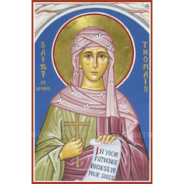
Thomais was the daughter of Christian parents in Alexandria, Egypt in the 5th century. She had received some education though it might have been at the feet of her parents instead of a tutor. She had a natural beauty that was captivating but it paled in comparison to the beauty of her character and integrity. She filled her mind with spiritual reading and the study of scripture. At the age of fifteen, she married a Christian fisherman who came from a moderately Christian family. As a young couple with little in the way of possessions, they lived those first few years in the home of her father-in-law. Thomais was very welcome in the home not just because of her humble goodness but also because of her willingness to be family with her husband’s family.She had learned her faith well from her parents and knew the value of humility and gentleness as they relate to spiritual growth and maturity. She fit in well with her new family and was a welcome addition to the home.
One day, however, her husband was out plying his trade as a fisherman when his father–Thomais’ father-in-law–entered their room in the house. She greeted him warmly since she expected no ill intentions in his entry but he meant her ill. He had become inflamed with lust for Thomais and desired to have her and lead her by the hand into adultery and sin. He tried to convince her to join him but she resisted. She tried to remind him of their common faith in the Last Judgment and the need for spiritual maturity and sanctification. “Please don’t do this,” she begged, “it’s a sin against me, against you, and against your own son.” Seeing his advances spurned he became enraged. The very thought that this beautiful, young woman would resist his passion and dare to remind him of the power and danger of sin brought a sense of shame to him that was consuming. He had a choice as to how he would respond to that shame: he could be corrected by it or he could refuse it.
As he picked up his nearby sword it became clear that he was refusing the needed burden of his own shame. He threatened his daughter-in-law that if she would not concede to his lustful desires then he would cut off her head. He assumed that this would be enough to convince Thomais to indulge in a sin kept secret but he assumed incorrectly. She responded, “Even if you cut me into pieces, father, I will not stray from God’s teachings and commandments.” The steadfast words of faith infuriated the man and his shame was only intensified. He had given sin a place to dwell within his heart and his passions and it now consumed him and demanded more. He swung his sword at her in a rage and cut her in half. She died a martyr–having suffered and died because of a faith she wouldn’t let go. The man collapsed in grief and regret for what he had done. He was blinded–whether by his own hand or by God’s just hand–and was found on the floor of the room by his son that evening. Sin had consumed and commanded him but now had abandoned him–now that it had got what it wanted. So, the man asked to be taken for judgment. He confessed to the crime eagerly and so the city officials beheaded him in punishment.
Read more from Joshua Hearne at his personal website and the website of Grace and Main Fellowship, the non-traditional community he ministers with.
Yoga Theology: Im”prop”er Pride
When we go through busier seasons, such as the days between Thanksgiving and Christmas, it’s easy for us to get out of certain routines. We opt for shopping over an afternoon jog at the end of the work day. At holiday parties, we eat cheesy appetizers and chocolate-covered strawberries instead of raw fruits and vegetables. Then, when the decorations are stored and the refrigerator cleared of all sugar-coated goodies, we are faced with the reality of routine.
For clergy folk, such a busy season has just passed. Along with Easter Sunday comes the preceding Holy Week, full of extra services and activities. This year, I helped to lead six worship services in the course of five days. Each service was meaningful and uplifting, and I am grateful for the lay participation of St. Luke UMC, Shipman Chapel, First UMC of Cleveland, and Monticello UMC to make these possible. However, I must confess that I almost fell asleep in my quiche on Sunday afternoon! Some of you might have done the same.
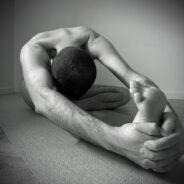
In the course of the Lenten season and Holy Week, yoga has been such a changed routine. My time spent on the mat did not disappear, but it was much more sporadic. I would cut my practice short in order to check more items off the to-do list. It was no surprise that two days after Easter, I discovered many a tight muscle when I got on the mat. Poses that were usually “easy” now required more effort. As I eased into Head-to-Knee pose, the inevitable happened: I could not touch my toes! I bent my knee and lengthened my spine. Still no success. The foot seemed further away the more I reached.
If I were teaching a class and a student had this problem, my response would be immediate: “Use a prop. Wrap a strap around your foot, hold both ends, and all you’re doing is lengthening your arms.” But here I was, both teacher & student, alone in my yoga room, and my response to myself was the opposite: “A prop?! I don’t need a prop. I can do this pose just fine without a prop.” The more I tried to reach my foot, the worse the pose became. The more I resisted using a strap, the more resistant my body became to the stretch.
I had unintentionally welcomed pride onto the mat, a pride that basically says, “I can do this just fine without any help.” Physically and spiritually, pride is a dangerous companion in the yoga practice. It can cause physical injury. But it can also have spiritual implications, telling us that we don’t need God’s help on or off the mat. In the book of Proverbs alone, the word “pride” appears nine times in the Common English translation. All of these mentions are negative because they include an attitude of, “I know more than anyone (or Anyone) else knows.” Such pride hinders us, and it’s something of which we should let go. When we do so, we discover that a little “prop”-er help makes us better.
I eventually and begrudgingly got a strap from the closet and spent five minutes working on the stretch. Before long, I looked to see that my hand had reached my toes, and I had kept the correct alignment. The pride had slinked away from the mat when I let something (and Someone) help me touch my toes.
As we journey through this Easter season, let us guard against a pride that hinders us from learning more about God and each other. Instead, why don’t we “prop”-erly rely on God and each other to help us in our tightly wound areas? Who knows how far we can reach when his love reaches with us?
all good things to each of you,
Pastor Darian
Read more from Darian Duckworth at her blog.
See My Hands
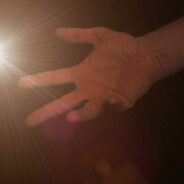
Then he said to Thomas, “Put your finger here and see my hands. Reach out your hand and put it in my side. Do not doubt but believe.” (John 20:27)
The resurrected Christ kept his wounds. But why? What does it say to us that the very first fruit of God’s new Kingdom kept his wounds? Are not all things to be made new? Are not all things to be made whole? Are we not to expect God’s heavenly outcome to be one of perfect health and perpetual youth in the flawless garden? Why the wounds? Where they kept for a witness? Would the disciples not have believed had the resurrected Jesus been without the wounds? Did they need the scars to know the Christ? Were they kept just for Thomas, who asked for them in particular, or were they kept for the whole church as well?
I must conclude that since the wounds of Christ were a part of the witness of John’s Gospel to the church, they were in some way meant for the church as a whole – which means they were meant for you and me. And if kept for us all, then what was kept by keeping the wounds? Were they kept as a sign for us of “the way”? Were they present as pointers, not just to to the cross of Jesus, but to ours as well? Had the wounds been cleared, would the church have forgotten the way of the cross? Is the church to know something important about its own wounds? Is there something important I am to understand about my own wounds and their place in eternal things? To what does this presence of wounds invite me?
And might these wounds of Christ also tell us something about not just our own journey, but also about God? Are they windows into God’s soul, indicators not just of the condition of skin, but also of the condition of heart? Perhaps they were not scars at all, but living wounds, still active and marking not a past experience but a present and ongoing reality? Have these wounds now become part of the Godhead, changing the eternal nature of things? Do they tell us that wounded-ness is now woven into the very fabric of the universe, and that God himself is a wounded healer?
Julian of Norwich, that Christian mystic who so sought to identify with the suffering of Christ said, “Our wounds become our honors.” I think she was speaking of honor not as pride, but of humility. And I think she was speaking of wounds not as a badge of honor but as a path to honor. For Julian, our wounds are the very tools of finding right relationship to ourselves, each other and God. Without them we would most certainly drift down the path of false independence and the illusions of self-sufficiency. Without them, we most certainly would retreat from the difficult work of truth telling and true loving. Our wounds remind us of our limits and our need for each other and for God. Our nagging wounds are what keep us from settling for the shallow and the cheap. Our persistent wounds are what force us to accept the wounded-ness of others, and thereby learn compassion.
In other words, there can be no resurrection without the cross, and there can be no cross without the wounds of the cross. And if Jesus kept his wounds, I guess I am to keep mine as well. Rather than regret them and hide them, perhaps I should learn to accept them and wear them as my own path to honor – the true humility that honors God and all that God has created. And if the resurrected Christ still wears his wounds, I guess mine will never go away either. We might as well be friends, and in friendship there will be healing.
So, fellow followers of Christ, let us also be willing and able to show our own wounded hands to each other and the world. Because far from being signs of shame, they are rather signs of the honorable humility that is the Way of the Cross.
The Rev. Jerry Cappel is the Environmental Network Coordinator for Province IV of the Episcopal Church. Learn more about Jerry at his website and blog.
Follow Us!