
everything else.

As is my custom, a few years ago I found myself in a heated exchange with someone over the nature of belief, God, the Bible, human origins, and whether or not the Office was going to make it post-Michael Scott (it did, but with a limp).
You know, the core tenets of the Christian faith.
In the midst of this discussion, as we circled round and round and round both giving up and convincing one another of nothing, I was struck by the hilarious sadness of the situation, this is what the Christian faith has ultimately become: fodder for pointless debate, narcissistic blogging, hate speech, and tense Christmas gatherings involving arguments between your secular-Jewish uncle and Fox News watching grandparents.
Which brings me back, after what probably resembled a George Michael 45-second-thought-blackout, both to the original conversation as well as the only card I’ve learned to play whenever I find myself in a game of theological chicken:
“Why believe in any of this? What’s the point of it all? What has believing in these truths rather than those changed about how you shop, eat, live, mow your lawn, vacation, wash your socks, and treat your neighbors in this world (rather than the one coming after it)?”
Now, since we’re likely having a one-way conversation with one another over the internets, I’ll answer first and you can follow up later.
Mine, obviously, begins with a first date:
year: 2002
setting: The Carmike Theaters on Millertown Pike
car: a 2001 Pontiac Grand-Am
car color: champagne (or “gold” for the uninitiated)
windows: manual
AC: smells faintly of exhaust
12 disc changer in the trunk: filled with various DMB bootlegs, August & Everything After, The Mark, Tom, and Travis Show, and of course, the Clarity album.
jeans: carpentered as always
movie: The Ring
palms: extra sweaty
knees: weak
arms: obviously quite heavy
conversation: somewhat stilted, quiet, self-deprecating, overly concerned with movie theatre, car, and outside temperatures.
total time spent together: 3 hours
total time spent in direct communication: 20 minutes
Honestly, it’s hard to believe that almost 11 years later we’re not only married (almost 6 years now!), but are also co-parenting a child together. (Granted, our “child” is a 14-month-old pug, but I’ve seen every episode of Teen Mom 1 on Netflix, and based on my extensive research over a weekend 2 years ago, pug ownership and child-rearing have way more in common than one might imagine. Everyone ties their toddlers to bike racks outside Chick-Fil-A, and encourages them to poop in their neighbor’s yard right?)
Lindsay and I have survived earthquakes
forest fires
tornadic activity (thanks only to Todd Howell)
leaving the Southeast for California
420 square foot studio apartments cooled by only one window unit
3 hour family budgeting sessions
changing at least 2 flat tires
grad school
returning to the Southeast from California
working full-time at a Baptist Church in a small town
and one of the longest dry spells in University of Tennessee Football history.
I realize now, after looking back over the list, that much of this would never have happened without Lindsay. Now, I don’t mean this in a J.J. Abrams style time-travel episode where removing one person from a particular timeline shakes the foundations of human history: Todd Howell and Viva Laughlin would probably have happened anyway. No, what I mean is that without this particular relationship with this very particular person much of what I now refer to colloquially as “my life,” would be categorically different:
like in the sock washing, grocery shopping, neighboring sorts of ways.
I heard one time that love isn’t actually the meaning of life, but is instead the light by which we discover meaning in life.
I don’t remember where I heard that*, but for me at least, Lindsay is what enables me to find meaning, purpose, and hope bubbling up in the world around me. She’s the light providing enough courage and clarity in the murky darkness of confusion, struggle, and annual disappointment each fall at the hands of the Vols, to continue loving others, my family, my friends, God, and even myself.
In short, I believe in and love Lindsay because she’s that which allows me to believe in and love everything and everyone else.
(*NOTE: I now recall where I “heard” that, it was on a $1.29 card at Walgreens I got for my mom a few years ago on Mother’s Day. YOU’RE WELCOME MADRE!)
This is also the very same reason the Office managed to survive the departure of Michael Scott (however painfully at times) without completely coming off the rails. Because the beauty of the Office wasn’t found in characters who overpower our screens with bombast, beauty, success, or superpowers (which is precisely why Robert California was so toxic for season 8), but ones that remind us all that life wherever we find it is humming with story, and wit, and complexity, and struggle, and divinity.
This could be why, after the credits rolled on the series finale, I sobbed for 45 minutes on the couch while clutching my confused and increasingly more agitated pug.
This could also be why I did not shed a single tear at the conclusion of Man of Steel, despite Warner Brothers’ repeated efforts to compare Clark Kent to Jesus (*cough* they aren’t the same *cough* Jesus died *cough* Superman never will *cough* the movie was bad *cough*).
I believe in the Office because it’s helped me to believe in life, not just in spite of, but precisely because of all its small and seemingly insignificant mundanities.
For some time now, many of us have been told that “having faith in God” naturally requires the end of many other beliefs we’ve found meaningful, good, true, and yes, even beautiful. In this story, the word “God” actually marks the death of new beliefs rather than their genesis. And, much like a late night infomercial, this god’s religion plays the role of a ruthlessly upbeat foot soldier laying verbal (and sometimes extremely physical) waste to all other competitors in an effort to become the sole source of meaning, purpose, and relational flourishing in your life.
So for 3 easy payments of $39.99…
In the 4th book of the New Testament known as the “Gospel of John,” Jesus begins referring to himself as “the light of the world”.
For instance:
“I am the light of the world. Whoever follows me will never walk in darkness but will have the light of life.”
I would argue that what we discover on the lips of Jesus isn’t yet another competitor desperately waiting in line for the scarce resources of our religious fidelity, but is, counterintuitively, a self-disinterested invitation to see the holiness whirring about wherever we find ourselves standing at the moment. Because light, rather than demanding our attention and appreciation, instead, in a quietly patient if not confusingly generous manner, allows us to focus our energies more intently on everything else around us.
In my experience, the “light of the world” (whether it be named Lindsay, Michel Scott, or even Jesus) has been just that, a way of finally encountering the world and all its naked pain, brokenness, beauty and endless possibilities, clearly,
maybe even for the very first time.
So, to finally come back around to the initial question, I believe in Jesus specifically because he’s helped me to believe in the sacredness of every other sock and tree and conversation and cup of coffee and republican and 9 season television show and relationship and democrat and self-important blog post and even the church itself (in all its limping stiltedness and half-hearted strivings).
I believe in Jesus because he’s the only way I can muster enough strength to believe in anything and anyone else.
Myself included.
So may you, in all your mundane and seemingly insignificant conversations, in your failing faithfulness and first date awkwardness, and yes, even in your wounded agnosticism, bumper-sticker Christianity, and erudite atheism, find that when you turn on the light it manages to fill the room you’re standing in with clarity and a soft glow.
I call that glow, “God”;
you may not.
But I guess the name’s not really the point of the light.
The point is quietly celebrating its warmth together.
To read more from Eric Minton, click here.
Tikhon of Amathus, Bishop, Generous, Did Much With Little
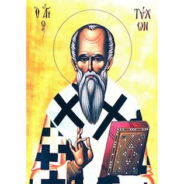
Tikhon was born in the city of Amathus on the island of Cyprus. He was born into a Christian family and was brought up in the faith of his parents.They taught him to read at a young age and they did so by teaching him to read the scriptures so near and dear to their hearts. That way, at least, if he didn’t learn to read well and benefit from the rare skill, then he would at least hear the life changing stories contained therein. He had the opportunity to receive education–a relative luxury at the time–because his father owned and operated a fairly successful family business: a bakery. Growing up in a family with a business meant that Tikhon received regular opportunities to help the family prosper economically. When his father needed to leave the shop, Tikhon would mind the wares and make the sales necessary. As he got older, Tikhon was able to begin baking while running the shop in his father’s occasional absence. Eventually, as is the way of family businesses, Tikhon was essentially a coworker with his father when he was not busy with some other more pressing matter.
So, it was no surprise when Tikhon was left in charge of the bakery once again but it was surprising to his father what he did when hungry people came begging. Tikhon took a loaf of bread, broke it, and gave it into the hands of the hungry people on the doorstep. He invited them in for a little while so that they might find some momentary shelter and eat in peace. He broke another expensive loaf of bread and began baking yet more for them. He did it all, of course, because he felt that the faith he had learned at the knee of his mother and father commanded him to do so. When he was presented with the opportunity to do what Jesus had taught Tikhon didn’t know that most would avoid this command and, instead, followed the words of Jesus. Specifically, he gave food to the hungry because Jesus had said that those who feed the hungry are, in actuality, feeding God. So, he treated those hungry people in the shop with the love and attention that he desired to lavish upon God in the flesh. In a very real way, he was able to draw closely into the presence of God by handing over hot bread into the hands of one unable ever to pay for a slice–let alone a whole loaf. Then, Tikhon’s father came home just as Tikhon was handing over yet another expensive loaf–it seems that generosity truly is an addiction–and saw what was happening to the valuable bread meant to be sold to support the family.
He rushed Tikhon’s beloved guests out of the shop and asked Tikhon what he thought he was doing. He began to lecture Tikhon about the need of the family to support itself and how giving away bread robbed his own family. He mentioned that the granary where they kept the wheat was nearly empty because he had made bread in anticipation for some festival or feast. Now, that bread was in the stomachs of the hungry. He assented that it was good to feed the hungry as Jesus had commanded but not to do so so radically and lavishly. After all, wouldn’t the crusts be enough for the hungry? Tikhon, however, with honest and sincere faith asked his father if he had forgotten what God had promised. “I wasn’t feeding the hungry. I was feeding God. Didn’t God tell us that we would receive again one-hundred-fold for what we have given away in love?” His father agreed that this was the command but refused to accept such naive idealism–having been thoroughly indoctrinated by the world’s gospel. So, Tikhon led his father to the granary where, miraculously, it was filled to overflowing with wheat. At the sight of such a promise miraculously fulfilled, Tikhon’s father repented and insisted that they must continue to bake and break bread for the poor and the hungry–and so they did for many years even after Tikhon’s path led him away from Amathus and elsewhere into God’s service.
Photo Credit
Read more from Joshua Hearne at his personal website and the website of Grace and Main Fellowship, the non-traditional community he ministers with.
Brother with a Semi-Colon: My Connection with Rev. Will D. Campbell

In the Fall of 2004, I was taking a seminary course on Thomas Merton. It was being taught by Merton friend and scholar E. Glenn Hinson. Dr. Hinson knew of my near-obsession with all things Will Campbell, and he helped arrange a trip in which he and I would travel together to visit with Will Campell at his home in Mt. Juliet, Tennessee. In addition to simply getting to hang out with Will Campbell, I was going to set up a recorder and let Campbell and Hinson swap their stories about and memories of Thomas Merton. I would then write something up and submit it for a project grade for the course.
Less than two weeks before our trip, Will called me and said that he’d been thinking a lot about it, and his memories of and experiences with Merton were just too personal, and he’d prefer not to talk about them. After all, Merton himself wrote a little about their friendship in his journals, and I could read about everything in there. He really treasured his Merton memories and didn’t want to talk much about them, so he canceled our meeting, and asked me to give his greetings to Glenn Hinson. He did, however, invite me down simply to visit with him any time, which I of course did – once. We talked about everything, including his friendship with Waylon Jennings (one of my musical heroes). We didn’t, however, talk much about Merton.
I never presumed to think of myself as a friend of Will’s, but he was very gracious to me; we corresponded a few times over the years, and we’d talk on the phone from time to time – a couple of times he even called me! One of the greatest thrills of my life was when he agreed to consider writing a preface for my second book, Psychic Pancakes & Communion Pizza. With his permission, I sent him an advanced manuscript – but that ended up being about the time he was not able to do much at all anymore, and soon he was in the hospital. Even though he didn’t write the preface, I can still tell people Will Campbell agreed to read my manuscript! Whether or not he actually read it, as far as I’m concerned, is moot.
During that period of time that Glenn Hinson and Will Campbell and I were planning our Thomas Merton summit, I had to have surgery to remove twelve inches of my colon (due to severe diverticulosis). Will told me over the phone that I had nothing to worry about – he had the same problem and had the same surgery done many years before. He then added, however, that his heart actually stopped at some point during the surgery, and he had to be resuscitated back to life. “You mean I was actually dead there on the operating table?” Will asked the surgeon during a follow-up meeting. “Yep – for about three minutes you were dead.” To which Will replied, “Can I get you to sign an affidivat saying I was dead for three days … I’ve got a few people I’d like to show that to.” That was 100% pure Will Campbell.
When I was leaving Kentucky to pastor in Mississippi, Will told me about his recent experience with the University of Mississippi (I was coming to pastor University Baptist Church in Starkville, home of Ole Miss’ archrival Mississippi State University). Ole Miss folks invited Will back down to Oxford (from where he was run off while serving as campus minister due to his insistence on living out racial equality – this was before James Meredith successfully enrolled there). Ole Miss wanted to name him “Chaplain for Life.” Will said he hemmed and hawed and reminded them that the last time he was in Oxford, he was followed up to the state line by men in cars who pointed their guns at him, and when he crossed over into Tennessee they threatened to kill him if he ever set foot back in Mississippi. Therefore, said Will, he figured he’d pass on that chaplain-for-life thing. “Oh, but Rev. Campbell,” they replied, “we’ve been reading all your stuff over these last many years about forgiveness and reconciliation and all that – and we figured you meant it.” Will, recognizing that they had him on that one, grumbled and complained and cursed, then came down and “accepted their little piece of paper.”
There’s a lot about my conversations with Will that are really special to me, and I prefer just not to talk about them. Since his passing, many have been and will continue to be writing about their memories of and experiences with Will Campbell – and rightfully so. I look forward to reading them. But, I now understand why Will chose to keep his Merton memories to himself.
Thank you, Will, for everything. Oh, and please give my greetings to Waylon …
This post originally appeared at ABPnews.com.
Learn more about Bert Montgomery at his website.
Yoga Theology: Back to the Beginning

A few years ago, I regularly attended a yoga class that was usually filled with people. On one unusual Saturday, there were only a handful of us gathered, and we awaited the teacher’s arrival. When she came in, she said five frightening words:
“Oh good! You’re all advanced.”
Excuse me?
I had only been practicing yoga for a few years. Didn’t a person need 20 or 30 years behind him/her to reach the title of “advanced”?
What followed was a blur. We were jumping, kicking legs in the air, leaping onto our hands (I refused), and twisting into strange shapes. Apparently, to be “advanced” in this yoga class was to practice difficult poses. The next morning in church, when the minister invited us to “stand as we were able,” in the order of worship, I was not able. From my seated stance, I prayed for the “beginners” to come back to yoga the next weekend.
Since I’ve been teaching yoga, the question people ask me most is some variation of, “Is it okay for beginners to come?” I find myself mostly answering, “Of course.” What I should be saying is, “I sure hope so — because I’m a beginner, too.”
No matter how many years have passed since I started practicing yoga, I realize that to lose the “basics” of the beginner’s class could cause me harm. In a beginner’s class, we learn how to breathe. We learn proper alignment of the most used poses. We learn how to connect the breath to our movement. Whether a class is described as advanced, intermediate or beginner, all of them require knowledge of the basics. The more obsessed we become with mastering more “difficult” poses, the more likely we are to take for granted the seemingly “easier” ones.
When I think about such beginnings, my theologian’s mind returns to the book of the same name: Genesis. The first two chapters of the first book of the first testament are familiar to many of us: the story of creation, the story of our formation. When we’re studying the Bible, how often do we connect the passage we’re reading to the very first story? When we read of Jesus scribbling in the dirt, surrounded by Pharisees and filled with compassion for an adulterous woman, do we recall that this is the same dirt from which we were all formed? When Isaiah dreams of a day when lion and lamb will dwell together, do we recall that it once was this way?
How different our time in the Word might be if we connected everything to the first story! We’ve heard the story of creation so often, and it’s been so greatly discussed, that it’s easy to lose the awe of our beginnings. We want to dig more deeply into “advanced” readings: learn the original Greek and Hebrew, study the context, interpret the meaning. Whether it’s a psalm, proverb, parable, prophecy, or epistle, we can always connect God’s love story to us back to the first day–when light came forth from darkness.
Let us challenge ourselves to return to the beginning. Take time to be with the first and second chapter of Genesis. Pause to remember the breath of life. Return to the basic beginnings, and discover that there is a depth to these basics as powerful as the waters over the face of the deep….
all good things to each of you,
Pastor Darian
Read more from Darian Duckworth at her blog.
Joan of Arc, Martyr, Warrior, Victim of Injustice
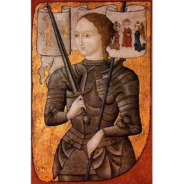
Tricky questions shouldn’t have a place in a trial that is meant to be an exercise of justice but, then, Joan of Arc’s trial wasn’t designed to be fair. It was designed to reach the scandalous verdict of blasphemy and heresy for one who opposed English rule. At its most basic, it was the cloaking of the State in the garments of the Church so that power could be exercised in new and terrifying ways. The inquisitor–the one in charge of determining Joan’s guilt–allowed her accusers to ask a leading question meant to solidify her guilt before the onlooking crowds. They asked her if she was certain that she rested within God’s grace. On the surface, it seems a simple question for a woman who had received visions from God calling her to do unconventional things and speak truth to powerful and influential people. But, Joan was aware that there was no good, simple answer. If she said she knew she was in God’s grace then she would be labeled a heretic for claiming knowledge that her accusers insisted was open to nobody–after all, only God could claim to know such a thing. If she said that she didn’t know then she would be dangerously close to admitting her own guilt before a panel of accusers all too willing to punish her.
Joan responded, “If I am not, may God put me there; and if I am, may God so keep me.” Though this was a beautifully crafted response, in Joan’s ears its beauty could not compare to the sound of the silence that followed it. Her accusers were dumbstruck by the careful precision offered in her words and were forced to take another route of accusation to arrive at the predetermined verdict of guilty and condemned to death. They condemned her for her visions and claimed she was an impostor wrapping herself up in the garments of the Church while serving a civil master. They condemned her for wearing men’s clothing and armor as she led French soldiers to resist the abusive and land-destroying practices of the English invaders. She was ceaselessly questioned and housed in a prison guarded by English soldiers instead of in a monastery or convent as the law concerning ecclesastical trials demanded. So, when she wasn’t being questioned and tricked by her accusers, she was held in a rough prison cell, forced to wear a flimsy dress that provided no protection from the cold, and “guarded” by the soldiers she had been fighting only weeks before.
After she was condemned–and her condemnation caused no surprise among anybody–she was asked to sign a statement renouncing the crimes with which she had been labeled. Being illiterate, she was duped into signing the statement under threat of immediate death and then this statement was replaced with one confessing her alleged crimes. With this final duplicitous act, she was condemned to be burned at the stake for heresy without it having ever been proved or rightly tried. She agreed to wear women’s clothing to her execution but this plan changed after she was sexually assaulted in her cell before the day of her martyrdom. They did not return her torn dress to her and so, instead, she was marched to her death wearing the same clothes she had worn when she fought the English who now condemned her. She was tied to a stake and burned to death on the 30th day of May in the year 1431. As she died, two clerics held a cross before her so that she might focus on the instrument of execution that had robbed her savior of his life. After the flames died down, the coals were raked back so that the crowd would have no doubt that she had died in the flames and at the hands of the English. They took the remains, burned them twice more until they were but ash and then threw the ashes into the Seine river so that no relics might be obtained by those still loyal to Joan.
Read more from Joshua Hearne at his personal website and the website of Grace and Main Fellowship, the non-traditional community he ministers with.
Take Your Shoes Off

To-morrow, and to-morrow, and to-morrow,
Creeps in this petty pace from day to day,
To the last syllable of recorded time;
And all our yesterdays have lighted fools
The way to dusty death. Out, out, brief candle!
Life’s but a walking shadow, a poor player,
That struts and frets his hour upon the stage,
And then is heard no more. It is a tale
Told by an idiot, full of sound and fury,
Signifying nothing
I’m not usually very Shakespearean (I’m more Bossypants than Beowulf), but when I found myself tearing up during Alan Cumming’s brilliant one act rendition of Macbeth in New York last week, I thought:
“I remember memorizing that passage incorrectly in Ms. Wilkes’ 11th grade English class!”
Now, once my obvious pride at being a member of the cultured elite quickly deflated (I only know the first and last lines), I became decidedly more introspective:
“There’s something haunting, rich, deep, and beautiful about this soliloquy that I likely failed to grasp during my monotone regurgitation of Shakespeare’s cumbersome prose ten years ago.”
EPIPHANY!
Later, out on the slippery street in front of the theatre, as I’m blown and jostled and harrangued by the wintry mix greeting me in late May, my thoughts become decidedly less poetic. New York has a funny way of getting under all our skins. I would argue, despite the proliferation of crowded subways, rotting garbage, and exorbitant rent, the thing about the Big Apple (no one calls it that) that eventually wears us all down to the nub is the sneaking suspicion that not only on an economic, geographic, and stylistic level, but also on a subatomic one, you don’t measure up
and you never will.
Perhaps this comes from the fact that everyone, even flared-out rugby-shirted hostesses at the Times Square TGI Friday’s* you’ve just (hypothetically of course!) abruptly left after discovering that the Jack Daniels BBQ Burger with onion straws costs double the price it does at the DFW airport,
is too busy
too important
and too well-read to waste their time giving you the code for the customer only restroom.
(This could also explain why many of the less-populated street corners in the greater New York area look as if they’re crying tears that smell eerily similar to ballpark port-o-johns. But what do I know, I’m not a real New Yorker.)
(*NOTE: I am nothing, if not a compression socked, zinc-oxide protected, disposable camera wielding tourist on the inside. Why yes, I would love my name written on a grain of rice thank you very much!)
It’s amazing really, the speed with which my self-loathing arises at not being smarter, wittier, more successful, and more widely admired because I haven’t decided to pay 900 a month in rent to share a 2 bedroom apartment with Toby Flenderson and 6 other roommates.
Which brings me inevitably to Liz Lemon misquoting Jay-Z: Concrete bunghole where no dreams come true, there’s nothing you can do.
Now, this feeling of inadequacy at the sight of tall buildings and pretty people is what philosopher and writer Alain de Botton refers to as:
“A worry, so pernicious as to be capable of ruining extended stretches of our lives, that we are in danger of failing to conform to the ideals of success laid down by our society and that we may as a result be stripped of dignity and respect; a worry that we are currently occupying too modest a rung or are about to fall to a lower one.”
Or, more succinctly:
“Status Anxiety”
Throughout my life “place” has always played a significant role in my identity formation. Whether it’s SoHo, WeHo, Dowisetrepla, Silverlake, London, or even North Knoxville, the spaces we inhabit powerfully color how we understand ourselves and our world. Por ejemplo: you can be a lonely hot dog vendor at the world’s fair site or you can be a lonely hot dog vendor in CENTRAL PARK, you do the math. Sometimes the spaces in which we find ourselves, can pull us deep into the recesses of our pasts, filling our eyes with equal parts pride and regret. Other times they can push us forward into all possible futures awaiting us were we to stay here and make a life for ourselves.
Unfortunately, either of these options seem to absentmindedly neglect the beauty of the day right in front of us.
In the 2nd book of the Hebrew Scriptures known as Exodus, there’s an odd exchange that accompanies one of Moses’ journeys to the top of a mountain known as Sinai where he, along with a few of Israel’s elders, comes face-to-face with the divine.
Upon arriving to the top of the mountain, the divine voice greets Moses and company with something unexpected and a little confusing:
“Come up to me on the mountain and be here…”
The obvious response is of course: “God, who have you been reading? Deepak Chopra? What’s with this 3rd eye mysticism?”
God, YHWH, the divine voice, whatever name you choose, understands the propensity for humans, despite your mother’s best and most exasperated claims to the contrary, to be in two places at one time. Especially whenever they find themselves in the presence of something epic and beautiful.
A bearded Jewish man a few thousand years later uttered something along the same lines:
“Consider the birds of the air; they do not sow or reap or store away in barns, and yet your heavenly Father feeds them. Are you not much more valuable than they? Can any one of you by worrying add a single hour to your life?”
In my experience, birds don’t spend a great deal of time plotting out the investment strategy of their 401k(s) or if skinny jeans really are for everyone. Nope, birds fly and eat and poop and mate and procreate and live (and I’m sure lots of other things that I don’t know about, as I am somewhat terrified of most birds).
Even in the very presence of that which holds all of us together (God), it’s possible to be somewhere else, lost in thought about what once was or what could be, all the while ignoring the sacred now quietly resting beneath our Birkenstocks*.
(*NOTE: this is a joke. No one wears Birkenstocks, not even Jesus.)
And, as the old saying goes: what’s true for formerly enslaved, uneducated, oppressed desert nomads who later form a nation only to experience strife, civil war, exile and even more oppression at the hands of the Romans is probably true for us today.
It’s always seemed strange how in the midst of this huge, epic story the scriptures unfold for us about the redemption of all things, there exist these pockets, these windows reminding us to keep our eyes on the road in front of us; quietly whispering like an interstate rumble strip on a late-night summer drive to the beach:
“pay attention”
Because, much like Macbeth, it’s quite easy to be controlled by our imagined futures awaiting us just beyond the next horizon. Demanding us to sacrifice everything, everyone, and all the ways that future has already come true on the altar of the someday and the not yet.
Put nicely, we refer to most of these people as “driven”.
On the other hand, as we meet in the incessant hand washing and debilitatingly fatal PTSD of lady Macbeth, crippling regret can tinge everything we see with sadness and cynicism and the odor of yet another failure yet to be undertaken. Reminding us time and again that we can never clean our hands of all the works we wish to forget.
All the while, the rumble strip rumbles on:
“Come up to me on the mountain and be here”
“Consider the birds”
“pay attention”
Throughout history, whenever people have been faced with these divine announcements to honor the day they’re standing in as holy, they’ve oftentimes undertaken very visceral, embodied activities to remind themselves, from that day forward, of what’s good, true, and beautiful about this life.
Sometimes they build
Or they sing
Or they mourn
Or they celebrate
Or they name.
Moses took his shoes off.
But the thing about these reminders isn’t that they explode and fill the sky with light, causing everyone in the Tri-state area to utter in awestruck unison:
“OOOOOHHH. AWWWWW.”
No, I’ve found these moments to be quiet, patient, and almost always a bit lower than the horizon. Amidst the dizzying heights of the book deals, business class boarding privileges, rock solid faiths, and salaries of others, what we need isn’t fireworks, but the quiet words of that ancient mountaintop epiphany and a crucified carpenter’s son 2000 years ago reminding us, not altogether differently from our grandmother standing before us in the living room no one uses except on holidays: to take our shoes off.
Because the ground on which we’ve been standing for quite some time now is holy, and filled with the divine. As a matter of fact, it always has been we just haven’t always been great at recognizing it.
So, with as much Shakespearean bravado as my state school liberal arts degree can muster:
Mayst thou, whenever thine discoverth a great disparity betwixt another and thineself, recall the sacral nature of the dirt under which thou is standing. And, in thus doing, regard that aforementioned dirt as the very site of divinity and opportunity. For it be in this day, and not another, that we shall meet God.
Oh, and whilst one is at it, takest your shoes off. It helps with the remembering, except in New York of course, there it’s just gross. People pee in the streets you know.
To read more from Eric Minton, click here.
Insight From Isaac (And His Hesitation to “Leave It”)

Long before Isaac the dog found me, I knew that I wanted a Labrador retriever. I’d talked to dog lovers who raved about what good pets they were. I’d done some online research and was pleased with what I saw. So when this brown-eyed, cream-coated lab mix walked into my life, I knew a little about what to expect. For example, I knew that he would sniff around a lot. Yes, I know that all dogs sniff, but cut this first-time dog owner a little slack ☺
What I did not expect was that sniffing would nearly cause injury to both of us.
When we first started going for walks, two things would happen:
1. Isaac would drag me down the street as he joyfully ran and
2. Isaac would drag me into yards as he chased something only he could smell.
Sore-shouldered and neck-strained, I asked Isaac’s trainer what to do. He introduced me to a style of loose-leash walking that has led to some improvement in the first problem. For the second problem, he told me to teach the command of “leave it.” When Isaac would go after something he smelled, dragging me with him, I was to say, “Isaac, leave it! Let’s go.” There were some at-home exercises we practiced to encourage this behavior. The goal was for Isaac to resist the smelly temptations and instead to follow his loving pet parent. How wonderfully theological!
And how extremely difficult.
To give him credit, and to show that the training is working, there are times that he obeys the command to “leave it” right away. This behavior leads to lots of applause and treats from me. Sometimes, the opposite happens. He glues his back legs to the ground, stretches his front paws forward, and bobs his wet and curious nose. The 55 pounds of lab then pull me through mud and grass into puzzled people’s yards. I can yell “leave it” all day long, but Isaac is leaving nothing until he’s satisfied.
Most of the time, something in between these two scenarios occurs. Isaac will not obey immediately, but he also won’t pull me down. He’ll investigate, then investigate some more, and eventually he will follow me for the rest of his beloved walks.
One day recently, I was getting particularly frustrated with Isaac when he wouldn’t walk away from some unknown smell. There was a lot on my mind. I was thinking about past hurts and irritations. I was dwelling on things that should have left my mind a long time ago. As I looked at my puppy dog on the other end of a taut leash, I realized that like Isaac, I couldn’t “leave it.” Just as I kept telling him to move on, God was gently urging me to turn away from what was past and focus on the joy of the present walk.
Like Isaac, we all can be a little stubborn sometimes. We become distracted by things that we should let go. Just as he almost injures both of us in his disobedience, we can get so caught up in the past that it causes us, and others, harm. I’ve accepted the reality that Isaac and his sensitive nose will not “leave it” completely every single time. I also believe that with time and practice, the temptations to cling to what’s past will lessen.
The same is true for us as we try to move forward in our lives and relationships with God. We can learn from the past, but we should not interrupt the joy of the present by dwelling on that past. In Psalm 17:5, King David prays, “Uphold my steps in your paths, that my footsteps may not slip” (New King James Version). May we follow in Christ’s footsteps and not try to forge our own paths. May we stay on the path that God has for us, acknowledging the past and its distractions, but “leaving them” as we walk forward into the beauty of the present moment.
All good things to each of you,
Pastor Darian
Read more from Darian Duckworth at her blog.
Practice Resurrection: Embrace New Possibilities
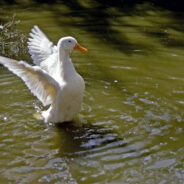
A sermon preached at the First Baptist Church of Christ at Macon on Acts 11:1-8
On the Friday afternoon after Easter Sunday, I picked up my three-year-old daughter, Merrill, from daycare. As we rode home, Merrill asked about our plans for the weekend. Still high off of egg hunts and candy and other Easter festivities, she said with excitement, “Today is Friday, and tomorrow is Saturday, and then it’s Sunday! It’s Easter again!” And she clapped and cheered.
My first thought was, “Bless her heart, the little minister’s kid. She just can’t help it.” And then my second thought was, “You know, she’s right.” And so I answered her, “Yes, Merrill, Sunday is Easter all over again.”
Her instinct was right. Easter is not just that one celebratory Sunday in the church year, when we all deck out in our finest and gather with our family and friends and proclaim “Hallelujah! Christ is Risen!” As people of the resurrection, we celebrate Easter every Sunday.
In our worship these last weeks since Easter Sunday, we have been exploring ways to live out that conviction. How might we “practice resurrection” so that our lives become a testament to what happened on Easter? We have looked to those in scripture who can teach us best – those disciples and first followers of Jesus whose lives were literally changed on that morning that the tomb was found empty.
These last couple of weeks in particular, the early Christians whose stories are told in the book of Acts have guided us. They were forging a new community.
What did Easter mean for them?
How would it shape them as a people?
What was the essential belief and practice for followers of Jesus?
What about their traditions and customs?
What did it mean to practice resurrection?
Here we find Peter in our scripture reading today. Peter returns to the church at Jerusalem, fresh off of a life-altering experience. And it landed him right square in the middle of controversy. It was the church’s hot button issue – just how far should this new Christian faith reach? To be a Christian, would one have to be a Jew first?
The dilemma Peter brought to the table was not just about the table – what was on it or who was seated around it. In a period when the church was facing one of its greatest crises of identity, they were trying to come to terms with what it meant to be the faithful people of God in the world.
Now, close your eyes and imagine with me for a moment. What is the one thing that for you that draws the line between Christians and other people? What is it that makes us who we are, that we cannot let go without giving up our whole identity as people of God? Have you figured it out? Now, get ready to give it up. That is what Peter did. The Spirit of God came to him and changed everything he had ever believed about who he was and how he was supposed to live. There, in his wildest dream, God’s Spirit showed Peter a new possibility. He found out that God was doing things bigger than he had ever imagined.
That’s how the Spirit works, you know. It’s all through the book of Acts, blowing and changing things in every direction. Seems like every time the wind blows, there it is, stirring up notions that are inconceivable.
Barbara Brown Taylor calls the book of Acts “the Gospel of the Holy Spirit.” “In the first four books of the New Testament, we learn the good news of what God did through Jesus Christ. In the book of Acts, we learn the good news of what God did through the Holy Spirit.”
We usually symbolize the Holy Spirit with a dove. We see it right here in our sanctuary windows, where Jesus is baptized, and back in the narthex over the door. The dove represents how God’s spirit comes to us, bringing peace and tranquility. We also talk about the Spirit as a Comforter, language which led one of the children in our discipleship class a few weeks ago to picture herself wrapping up in the comforter that covers her bed. She talked about how God’s Spirit surrounds her to warm her and protect her.
But the Celtic Christians have a different image for the Holy Spirit. It’s another bird, but it is just about the furthest thing from a dove. The Celts describe the Holy Spirit as a Wild Goose. Noisy and rowdy, untamable, unpredictable, free. A wild goose is always on the move, stirring things up and keep us on our toes.
It seems that the wild goose version of the Spirit is the one that showed up in Peter’s story, pecking him, prodding him, chasing him in a direction he did not want to go. The wild goose Spirit is not the part of God that wraps around us to protect us from harm. She is the part of God that pushes us beyond our comfort zones. She calls us to imagine possibilities that are beyond our scope.
The question for us is whether we still believe in a God who acts like that. Is our God old and tired, content with the way things are, someone to which we address our prayer requests but not anyone we really expect to change our lives? Or do we keep on our toes, just in case the Spirit of God decides to chase us like a wild goose into some new possibility we have not yet imagined?
Truth be told, some of us have gotten complacent about what God might do in our lives, if given the chance.
• A relationship has grown stale, and we just don’t see how to freshen it up.
• An old would has festered and the pain goes deep. We think it is beyond healing.
• Our work is no longer meaningful, and we simply go through the motions because paying the bills seems more necessary than finding fulfillment.
• We have waited and waited for God to break through in a situation or to answer a prayer, and we have grown weary of waiting for something to happen.
If there is any truth in the “Gospel of the Holy Spirit,” it is this: the wild goose is on the move. And she changes things through the stories and experiences of people. Take Peter: How did God choose to deliver this pivotal message that would alter the history of the church? A stone tablet? A miraculous natural occurrence? No! God’s Spirit chased down Peter and changed him. And through his story, God’s spirit burst through the boundaries of the church to extend salvation to the entire world.
God uses people to bring forth the gospel. Even people like you and me. This can be frightening, because it voids our excuses that we are not good enough, not gifted enough, not old enough, not whatever enough to get the job done. All that stuff doesn’t matter when the Spirit is on the loose.
What new possibilities might God be imagining in you? You may not be able to answer that question, because you have not dreamt it yet for yourself. But if you open yourself to practicing resurrection, and you look and listen for the Holy Spirit, you just might see some vision of where God is leading you to go next.
I have to admit, though, even more amazing to me than Peter’s openness to the vision God gave him was how the church leaders in Jerusalem responded.
Now, I will be the first to say that change is hard. Change in the church is particularly challenging. And changing a long-held, deeply-valued tradition, such as these Jewish Christians were asked to do, is downright nearly impossible.
But as Peter told his story, the wild goose got ahold of the church leaders as well. They could have said, “You are out of your mind.” Or “we’ve never done it that way before.” But they changed their minds because Peter’s story changed their hearts. The Spirit gave them the ability to listen and to imagine new possibilities.
As right and as necessary as some things have been in the past, time and history move on. Is it possible that one way of living the faith can be vital at one point in history but can actually be a hindrance to God’s movement at another point? Dare we change lest we abandon our identity and no longer know who we are?
Perhaps the hardest part of practicing resurrection is embracing the idea that in Christ, everything becomes new. “Behold, I am doing a new thing,” wrote the prophet Isaiah. “So if anyone is in Christ, there is a new creation: everything old has passed away; see, everything has become new!,” wrote Paul. And Revelation tells that the one seated on the throne proclaims, “See, I am making all things new.”
The gospel of the Holy Spirit says that the status quo cannot and will not contain the Gospel. It means that no matter how well-conceived our ideas are or how deeply entrenched our practices have become, the Spirit of God may chase us into a new place. This does not mean that our traditions and past experiences are not valuable or should be thoughtlessly cast aside. But it does means that the Gospel does not exist for the sake of preserving tradition, even good and valid tradition. It exists for the sake of calling people into relationship with God in ways that might even be in spite of tradition.
So what new possibilities might God be imagining for our church? Where might God be calling us to go next? I don’t know, exactly, but the best I can imagine is that wherever the Spirit blows, she is shooing us outward. She is stretching our boundaries, redrawing the lines that we have set about who’s in and who’s out. She is calling us to ask hard questions about what we have always been and done, things that in the past may have given us identity, but might now have become barriers to carrying out our God-given mission. She is daring us to open up rather than cling tight, to resist the temptation to define what is clean and what is profane. Like Peter, who are we that we could hinder the movement of God in our midst?
When we practice resurrection we embrace the possibility that God can do a new thing in us. After all, God has not called us to try to say where the Spirit may or may not blow. God has asked us to try to keep up with wherever it goes.
So, put on your waders and prepare to get messy. Get ready, because we are not peering through binoculars observing the movement of a docile dove who safely flitters in and out of our view. We are going on a wild goose chase. She may lead us through muddy waters, or over rough terrain. We may have to run to keep up, and we might even bleed in the process. But in the end, if we are faithful to listen to the distinctive call, then she will take flight, and we will see where to go next. And it may just be somewhere beautiful over the horizon that we have never imagined before. Amen.
To hear the audio of this sermon, click here.
Jesus and Baptists and Jews – Oy Vey!

Some of my all-time favorite people are Jewish: The Marx Brothers. Mel Brooks. Even my Lord and Savior is a Jew.
And then, there’s our local rabbi (sort of), Seth Oppenheimer. He is not ordained yet, so he’s always quick to interject a “student-rabbi” correction whenever I introduce him as Rabbi Seth.
The very first time I heard Seth singing lines from Kinky Friedman’s “They Ain’t Makin’ Jews Like Jesus Anymore” I knew we were going to be friends – and good friends we are. We get together regularly at the local tavern (along with the occasional priest and several friends) to talk about faith and everything else under the sun. Sometimes he even shows up at University Baptist Church (where I pastor).
I don’t know if our friendship has helped make him a better Jew, but I do know it has helped me become a better Christian.
I’ve been reading the two-volume book series Mount and Mountain – conversations between two friends somewhat like Seth and me. Two Tennessee clergymen, Rabbi Rami Shapiro and Rev. Michael Smith, examine together the Ten Commandments (volume 1) and the Sermon on the Mount (volume 2).
Rami and Mike bring into this dialogue their scholarship (each has a Ph.D. and is involved in higher education), varying interpretations from within their respective traditions, their own opinions, and of course, their trust and respect for each other. It is the latter that is most important, I think.
Both Mike and I come from the rich Baptist tradition of our Christian faith – specifically being Baptist in the deep south. It is from this tradition that we learned to respect others, to listen to alternative and opposing viewpoints, and – above-and-beyond all doctrine and all professed beliefs – to seek to hold Jesus Christ (whom Baptists have historically proclaimed to be the ultimate revelation of God to humanity) as our fundamental center guiding our actions as His disciples. Jesus seemed pretty good at following the Golden Rule, and it only seems natural that if we claim His name, we should strive to treat others the way we would want others to treat us.
At the same time, within our Baptist heritage in the deep south there arose a movement which focused less on the radically inclusive nature of Jesus and more on clearly defining and enforcing doctrinal statements; preferring not to serve others, but rather to erect walls separating and protecting “Christians” from people with different life-experiences and with alternative or opposing viewpoints. From that stream came the now infamous 1980 statement from then-Southern-Baptist-Convention-President Bailey Smith, “God Almighty does not hear the prayer of a Jew.”
Almost 30 years later a fellow Baptist pastor asked to meet with me; he was concerned I had been deceived regarding the status of Jews in the eyes of God. Judaism, the pastor stated, promoted the worship a false god – a god which in no way even resembled the God of Jesus and God as revealed in the Christian Bible. That last statement still gets me – after all, the overwhelming majority of the Christian Bible is, ironically, Jewish.
Both the concerns of a ministerial colleague and the 1980 quote from an SBC President are examples of why books like the Mount and Mountain series are so important. For understanding. For humility. For seeking to know the God of Abraham, Moses, Jesus, and the Apostle Paul, and for seeking to follow in the footsteps of Jesus (who himself worshiped in the Jewish Temple).
Mike Smith and Rami Shapiro do not agree on everything. Nor do they water down their beliefs or their traditions. But they do listen to each other, and each are willing to acknowledge that God as revealed in the Bible is far bigger than any of our limited human understandings of God.
In examining the Ten Commandments and the Sermon on the Mount, Mike and Rami push, probe, and challenge each other. They discuss everything from poverty, wealth, “inerrancy,” and interpretation, to suffering, suicide, the nature of God, and what God requires of us. Oh, and in the first book, there’s that little problem of deciding upon which of the many varied listings and numberings of the Ten Commandments they will use as their guide.
Reading the Mount and Mountain books are informative and enjoyable experiences. They remind me that I am not alone in treasuring my friendship with a rabbi – and in sensing his deep love for God that guides his interpretations and his daily actions. As a Christian, I am not threatened by Seth Oppenheimer, but rather encouraged and strengthened in my faith in God.
Mike Smith rightly points out that his and Rami’s friendship may help them to hear some things that they’d rather not hear; I know that’s true in my friendship with Seth. I agree with Mike when he writes, “Perhaps friendship should become the prerequisite to interfaith conversation.”
True friendship requires a lot of hard work, not to mention trust and respect. Sometimes it’s just easier to fall back on easy-to-spout doctrinal judgments rather than to invest in learning and understanding others.
Or, if I may quote Rabbi Rami: “This is America, and here ignorance trumps scholarship almost everytime…”
And to that I add, if I may quote my Jewish friends, oy vey!
I can think of nothing better right now than to spend a couple of hours with my friend soaking in some Jewish wisdom. Just let me grab my Mel Brooks’ Young Frankenstein DVD…
Learn more about Bert Montgomery at his website.
Peter Maurin, Teacher, Visionary, Radical
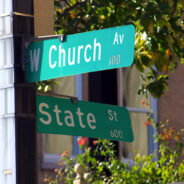
Peter Maurin’s mother and father were poor farmers in a village named Oultet in Southern France. As is often the case for those who make their living by the land, life was a challenge from sunrise and sundown that was punctuated with many moments of uncertainty and rare moments of quiet confidence. He was one of twenty-four children that indubitably did their best to help on the farm and fill each other’s lives with the comfort and solace of the community of family. When he was sixteen, though, Peter departed his family home and joined up with a Christian group called “The Institute of the Brothers of Christian Schools.” He trained to be a teacher and to move into some community in need of education and guidance and start a school. They professed vows of simplicity and piety as well as a passion for educating and caring for the poor. He found this life fulfilling but just as he was really beginning to enjoy the community he was conscripted into mandatory military service. He was uncomfortable with the nature of the relationship between politics and religion–how the State so often took upon itself the cloak of the Church in a manipulative and dangerous way–and this thread would run through the remainder of his life.When he was released from his mandatory service he found out, with much frustration, that the French government was shutting down religious schools throughout the country. Peter responded by joining a lay group known as Le Sillon which advocated for worker’s rights and democratic ideals. Though he tried to assimilate into Le Sillon he could not escape the pervasive suspicion that the conflation of politics and religion created problems. So, in 1909 he emigrated to Canada to escape the political life that so dominated his existence in France.
He had chosen Canada–specifically Saskatchewan–because they did not have obligatory military service or conscription and, so, it seemed to hold the promise of a life of piety without politics. He built a home and shared it with others but soon found that the life of escape was not one to which he was called even if he was still called to a life of poverty. He left Saskatchewan and began taking odd jobs in the United States or, in hard times, wherever he could find them. He worked hard and asked for little. When he was able and life and funds permitted him to do so he would go to New York and teach the poor the skills they might desperately need. Often, he was unpaid for this service because of the expansive quality of the poverty he struggled against. He would spend his time teaching in the public library or sharing his life and experiences with people on the streets. He had minimized his own interaction with politics while emphasizing his own relationship with his God and his Faith. One of the people whom he regularly had conversation with gave him the name and address of a new convert and freelance writer by the name of Dorothy Day. Peter sought out Dorothy and his life took another turn.
The two developed an intense and passionate relationship as two friends and beloved coworkers in the Kingdom of God. Dorothy was a gifted writer and Peter had ideas that had true potential to rock the world. Before they did anything, though, Peter insisted that Dorothy receive an education about how to look at the world through truly Christian eyes. It was always Peter’s insistence that the Kingdom of God operated on a different set of values and procedures. He didn’t think that the old world and the corrupt systems needed to be conquered so much as allowed to destroy themselves. Peter taught Dorothy and others that the Christian way was to focus upon piety and faith and allow broken systems to self-destruct. This is how Peter and Dorothy proceeded and this is how Peter finally understood himself to escape the worst part of the painful grasp of the political machines. The two of them started The Catholic Worker and it soon became a widely read and appreciated newspaper. Through the paper, Peter advocated a return to the practice of Christian hospitality, the increased importance of farms, and the value of community among other things. Insisting that “there is no unemployment on the land,” Peter moved to a communal farm in Pennsylvania and spent the remainder of his days aiding in the publication of The Catholic Worker, teaching those willing to hear, and advocating for the poor against systems that tried to undo them all. He died in 1949 and was buried in a second-hand suit in a donated grave.
Read more from Joshua Hearne at his personal website and the website of Grace and Main Fellowship, the non-traditional community he ministers with.
Follow Us!