
Mary of Nazareth, Mother of Jesus, Theotokos

That pain was sickening. The anticipation of his reaction fanned the flames of panic within her as she prepared to tell her soon-to-be-husband something that he, surely, would not believe. Something he would hate and something for which he very well may hate her. Her life had made so much sense and been comfortably predictable. She had been betrothed to a nice man who loved her and desired to provide for her. They would have children. She would provide for them and, then, the angel came and destroyed her predictable plans. It had told her that she was blessed. Yet, in this moment of anxiety she definitely didn’t feel it. It had told her not to be afraid but it did not comfort her in this moment. It had told her that she would give birth to a son who she should name Yeshua–God is saving–and that he would be called “The Son of the Most High.” It told her that her baby would sit on David’s throne and reign over the house of Jacob for all time. It told her that her baby’s Kingdom would never end. She had protested, “But… but… I’m a virgin!” The angel had smiled and said, “I know but God is going to work it out. The God who formed you will work this out.” She had swallowed the lump in her throat and said, “Okay…if that’s what God wants.” She struggle to believe it herself–how could she expect Joseph to believe it? And, yet, it had worked out. Joseph believed–eventually. God had worked it out.
That pain was overwhelming. It was the kind of visceral pain that made your skin crawl and made you want to be anywhere but where you were. Yet, she could no more escape it than she could will the dirty stable she was reclining in to become a beautifully-appointed palace. Her midwives were the animals and Joseph looked panicked at best. She was giving birth to her promised son–the one she would call Yeshua–but it didn’t feel like or look like what she expected. They had been compelled to travel far by the Empire and they had no choice but to obey the power that commanded them. It was on a crowded night, then, that they found themselves in a stable giving birth to the “Son of the Most High.” This, surely, could not be the birthplace of a King with a never ending Kingdom…could it? This couldn’t be safe. It couldn’t be appropriate and she didn’t feel ready. And, yet, it had worked out. He had been born and was healthy. God had worked it out.
That pain was seductive. It was the kind of pain that whispers in your ear that it would only take a few quick tasks to make it vanish. Yet, as you chase it down you become consumed with it. She had heard the terrible things they were saying about her son. They thought that they were shielding her from their hurtful words but she was hearing it in their anxious and downcast eyes andseeing it in their covert whispers. They thought her beautiful son was crazy and unfit for the world. The worst part was, when the fear started seducing her, she wondered if they weren’t right. He was traveling around the land erratically. The one whose Kingdom was supposed to have no end was not gathering an army but, rather, eating with sinners and outcasts. He was touching and loving lepers. He mocked the religious leaders that he had been raised to respect. He was offering a strange kind of resistance to the Empire where he essentially begged them to crush him and, then, offered his bare neck as a show of defiance. In return for their hatred, he was offering love. Surely, he understood that the world only like love on its own terms–that it resisted the kind of radical love he was offering. She had even begged him to quit upon occasion and he had looked at her–oh, the pity mixed with love in his eyes–as if she didn’t get it. She wanted to run to him and beg him to give it up. She wanted to protect him where he refused to protect himself. Oh, how she longed to gather him to herself like a chick to a hen. And, yet, it had worked out. He had continued his ministry and healed countless thousands. He had understood what he was doing and knew it to be important work. God had worked it out.
That pain was the worst. She would have given anything to release him from it. And, yet, the cruelest part was that she could do nothing to help him. Nothing. He had crossed the wrong people and resisted the powers too stridently to get away with it. They had arrested him, beaten him until she barely recognized him, and now they had nailed him to a cross–naked and bleeding–so that he might die a humiliating death. She longed to scream at the crowds that waited for her beautiful son to die. Instead, she sobbed uncontrollably willing the world to fall in around her so that she and her beloved son might be done with this. He looked down to his good friend and said, “Don’t worry about me. Take care of my mother.” Her heart broke again for her soft-hearted and loving son who thought of her at the moment of his death. He looked into her eyes and said, “Don’t worry about me, mom. Take care of this man–he’s your son.” She was panicked and overwhelmed and couldn’t comprehend the love that consumed her son. He died a criminal’s death. They took him down and buried him. And, yet, it had worked out. He had brought redemption even to a criminal on the cross. He had sowed the seed of conversion in the heart of, at least, one of his executioners. He had died but in his death he had inaugurated a Kingdom founded on love, peace, grace, mercy, and forgiveness. He had been raised from the dead after three days. He had ascended to Heaven. His Kingdom truly had and would have no end. God had worked it out.
Her pain was intense throughout life–she who was so close to the heart of the Son of God. She had been his mother and, perhaps, his most loving disciple. She had been present for his first miracle–she had even suggested it–and had been present for his greatest miracle–dying and being raised for the sins of the world. She had been the ewe who gave birth to the lamb that takes away the sins of the world. And, at that waning moment of her life she wondered what he might say to her when she saw him. Maybe, he would call to her as he had as a child: “Mommy!” She had been given a hard life and a hard calling. She had been made to suffer greatly. And, yet, it had worked out. She had been a vessel that bore God into the world. She had followed after her son Yeshua–God is saving–as he saved the world. Now, she was ready to see her son, again. God had worked it out.
Read more from Joshua Hearne at his personal website and the website of Grace and Main Fellowship, the non-traditional community he ministers with.
SHA Theology: Singing the Beatles on a Sunday Morning

My two-year-old niece, SHA, crawled on the off-white sofa and snuggled next to me. She placed a stuffed lamb in my lap and tickled my chin with her Pebbles Flintstone ponytail. It was not this preacher-lady’s typical Sunday morning. My two congregations were 1900 miles away, and SHA was not singing from the United Methodist hymnal. I was an auntie on vacation, and that meant one thing: I lived in the world of SHA’s vivid imagination.
The morning began with SHA fixing me a “picnic lunch” of watermelon and cherry pie. A plastic cheetah had interrupted that picnic. We had to escape the cheetah by reading a book about a bird looking for its mother. Then, sitting side by side in our Sunday dresses, she was telling me the latest escapades of the stuffed lamb in my lap. We sang “Row, Row, Row Your Boat,” and “I’ve Been Working on the Railroad,” when I caught a glimpse of the clock. Was it only 10AM? I felt like I’d done a day’s work already. I was relieved when she sighed and said, “Auntie Rev, YOU sing!”
She’s got a ticket to ride
She’s got a ticket to ri-i-ide
She’s got a ticket to ride
And she don’t care!
I have no idea why this particular Beatles’ song popped into my head at that moment, but it did. So, I sang it. I pumped my head and hands in the air for dramatic effect, my eyes closed. When I finished this impromptu solo, I opened my eyes to see SHA’s clear-blue eyes staring at me, her eyebrows bunched, and her mouth concernedly crooked. She was staring at me as if I’d lost my mind. And she was silent. The silence scared me more than the crooked smile.
I guessed that I’d overdone my auntie-antics until she finally spoke.
She cocked her head to the side. “Auntie Rev, that’s not a real song.”
Huh? She’s two, I thought. How does she know what’s real or unreal?
“It’s not?” I asked.
She shook her head, “no,” the ponytail bobbing like a sprinkler.
“Then what’s a real song?”
The corners of her pink lips turned upward into a grin. Her mouth opened, her arms extended out. She paused. This is one dramatic kid, I thought to myself. She’s got me on the edge of the couch to learn her meaning of a real song!
Finally, after what seemed like an eternity with her mouth wide open, she began to sing:
“A – B – C – D – E – F – G”
I let out a laugh so sudden and loud that she quit singing and looked scared.
“Oh no, sweet girl, please keep singing! I love your real song”
She resumed with more vigor and sat up on her knees: “H- I – J- K-….”
I joined her for the rest of the song, our “call to worship” for this Sunday together.
The next day, I related this story to my friend, Keith, who said, “I would argue with SHA that ‘Ticket to Ride’ is real. But I guess when you think about it, if you don’t know the ABC song, you probably can’t write any other music.”
Well said. Without the ABCs, there are neither any words nor chords. Throughout the Scriptures, God frequently calls us back to the basics of life. Obeying the law. Loving each other. Walking in wisdom. Shunning evil. Salvation by grace through Christ Jesus our Lord. The indwelling presence of the Holy Spirit. These are only some of the basics that we need first to embrace in order to grow in relationship with God. As the Church, we must not forget the core tenets of Scripture on which we must work together for God’s kingdom.
In SHA’s observation, I also hear a call to creativity. While I was singing someone else’s song, she was reviewing the basics of writing her own song. She didn’t need any other songs because she could write her own. Why do so many of us lose that childlike freedom to create something “real”– something original? Why do we settle for copying one another?
On that Sunday afternoon, while SHA and her parents were taking naps, I drove to a local store and purchased a sketchbook and colored pencils. I then traveled to a pier overlooking the Pacific Ocean and began to draw–something I hadn’t done since junior high school. I listened not to the Beatles but allowed the ocean’s tide to be my soundtrack. I did not write a song, but I did welcome the sermon my niece had “preached” to me that morning. Be real. Be creative. Reconnect with the basic creativity of a child–and sing, write, draw, or dance your heart out to the “real” music of God’s kingdom.
all good things to each of you,
Pastor Darian
Read more from Darian Duckworth at her blog.
American Folk Religion

When I was in college, I had the privilege of spending a couple of weeks in Mexico,
on a mission trip,
as a member of something called a “youth choir”.
A couple of pre-emptive answers to your inevitable questions:
Yes, our shirts always matched.
Yes, a youth choir is as cool as it sounds.
No, most of us were quite terrible at Spanish, especially in song form.
Yes, roughly 99.6% of us got travelers’ diarrhea…and spoke of it endlessly.
No, in Mexico water parks aren’t a huge draw, so sadly we did not have the chance to serenade sunburnt families bobbing up and down in the wave pool with a Spanish rendition of “Better is One Day in your Courts.”
And finally:
You’re absolutely right, 40 middle-class Caucasian kids in matching red t-shirts and Abercrombie khakis do have a way of effectively communicating to everyone within ear shot of our unintelligible hymns:
¿Cómo se dice?: “Dont hassle me, I’m local!”
Throughout my time ministering south of the border with the “Passionate 40″ (as we were un-ironically known throughout central Mexico), our conversations usually revolved around differences in the food, weather, language, toilet paper disposal options, water quality, showering facilities, and if it’s appropriate to ever actually refer to people living in the country of Mexico as “Mexicans”*?
(*NOTE: I miss you Michael Scott, give Holly my love.)
However, one topic that remained a consistent point of confusion for the Passionate 40 were the divergences between the faith of Mexican Christians and that of us Southern, White, middle-class Evangelicals.
The style, beliefs, holy days, rites, incense.
The honoring of the dead.
The witchcraft.
All of it necessitating questions like: “these people are Christians!?”
For the most part, these differences were quickly dispatched by a single phrase used endlessly by Americans on mission trips to foreign lands:
“folk religion”
As in: the practices, rituals, and strange behaviors accompanying Mexican Christianity are simply forms of “folk religion” or “indigenous beliefs” that have worked their way insidiously into the faith over time. And, in order for true communion with God to take place, these indigenous beliefs must be excised and abhorred.
Enter, The Passionate 40
Today, with Mexican youth choir stardom squarely in the rearview, I live in East Tennessee.
And, if there’s one thing I’ve found to be true about my current home it’s this:
For a persecuted sect of meek and weary pilgrims being rooted out and harangued by the totalizing forces of godless secularity, there sure are a lot of us down here!
Here’s what I mean:
It is, to this day, more scandalous in my community to admit a lack of belief in God than it is to fly not one, but two oversized Rebel flags on the back of one’s truck while driving in circles around downtown.

Oh, and to be clear, I mean it’s more socially acceptable to be a racist than an atheist.
So, what am I saying that you, the reader of this internet soapbox diatribe (who is undeniably a blood relative), don’t already know?
All of us practice folk religion, we just don’t always use witches.
Because, if there’s anything I learned from traveling with my band* through Mexico in college, it’s that sometimes native practices, toxic familial baggage, unquestioned cultural assumptions, and weird forms of mysticism involving angels and parking lots can work themselves insidiously into our faith and end up corrupting its most basic elements.
(*NOTE: As with most things in my life, I mean “band” in the most liberal sense of the word.)
How else do we explain a faith expressing belief in the divinity of a 1st-century homeless, Middle-Eastern rabbi who was crucified for his subversive (not to mention non-violent) religious and political practices being currently utilized as a prooftext for endless militarism, violence, and bloodthirsty nationalism?
“If God’s on our side…he’ll stop the next war.”
-Bob Dylan
Or, how do we make sense of the fact that a religion founded on inclusion, welcome, generosity, and an overwhelming identification with the impoverished, immigrant, and oppressed communities has become the very grounding narrative for racism, classism, sexism, homophobia, xenophobia, and militant consumerism of every kind?
“Never trust a millionaire quoting the sermon on the mount.”
-Arcade Fire
Or, (and I can do this all day)
what do we say about the central idea currently defining American Christianity? You know, the one that understands Jesus centrally as that which removes pain, sacrifice, and struggle from the lives of those he loves. Or, maybe you’re more familiar with his popular work in rewarding the faithful and just with political power, business success, attractive spouses, well-adjusted children, endless game-winning touchdowns, and/or a grammy…
as long as they thank him profusely in their acceptance speech.
Despite the fact, and I’m beating a dead horse here, that he was killed the last time he clearly articulated what it was he believed about wealth, power, faith, and what life is actually about.
Honestly, compared to some of the things we believe, witches seem pretty tame.
I would argue our problem with folk religion isn’t that our beliefs are too strange, too odd, too offensive, too misguided, too fanciful, or too naive.
Frankly, it’s that they aren’t weird enough.
They aren’t political enough. They aren’t dangerous enough. They aren’t poor enough. They aren’t persecuted enough. They aren’t minority enough. They aren’t “folksy” enough. They aren’t uncomfortable enough.
For instance:
You aren’t weird if the most severe form of persecution you endure “in the name of Jesus” occurs seasonally in the form of haughtily harrumphing into your morning coffee during yet another tear-jerking segment on Fox & Friends about the “WAR ON CHRISTMAS!”
You aren’t weird if the way in which you eat, spend, work, live, school your children, and vacation is exactly the same as everyone else in your socio-economic tax bracket despite the differences between how you and your neighbors spend the hours of 10-12:30 on Sundays.
One more time, with feeling:
You aren’t weird if the central image you have of God is that of a cosmic vending machine dispensing divine favors and national stability for good behavior, while reserving catastrophic weather and terrifying diagnoses for obviously toxic and decidedly un-American decision making.
It’s little wonder that impoverished and unstable countries such as Mexico, Uganda, Venezuela, Guatemala, and South Africa have begun sending summer missionaries in matching t-shirts and khaki capris to the godless water-parks of the Midwest.
Singing songs in a strange tongue about an unfamiliar God to confused practitioners of American folk religion, endlessly bobbing up and down as they cool off from the hot summer sun in the wave pool.
Perhaps one day they’ll get through to us, but until that day is this one:
“could you guys move a little to the left, you’re in my sun.”
To read more from Eric Minton, click here.
The (Half) Gospel According to Bon Jovi: It’s My Life

When I was a freshman at Vanderbilt University, Bon Jovi’s song, “It’s My Life,” was my anthem. I’d play the song on repeat in my dorm room, tossing my curly hair with the big-haired, Bon Jovi boys from New Jersey (even though their perms had shrunk considerably by the time “It’s My Life” was released). Electric guitar and drums spilled into the hallway. Dorm mates would join in the dance. Mom and Dad weren’t there to tell us to turn the volume down, so we turned it up.
I don’t wanna be just a face in the crowd
You’re gonna hear my voice when I shout it out loud
IT’S MY LIFE
It was the perfect theme song for a young person experiencing freedom for the first time. I was figuring out who I was and what I wanted my life to be.
Time moved on, and I donated my Jon Bon Jovi collection to a thrift store in Nashville. I went to graduate school and settled into “my life” as a pastor. I had forgotten about the song — until I stumbled upon the television show, Glee a couple of weeks ago.
I had read about Glee since it debuted in 2009, and I said four dangerous words: I’ll never watch that. I called it “silly” with its story of obviously-20-something actors playing high school misfits with amazing, song-dance coordination. One evening, at the end of a long day, I picked up the remote control in search of something to watch that required (a) little thought and (b) mild entertainment. As the cast sang, “Don’t Stop Believing,” in the pilot episode, I started to believe in Glee. Pardon my cheesiness 🙂
A few episodes into the first season, I was half-listening, half-watching when I heard the familiar sounds:
Bomp bomp… ba da da bom bom… bomp bomp ….. (or something like that)
It was my song from freshman year! My voice joined the glee club as the lyrics rushed back to memory.
It’s my life
It’s now or never.
I ain’t gonna live forever.
I paused mid-dance and felt a strange chill go over me. The young man who’d just sung, “I ain’t gonna live forever,” was Cory Monteith. A week before I watched this episode, Monteith died at the age of 31 as the result of drugs & alcohol. Bon Jovi’s song played on, but I was not singing or dancing anymore.
Carpe diem.
Seize the day.
Enjoy the moment.
Live life to the fullest.
Don’t put off till tomorrow what you can do today.
No day but today.
These are all adages reflected in “It’s My Life” that are positive reminders. We’re not guaranteed a tomorrow, so we should indeed make the most of today. But there’s also a dangerous trap in the phrase, “It’s My Life.” It’s the “me.” Am I so focused on what I want and need that I neglect to see the needs of those around me? Am I so caught up in my own world that I forget it’s our world? Do I focus so much on living my own life that I forget Who gave me life?
Cory Monteith’s tragic death reminds us of life’s brevity and unpredictability, reviving the lyrics to another song of long ago:
The life of mortals is like grass,
they flourish like a flower of the field;
the wind blows over it and it is gone,
and its place remembers it no more.
But from everlasting to everlasting
the Lord’s love is with those who fear him
(Psalm 103:15-17, New International Version)
It’s not my life. It’s not your life. We’re not just one face in the crowd. We are many faces in community. So let us work together to help each other and to glorify the one who gave us Life. Let’s shout it out loud: it’s our life.
all good things to each of you,
Pastor Darian
Read more from Darian Duckworth at her blog.
Bless Our Hearts

I love the South.
I love Dogwood trees in March, and couples who drive just under 7 miles an hour in order to view them in mind-numbing detail from the comfortable confines of their mauve, oversized, Earth-bound star destroyers.*
(*Note: Please read “Earth-bound star destroyers” as “Buicks” )
I love lightin’ bugs,
drinking insulin neutralizing syrup-tea out of Mason Jars,
and how on fall Saturdays Neyland Stadium becomes the 5th largest city in the state of Tennessee (that is, only when we play Alabama or Georgia, no one shows up for the Austin Peay game).
I love Cracker Barrel,
when complete strangers call me “honey,”
and Johnny Cash.
But one thing I’ve always been at odds with…
(aside from the obvious consequences associated with frying almost everything: HAVE YOU SEEN DOLLYWOOD IN THE SUMMER!? OH, THE RIVER RAMPAGE!)
…is our complete reliance on repression as that which maintains a peaceful equilibrium in our selves, our families, our neighborhoods, our churches, and our passive aggressive comments to unmarried grandchildren in their early 30s.
Whether it’s a 19th century Victorian keeping watch over a tree lined Savannah street, or an exhausted window unit groaning under the weight of an oppressive July afternoon in the projects of South Atlanta, the strained whispers of embarrassed parents to their confused children sound quite similarly:
“We don’t talk about that here.”
“Don’t bring that up in front of company!”
“We wouldn’t have a problem if people like you would stop talking about it.”
So, needless to say, I was far from surprised whenever these eerily familiar responses, reworked to match the needs of the moment, were trotted out in the wake of the Trayvon Martin verdict.
First, I must say the diversity in implementation was impressive: from friends, family members, and acquaintances, all the way to someone I’ve never met quoting a Bill Cosby meme, my News Feed quickly filled with the same message I’ve heard for years anytime tragedy and social-unrest strikes us unexpectedly:
“We wouldn’t have a race issue if people would just stop talking about it.”
Which was the same message we heard after Newtown:
“Now isn’t the time to talk about gun control, now is the time to grieve.”
Or, put another way: “We don’t discuss politics at the dinner table. EAT YOUR PEAS!”
Which was the same message greeting us when our friend’s drug problem went public in high school, or the girl 2 rows over from us in World Geography got pregnant, or an old friend from “youth group” moved in with his partner:
“Well, bless his heart, he always was a bit strange ever since his mom left. Well, I’ve already said too much. Let’s go to the Lord in prayer for his family.”
The only problem with repression, both individually and communally, is that no matter how hard we push something to the ground, it always manages to leak out through the sides of our straining palms.
My issue with the response to the Trayvon Martin verdict isn’t that people have different perspectives on what happened, why it happened, and what we should do next (disagreement is part of living in a society). My issue is that we aren’t actually allowed to publicly discuss it, honestly, in the full light of the morning without being met with the moniker of “rabble rouser,” “contrarian,” “one of “those” people,” or a perpetuator of that which we oppose.
“There wouldn’t be a race problem if people like you would just move on and stop mentioning it.”
Sure, this logic makes sense in my world.
Although:
My church doesn’t talk about race. Ever.
My local politicians don’t talk about race. Usually.
My TV shows don’t talk about race. Seriously.
My TV news anchors on Channel 10, they don’t talk about race, but I did hear they wear shorts behind the news-desk.
Yet, shockingly the problem remains.
I would argue this conundrum (on one level) may be related to the words of individuals (and/or public school sponsored mascots: looking squarely at you “Rebels”) I encounter each day (who also happen to be somewhere in the neighborhood of 99.9% white).
While, on the one hand imploring me to hold my tongue on the internet and the pulpit and the microphoned podium about race, these keepers of the public peace discuss race endlessly to those they meet each day:
Race is an explanation for parking proclivities and late-decision lane changes on the interstate.
Race is that which gives insight into why one nurse is more attentive than another.
Race is an obvious component for who may or may not win The Bachelor.
Race is an important descriptor in determining why one is more intelligent, a good cook, a better singer, a more talented wide-receiver, best-suited for the presidency, and whether or not one should be hired for a gig as a “white gloved, white-coated wedding reception server”.
The problem isn’t that people talk about race too much.
The problem is that people talk about race in the wrong ways and at the wrong times, while demanding silence from the right people or the right organizations at the right times.
In my few years of experience, I’ve found that what we repress always leaks out the back door at the worst possible time in the worst possible way.
Like in the middle of the night on a snack run.
Now is actually the time to begin speaking frankly and publicly with one another about the jokes, the horrifically ill-timed pejorative accents, the rants about immigrants over Thanksgiving dinner, and Christmas morning present opening, and Sunday lunch, and in traffic, and at Target, and at church before and after and during the sermon.
Now is the time to talk about race, and guns, and sexuality, and fear, and violence, and our own participation (individually and communally) in the death, incarceration, oppression, and impoverishment of too many of our brothers and sisters. So that whenever we encounter words and assumptions and stereotypes and destructive correlations and institutionally toxic practices we will greet them each and every time with the gentle but firm reminder:
“I’m sorry, but we don’t talk like that here.
We wouldn’t have a race problem if folks would stop making racist jokes, would stop collating race and violent crime, race and economic recession, race and welfare, race and athletic success, race and poverty, race and intelligence, race and whether or not someone in a hoodie late at night is a friend or a foe. We wouldn’t have a race problem if these individual inequalities and perceptions that remain unarticulated publicly, would finally be called out, acknowledged, and challenged not just in particular people, but in whole organizations, whole institutions, whole schools, whole neighborhoods, whole churches, and whole countries.”
Bless our hearts, honey, let’s all pray.”
The sooner we stop talking privately about race to our friends and angrily to our steering wheels in traffic, and the sooner we start talking about our blind spots and biases and toxic stereotypes in public, maybe we can finally stop murdering one another in the streets.
Pray with me: God forgive us all.
To read more from Eric Minton, click here.
Augustine Tolton, Ex-Slave, Priest
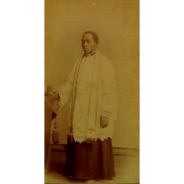
Augustine was born in Missouri to Peter Paul Tolton and Martha Jane Chisley in the year 1854.They were slaves of a white man named Stephen Elliott who suffered under the delusion that men, women, and children could be held in bondage simply because of the color of their skin. Perhaps Stephen rationalized that the men in charge had made the decision and it wasn’t his place to rebel against the status quo but, ultimately, he was a part of the problem if for no other reason than his refusal to be a part of the solution. All of this meant that their four children–Charles, Augustine, Cordella, and Anna–were born into the slavery that held their parents captive. The Elliot family was Roman Catholic and insisted upon all of their slaves being baptized into the faith of their choosing. Peter Paul and Martha Jane had developed a faith of their own in a Lord who promised liberation to those held captive and life to those who dwelt with death. Their children were raised in this faith and began to claim it as their own long before Peter Paul escaped slavery to help put an end to the heinous institution. Peter Paul joined the Union army at the beginning of Civil War and served as best he knew how to put an end to the system that so many others refused even to acknowledge as problematic. Peter Paul died in some battle now lost to the fog of history.
Martha Jane and her children–including Augustine–soon fled the land where they were enslaved and forced to work. Taking advantage of the uproar that gripped their area, they slipped away from the farm at night and began travelling for the”free state” of Illinois. When they crossed the Mississippi river she told her children never to forget the day that they had gained their freedom and, more importantly, never to forget the goodness of God to lead them out of bondage. Augustine, his mother, and siblings went to work in a cigar factory but after the death of his older brother Charles it became clear that he would need to find a better and safer life if he was going to help take care of his mother and sisters.The priest in the church they attended–Peter McGirr–took a liking to Augustine and decided to take a stand on his behalf: he admitted Augustine to the parochial school of St. Peter’s Roman Catholic church. This caused an uproar among even those who had fought against slavery–they were comfortable with freeing slaves but not freely offering equal opportunities to ex-slaves. Father McGirr was constantly berated and criticized for this decision and it indubitably cost him much of his credibility in the community but he was not willing to be complicit in a system that dehumanized ex-slaves.
Augustine received an excellent education and professed a calling to become a priest like the man who had given him a chance at a better life. He applied to seminaries throughout the United States and was rejected from each and every one. So, instead, Father McGirr talked to those he knew in Rome about Augustine received his education at the Pontifical Urbaniana University. He was admitted and received the training he needed to enter the priesthood. He became fluent in Italian, Latin, and Greek and, finally, was ordained to the priesthood in Rome in the year 1886. He returned to the United States where he tried to establish a parish in Quincy, Illinois, but he was resisted heavily by both the white and the black residents of the town. He stood in the middle and insisted that both black and white citizens were welcome in the church even as both sides insisted that the other should be outcast.Eventually, he was transferred to Chicago where he was able to establish a parish church that had over 600 parishioners. In this place they welcomed people of any color and nationality in a hope to banish the status quo of the past from the minds of men and women set free from the evils of slavery. When Augustine died in 1897 his body was taken back to Quincy and buried in the priest’s cemetery next to St. Peter’s Roman Catholic church where his new life had begun in the ashes of slavery left behind.
Read more from Joshua Hearne at his personal website and the website of Grace and Main Fellowship, the non-traditional community he ministers with.
The Candid Clergywoman: I Will Not Try to “Fix You”

My friend, Adam, and I were catching up over lunch in Onward, Mississippi, a speck on the map between Vicksburg and Rolling Fork. People usually journey to this delta community for two reasons. One is to see the spot where Teddy Roosevelt, while hunting, spared a brown bear, coining the term, “teddy bear.” The other is to visit a 100-year-old general store. Recently renovated to include a restaurant, the Onward Store is a welcome respite on a dusty road.
Adam looked up from his plate and asked, “Why did you become a minister?”
I paused mid-sip of the first Coca Cola I’d drunk in six years. Trying to buy time, I took a bite of hamburger and chewed — and chewed — and chewed. I could easily gain another minute by munching on the last five french fries. Many delays later, the best answer I could muster was playful. “Dude, don’t you read my blog? I wrote a whole post not long ago on why I became a minister.”
When Adam did not laugh or even twitch, I knew I wouldn’t be able to brush off his question with a clumsy blog promotion. I had to tell the truth.
“I became a minister because I care about people. I wanted to be a doctor of the heart.”
Adam crossed his arms and smiled. “Are you sure you weren’t trying to fix people?”
“No,” I protested. “If I wanted to fix people, I’d have gone to medical school and become a doctor. Then, at least I could prescribe penicillin to make an infection go away. I could fix the person’s body — sometimes.”
Picking up a piece of twine that had held my napkin together, I rolled it between my thumb and forefinger. “I’m in a job where I’m reminded everyday that no matter how much I want to, I can’t fix people. There’s a great freedom in that. As a minister, I don’t do the fixing. My job is to try leading people to the Fixer.”
There, along a lonely delta highway, a burden lifted. I had moved “onward” from a pie-in-the-sky desire to make everything okay. I accepted that we can’t fix each other. If we try to do so, then who’s in control? What we can do is ask God how to be instruments of his peace to one another, to create space for his Spirit to work in us and through us.
When I first started teaching yoga, in an upstairs room of my first church in Natchez, I frequently ended classes with the song, “Fix You,” by Coldplay. I would invite students to hear the lyrics as God saying to them, “Hey, I’m trying to help you. I want to heal you. I’m trying to fix you if you’ll let me. But you’ve got to let me in. You’ve got to let Me fix you.”
As Adam and I finished lunch and said our goodbyes, I tied the twine from my napkin into a makeshift bracelet around my wrist. I wear it to this day. Now, it has knots in it, and the circle widens every time I slip it over my hand. I don’t try to fix its rough edges.
all good things to each of you,
Pastor Darian
Read more from Darian Duckworth at her blog.
Zoe and Nicostratus of Rome, Martyrs, Complicit in Conversion, Guilty by Association

Guilt by association is a peculiar thing because it criminalizes not an action but a state of being. In the days that Diocletian persecuted and pursued the Church at every opportunity and every turn, Zoe of Rome was guilty by association in the eyes of the empire and Diocletian. Her husband was a man by the name of Nicostratus who was a jailer and officer within Dicoletian’s empire. Zoe, however, was mute and could not speak no matter how hard she tried and no matter how much she desperately wanted to do so. Then, one day, Zoe and Nicostratus heard that Sebastian was preaching nearby and that he had been known to heal and cure the people whom he touched and for whom he prayed. So, they went seeking life and the one who seemed to carry it with him in his words and actions.When they found Sebastian Zoe knelt before him and indicated her muteness with signals and the help of Nicostratus. Sebastian looked upon her for only a moment before making the sign of the cross over her and offering a short prayer to God on her behalf. She was healed and both she and Nicostratus became convinced of the truth behind Sebastian’s preaching. After all, the wonders Sebastian worked made it apparent that he spoke holy words of life in opposition to an empire bent on destruction and the threat of death. By taking the Faith of Sebastian as their own faith they both became guilty by association since the empire already despised Sebastian’s words and works.
Zoe and Nicostratus were soon baptized and asked Sebastian and the other Christian leaders what they should do with their new found faith. They sensed that their faith made demands of them–in fact, they wanted it to do so–but could not readily identify what it was that they should do. Since Nicostratus was a jailer and there were many Christians in prison, Sebastian insisted that he had an obligation to share his faith with them. Nicostratus sent his clerk to the prison to fetch the prisoners and bring them to the home he shared with Zoe and where they were resting currently. The prisoners arrived and listened to the preaching of Sebastian. The unbaptized Christians among them were soon baptized at the hands of the priest Polycarp. Among those who were not Christian there were numerous converts. But this audacious act of evangelism and love did not go unnoticed even though the prisoners soon returned to the prison in which Nicostratus served. The powers of the empire soon found out what Nicostratus had done and with whom he and Zoe were associating. So, they decided to arrest them and apply the pressure of their own faith to them.
They found and arrested Nicostratus with ease because he was an official within the empire. All they had to do was wait for him to show up to the prison and place him in chains to await his trial. Zoe, however, was much harder to track down. It wasn’t that she was avoiding the people she must have known would soon come to arrest her but she was not as easily known as her husband. Zoe was arrested at the grave of Peter. She had gone there to connect with the man who had been called by Jesus to feed and care for the sheep of God. She must have wanted to connect to a tradition older than herself and a man much beloved and admired by the Church of which she was now a part. When they found Zoe praying at that sacred site they knew it was her and so they took her from the grave of Peter to her own grave with a short detour for a sham of a trial. At the trial, they both bravely confessed their faith even when promised forgiveness in return for their apostasy and threatened death if they refused. Though Nicostratus was only beheaded because of his former service to the empire, Zoe was hung by her hair from a tree branch and slowly roasted over a fire. Both died with forgiveness and mercy on their lips and both bodies were thrown into the river so that the empire could try to forget about yet another couple who had chased after life even if it meant walking through imperial death.
Read more from Joshua Hearne at his personal website and the website of Grace and Main Fellowship, the non-traditional community he ministers with.
A MennoNerd Conversation

Robert Martin, one of my fellow MennoNerds, and I had a conversation recently on a topic that has divided conferences and congregations across our denomination (Mennonite Church USA). We come from different perspectives and opinions on the topic but felt it was an important conversation to have and to share. Follow along as we try to carefully find our way through this emotionally charged topic.
Robert: I will have to confess that I feel very intimidated broaching the topic of homosexuality. I realize that, in some ways, my viewpoint is unpopular. And it is one that, at times, seems to draw some sense of attack, at least in my experience and what I’ve witnessed. I know that some people may call me a “hater” or a “homophobe” because of the way my position has been expressed in the past. And I really don’t like the way my position has been expressed. It certainly has not been full of love. And that grieves me, really, that folks that I agree with on a point make me ashamed of my position. So, it’s with a lot of trembling that I want to talk with you about this.
Jennifer: Since we are confessing, I must admit my own fears. It seems many assume that Christians who don’t share the view that homosexuality is a sin have simply thrown out the Bible and want to rewrite the tenants of the Christian faith.
Robert: And those who do have that view sometimes seem to get labeled as if we are going against the God of love and the gospel of grace, mercy and compassion.
Jennifer: So why is it that we aren’t able to come to the table and actually discuss these fears with each other more often?
Robert: I wonder if fear is, overall, the reason behind even that? Both sides seem to feel the need to defend, to stand up for a principle, and to make sure their voice is heard and not suppressed. I fully recognize that there are those who share my view who have contributed to the fear of those who affirm homosexuality. And so, those in my “camp” (and I hate making that reference), add to this fear while they, too, live in a sense of intimidation by opposing voices. And so fear divides us. Does this ring true with you?
Jennifer: You know, Chuck Neufeld, Conference Minister of the Illinois Mennonite Conference wrote a song last year, “I Can’t See What You See From Where I Stand.” Part of the chorus is “I can’t see what you see from where I stand / You can’t see what I see from where you stand / If we just stand together / Might we just brave the weather? / You got to look to see — you and me.”
Robert: Wow.. that’s pretty deep.
Jennifer: I’m glad that we are taking steps to stand together. It seems from our conversations before that we are both troubled by the sense of “issue” here and are more interested in the people that end up in the crosshairs. Is that accurate?
Robert: I think so. Why is homosexuality the “poster-child” sin? Why is it the issue that must be solved? That seems to be the question in my mind, especially since there are so many other sins that we could just as easily talk about. Divorce and remarriage, for example, is one that occupies some congregations. Meanwhile, there are human beings that get lost in the shuffle. It seems, sometimes, that as much as we are a church denomination that aims to be different than the world that we still tend towards the same polarization that characterizes the world around us. Is there a way through this which remains faithful to Jesus’ message of healing and compassion but stands counter to this division? What do you think?
Jennifer: It seems that if we set aside the sin/not-sin debate, we would see a lot of people who have been deeply hurt. Whether by a society that likes to place labels on people or by those in the church who have been yelling loud messages of hate, there are many in the LGBT community who have heard a message that they aren’t wanted. It seems that the message of Jesus is that we are to love one another. Are there ways we can do that with one voice?
Robert: One of the ways I’ve seen proposed, as you said, is to be very careful and cautious about the labels we use, even when it comes to characterizing our communities. Even the terms “affirming” and “not-affirming” have already been co-opted into the debate as representative of the two sides and so end up continuing the polarization. What if, instead of explicitly taking a stance, we simply stood by the Christian witness of hospitality, of being welcoming and allowing people to come as they are and know that there are folks who see them as human beings, worthy of love?
Jennifer: It seems one of the potential disadvantages we have in this conversation is that we are both straight. I think it is important to make sure we are listening to others—for instance, does our hospitality feel hospitable?
Robert: Yes, that is a disadvantage. Listening to the other is important and I think we do far too little of that. David Fitch and Geoff Holsclaw in their book “Prodigal Christianity” make this, actually, their 9th signpost. Relationship is important in this conversation (as well as in any others we might have) and we can’t really have relationship if we keep people at arms length. Welcoming has to be more than just opening the doors and let them occupy a pew. An attitude of mutual transformation is how those two authors phrase it. There is a recognition that, even in a “non-affirming” congregation, both sides will be changed and transformed into a closer image of Christ by exercising full hospitality.
Jennifer: I think that is part of the definition of relationship. If we are not changed by our encounters with someone else, are we really in relationship? Or are we just making someone else a project? There has also been a mistaken sense—on all sides—that all LGBT individuals share a common view or fall on a common “side.” Justin Lee, executive director of the Gay Christian Network does a great job of representing the variety of viewpoints held even within the gay Christian community—from those who believe that committed same-sex relationships can be part of God’s plan to those who believe that they must remain celibate in order to follow what God wants for their lives. It becomes important to make sure that we invite all into the conversation.
Robert: I think that before that can happen, we need to take a step back out of our positions and find a common ground. Something that I hear you saying and that I have heard from others is that there is a need within the conversation to have a loving, servant, Christ-like position. We cannot hold people at arms length because we think they are sinners. Even if, somehow, Mennonite Church USA resolves this one issue, there will always come another one. And we will end up polarized then, too. How can we invite all into the conversation when, as we are carrying on our debates, we are creating a wider and wider chasm between us? It feels, sometimes, that there are some of us in the middle of that chasm who get lost as the efforts to be heard continue over our heads. That is where I feel I am at times. Can you relate to this feeling?
Jennifer: Certainly. And I wonder if the trouble is that while the wider conversation takes place, we see the need for ministry in our communities. I can’t help but think of all of the school bullying that ends up in the news. While bullying isn’t limited to those who are gay, gay individuals are certainly targets. It seems that MCUSA, as a peace church, has a responsibility to look at the ways our debates play out in the culture around us. Does the way we discuss certain topics aid—or fail to discourage—a culture of violence?
Robert: I think that the debate has become more about position and less about people. While you and I may disagree on the sin/not-sin position, as a follower of Jesus who asked, “Where are your accusers?” or told the woman washing his feet “Your faith has saved you. Your sins are forgiven” it seems that my first duty would be to show love to others, not hate, and to bring them that grace and mercy that our culture seems to be lacking. Personally, when it comes to the work of the church, I think this is much more important than the debates that rage in our conferences and denomination. What do you think?
Jennifer: I think we may also need to recognize ourselves as the ones who are standing to accuse. We are the ones who are so-often holding the stones, at the ready to throw. In order for us to be more like Jesus, we must not only put down our stones, but seek forgiveness for the sin of holding them. I need forgiveness from you, with whom I have disagreed, and from my LGBT brothers and sisters. I need forgiveness for the times that I have been unwilling to sit with those who are different from me and learn from perspectives that are not my own. I need forgiveness for the times that I have allowed violence—both physical and the deeply-cutting emotional—by not standing against it. Perhaps that is where I must start. Will you forgive me?
Robert: Cliche as it may sound, I don’t think I could call myself a Jesus follower if I didn’t. In return, will you forgive me my judgmentalism and for those times when I’ve put being right ahead of the bond of filial love?
Jennifer: You got it, Captain.
Robert: Ahead warp factor 3, Commander Harris Dault…let’s see what this baby can do…
Jennifer: Dear Lord, help us all!
Robert: Hey, we wouldn’t be MennoNerds without some sort geeky reference…
Jennifer: Fairy Nuff (*term stolen from Robert)
Read more from Jennifer Harris Dault at her blog.
Christ for All Creation: Why Now?

“That the arc of creation does not match the arc of redemption is a big problem in Christianity.” (Larry Rasmussen – Festival of Faiths, Louisville, Kentucky 2010)
The fact that you are reading this paragraph must mean that you have some interest in the issue of environmental crisis and the response of the Christian faith. You may be a skeptic, a newly open seeker about this issue, or a full-fledged member of the environmental choir. In any case, it is hoped that you understand the importance of this topic for the church, for good or ill.
You are part of a rising tide. There is a growing interest and consensus in faith communities that our present day environmental realities do indeed involve issues of faith, morality and spirituality, and therefore demand a response from the church as the church. But just what that response should be is not so clear. As you have probably already experienced, this issue can quickly lead to conflict within churches. Opposition can range from open hostility through suspicion to unease.
Why this, Why here, Why now?
Within the debate is a set questions often asked by the church and of the church: “Why this talk of the environment within the walls of the church? Does this belong here? And with the many pressing issues without and within, is this the time for it?” These are valid and serious questions, so let us begin by granting them serious consideration.
“Why this?” is a hard question to respond to, since there is little consensus about what this “this” is. What does one mean when referring to the “this” knocking so persistently at the church door? What is the nature of “this” issue and what is it asking of the church?
For some, the “this” is thinly veiled idolatry or paganism. For those whose faith has taught them to distrust the things of body and earth, the “this” is a distraction from the root work of getting to the post-earth, post-body heaven that is the central concern of God. For them, body weighs against spirit and spirit against body, and a body/spirit competition is a zero sum game. The more you care about the body, the less care remains for the spirit. The core work of salvation, then, is to become free from worldly concerns and therefore become more spiritual. For them, calling the church to environmental care is a distraction about lesser things. The “this” is seen as a temptation to the church to be resisted and overcome.
For others, the “this” is secular environmental activism – a largely political effort that has been on the public scene for forty years or so. This scene has been experienced as dominated by the likes of Greenpeace, the Sierra Club and the various “tree huggers” who have been carrying out their activities without (and sometimes against) the church. Often these activists with their political agendas are seen as simply wanting to recruit church members to the service of their cause, with little concern for whether their cause is actually germane to the church or to the faith. They simply see the church as a ready-made pool of recruits for political activism, with little care or respect for who and what churches are. The “this” is seen as a political manipulation of the church to be deflected.
For yet others, the “this” is a practical and worthy cause among many causes. For them, environmental problems are serious and real, and deserve the good efforts of those who find it their calling to serve such a cause. Environmental injustice is another form of injustice to be responded to, just as are feeding the hungry or advocating for all victims of social injustice. They agree with the Sierra Club that the “environment” is a social problem that deserves advocacy and social organizing – along with the many other causes that deserve advocacy and action. Since the church is a diverse place with many gifts, it is natural that some would choose the environmental cause as their particular gift and calling. The “this” is a cause to be added to the various ministries of the church – one on a long list of worthy causes that deserves a portion of church attention and resources.
For others, the “this” is good economic and common sense. Good stewardship, energy efficiency, recycling and the like are all wise and helpful things to be doing, and the church should be embracing them. The environmental crisis is a sign of poor stewardship (at least as far as the church has any role in it), and poor stewardship should be corrected with good stewardship. However, since this is an issue of poor judgment and neglect about material resources, the issue has no place in the church’s life of worship, prayer, evangelism and mission. The “this” is crisis of poor management, about which the church can correct its course.
Sometimes you can get a hint about how your church views the “this” by how its response is incorporated into the church structure and budget (if at all). If it is not allowed any placement or budget, perhaps the “this” is seen as a threat or distraction. If it is part of the social justice committee, perhaps it is seen as a cause for eco-justice. If it is part of buildings and grounds or stewardship committee, perhaps it is seen as a problem of stewardship.
A Need for a Deeper, More Holy “This”
But none of these definitions of the “this” is going to move the church into an adequate response to the environmental realities before us. Because behind each of these definitions is a common assumption: That human beings are the sole recipients of God’s attention in creation and the solitary actors in God’s unfolding work. In other words, these are responses that act as if planet earth is but a stage upon which God’s human drama is being played out. As a result, each of these definitions fail to place environmental issues within the historical central concerns and work of the church: holiness, justice, love, worship and salvation.
What the church needs is a way to keep on being the church and still find within its traditional self the ways and means of responding to this issue of environmental health and wellbeing. The church needs to find a way of owning the “this” as a something that fits clearly into the ways and means the church has always claimed for itself as core to its being.
Our destruction of nature is not just bad stewardship, or stupid economics, or a betrayal of family responsibility; it is the most horrid blasphemy” –Wendell Berry
What Wendell is putting his finger upon perhaps points a way forward for placing the environmental crisis into the heart and center of the Christian church: the worship of God with all our heart, soul, mind and strength. The “destruction of nature” Wendell refers to can serve both as a call to stewardship and justice, but also as a mirror reflecting the fundamental spiritual disconnects between our souls and God’s coming kingdom. Naming “this” as a blasphemy extends to the church an invitation to genuine repentance and a pathway for restoring a relevant form of Christian holiness and discipleship that reflects a whole hearted participation in God’s unfolding work of reconciling all things to Himself.
The depth of the problem is well articulated by Thomas Berry:
In our present attitude the natural world remains a commodity to be bought and sold, not a sacred reality to be venerated. The deep psychic shift needed to withdraw us from the fascination of the industrial world and the deceptive gifts that it gives us is too difficult for simply the avoidance of it difficulties or the attractions of its benefits. Eventually, only our sense of the sacred will save us.
What the church needs are ways seeing the salvation of all creation as the work of Christ in the world, and of including the “this” into the very work of being Christ in the world, and not simply one more agenda item which demands from the church precious and limited heart, soul and resources. What the church needs are ways to incorporate into its language, worship, prayer, education, ministries and service the shared work of Christ’s redemption and reconciliation of all things, in the heavens and on the earth. What this means is that that we need to begin to address these issues in the terms most central to the Christian faith: Repentance, worship, redemption, salvation, obedience, holiness and the like.
With the state of the Christian church in Western society being what it is, and with an aging and declining membership operating in a society of growing numbers claiming “none” as their faith tradition of choice, the church has its hands full just figuring out how to have a future. If those of us with environmental concerns approach her with yet another problem to solve or as simply a bottomless pool of time and resources to recruit for yet another cause (especially one of such magnitude as climate change, food justice, toxics and mass extinctions), our appeals will continue to fall upon deaf ears. Rather, we need to help the church make the spiritual connections between what is happening to our natural eco-systems and what is happening within her own pews. In other words, we need to make connections between church life and God’s plan of salvation. This needs to become Good News.
The Rev. Jerry Cappel is the Environmental Network Coordinator for Province IV of the Episcopal Church. Learn more about Jerry at his website and blog.
Follow Us!