
Have Mercy On Me

I’ve seen a lot of cartoons going around facebook today explained Good Friday. There is a B.C. cartoon where one character asks the other why the day is good. The response is “If you were going to be hanged that day and he volunteered to take your place, how would you feel?” The response was “good.” So there you are.
My gut reaction was to think “I wouldn’t feel good, I’d feel guilty.” I’ve seen the cartoon posted several times, and each time something would just rub wrong. It wasn’t until the middle of our Good Friday service tonight that it finally clicked . . . no one ever wanted to hang me.
Jesus was killed because of the things he taught, because of the life he lived. He was dangerous. He spoke out against the Roman government, and he acted in defiance of the religious leaders. He gave authority to the outcasts and sinners. He listened to women and empowered them to lead. He healed those who had been suffering, gave sight to the blind, and called back those who had been dead. He spoke of a new order where the last shall be first, where the oppressed shall be free, where the poor shall not want. He spent his time with the unclean, but had a voice that compelled the masses. And as the Low song states, “if you were born today, we’d kill you by age 8.” Dangerous people make enemies. And Jesus had many. He was put to death because he needed to be silenced.
I, on the other hand, am far too timid to be dangerous. After all, in his last days, Jesus said “those who love their lives will lose it.” As it turns out, I have loved my life. And because of it, people haven’t needed to kill me. I have died already in my apathy.
Jesus didn’t volunteer to die in my place; rather, he invited all of us to follow him to the cross. We are to stand alongside him and call out the places of injustice. We are to stand with those in pain. We are to hold up and cry with those who weep. We are to lead the sort of dangerous lives that make us targets to the powers that be.
If Good Friday doesn’t make us call out “Lord, have mercy on me,” then we’ve somehow failed to read the story of Jesus’s life and death. Because we are in no means off the hook, merely indebted to a God who would sacrifice God’s own life so that we don’t have to die. No! We are to take up our crosses and march right there to Golgotha. And lest we think ourselves righteous enough to say that we do that, remember that even Jesus was sweating drops of blood in the garden before he was betrayed. This isn’t easy or light. It literally requires our lives. We are to die with Jesus.
And that’s where I have failed.
When I hear of human rights atrocities around the world and walk away, I let Christ die alone.
When I hear of sex trafficking in my own state and think “well that’s too bad,” I let Christ die alone.
When I see hungry people on my street, but have dinner privately in my apartment, I let Christ die alone.
When I hear statistics about the number of people in American prisons and don’t ask questions, I let Christ die alone.
When my gay brothers and sisters are killing themselves to end the bullying and hatred, I let Christ die alone.
When people die of preventable and curable diseases, I let Christ die alone.
Because you know what? I believe in the Kingdom of God. I believe that the way of Jesus is good news. But I live as if I love the Empire that oppresses. Jesus Christ, have mercy on me.
Good Friday is no good if we walk away thinking ourselves righteous. Good Friday is only good if it motivates us to pick out our nails and get involved in giving our lives to the things Jesus lived for — to the things good enough to die for.
Read more from Jennifer Harris Dault at her blog.
Easter Flowers

I drive through town
Going to my office
Catching up on what was not done
This past silent Friday
The trees on the roadside
In yards I pass
Heavy with blossoms
Purple
Pink
White
The Easter flowers
leave their cars
Women in spring colors,
Brighter and more varied
Than tree born blooms
Men
More somber in suits
Ties
Splashes
Slashes
Of color
The occasional bowtie
Peeping out
Beneath a double chin
I slow and stop to let them cross
These flowers of the season
I see them orbit full church lots
Looking for a place to park and alight
A Jew passing through a small southern town
My home
My place
Always comfortable
But sometimes
Separate
Which separateness is holy?
Which profane?
Can not both be holy?
I wonder,
As the occasional head
Turns
Follows my slow path
Down the street
Avoiding the riotous spring colors
As they walk to various churches,
Are they surprised
On this holy day?
Are they like me on
Yom Kippur
Looking out from the door of the sanctuary
Shocked that the world is not still?
Holding its breath?
Awestruck on an awesome day?
I take joy in the spring flowers
Planted and nurtured by The Gardner
The Gardner who planted and nurtured me.
I smile and take comfort
I am lifted up by the reflection
How lovely the outward colors of spring
How greater the beauty
I know
Must lie within.
So this is Holy

Like most in the church world, I’ve been absorbed by Holy Week. Since my church staff position is as administrator, I have the fortunate position of being busy, but not so busy that I don’t have time to stop and reflect along the way.
Our journey to the cross is almost over. Our sights are on it as this is the night that Jesus will be betrayed. As Bob Goff pointed out, this is the night that Jesus chooses to eat his last meal with the person he knows will betray him. This is the night when he will break bread and pour wine and wash feet. It is the night when hope begins to die.
I can’t help but wonder what it means that this is the week in the church calendar we have called holy: a week wrought with grief and pain. Why not start holy week with Easter so it can be a week of rejoicing? Wouldn’t that seem more holy? Or perhaps the week when Jesus was born. Those precious moments when mother and son are bonding, with Mary realizing that she is caring for the very son of God. Surely that is holy. Or what about Pentecost when the Spirit comes down in tongues of fire? Now that is holy AND exciting.
But it is here –here in our despair, in our loneliness — that the church has seen fit to use the term holy. If there is to be comfort in this time of waiting, in this time of sorrow, it is that our hurt is not separate from God. This, too, is holy.
Read more from Jennifer Harris Dault at her blog.
The Enemy at the Table

A sermon preached on John 13:1-20
Easter is just around the corner and we all know the importance of that day; but it is not Easter yet. It is Maundy Thursday. We are with our Lord, gathered for the Last Supper we will have with him prior to his arrest and crucifixion. We would do well to remember that those closest disciples, so glad to be with him that night, were absent from the next day. The question we must face is: How different are we from them.
I don’t know about you, but I always find it comforting and encouraging to gather around the Lord’s Table. In fact, one of my favorite images of heaven includes being at the banquet table with Jesus and all the saints.
I suppose my pleasure of being at the Table and my image of heaven comes in part from memories of all the joyful gatherings with friends and family around a variety of tables. In particular, I recall those Thanksgiving gatherings at my grandparents’ home with uncles and aunts and cousins present. Then there were those most pleasant times when it was just me and my grandparents. In addition, Donna and I have fond memories of sharing at table with our friends. Such good times those were, and are!
What could be grander than being at the Table with Jesus! He is our All in All, our Lord and Savior, and our Ever-Present Comforter. How grand it is . . . except when it isn’t.
On that night long ago, those gathered with Jesus were anxious. They all had a sense that things were going wrong. Earlier, they had tried to dissuade Jesus from going to Jerusalem. They had seen enough to know what he knew—that there were those who wanted him gone and were willing to go to extreme lengths to make it happen.
Perhaps there was some sense of peace and safety in the room in which they had gathered. Surely there was safety behind the closed doors. Perhaps things were not as bad as they seemed. After all, Jesus’ entry into the city had been greeted with shouts of “Hosanna.” Crowds had welcomed him. Perhaps their anxiety was misplaced.
If the response of the crowd could be believed, maybe it was only a matter of time before all would see who Jesus was—the One who came “in the name of the Lord, even the King of Israel!” The first sign of trouble came from Jesus himself.
They had finished their meal. Jesus arose from the table, took a towel, filled a basin with water, and began to wash the disciples’ feet. There was nothing unusual about guests having their tired, dirty feet washed; but the host didn’t do it. The host saw that it was done. Certainly, Jesus, the soon-to-be-seen King of Israel, should not being doing it.
Peter voiced what all of them must have thought. “You shall never wash my feet.” Do you recall Jesus’ response? “If I do not wash you, you have no share with me.” Peter said what perhaps we feel, Ah, Lord wash all of me. Jesus must have smiled as he replied to Peter and to us, “If you’ve had a bath in the morning, you only need your feet washed now and you’re clean from head to toe. My concern, you understand, is holiness, not hygiene. So now you’re clean.”
Peter, perhaps as do we, missed what Jesus meant. In that one statement, Jesus declared his mission—the mission of once and for all washing away the power and the penalty of sin. You are clean, Jesus was saying. You are with me. You just need a little freshening up.
There was one present who was not clean, who had apparently never been clean though he had traveled with Jesus and the others. He had been in Jesus’ presence but was not in relationship with Jesus, was not of Jesus. Were the story to end here, it would be a nicer, cleaner story. But it doesn’t end here.
Jesus has more to say. What the disciples see him doing—serving them—they are to do for one another. In Jesus’ fold, there are no super disciples, only servant disciples. At his Table we are served by him, but from his Table, we are to serve others. It’s always been hard for us to grasp this ministry of service.
Then there was the most damning statement of all. “He who ate my bread has lifted his heel against me.” This is bad enough—that one of the twelve is a traitor. Yet, if the story could end here, it would be a nicer, cleaner story.
On that night, what was to happen had not yet happened. Those gathered there that night could not know what would follow and that they all would exit the stage, leaving Jesus to face the passion of the cross alone. They couldn’t have known, but we do.
Knowing what we know, we dare not come to the Table too full of Jesus’ words “. . . you are clean.” Those who had left everything to follow him left him that night. Are we all that different from them? When following Jesus becomes difficult, dangerous, controversial, and threatening, will we stay the course?
Come and eat. This is the Body of the Lord. Come and drink. This is the blood of the Lord. Body broken and blood poured out results in sin’s power and penalty being removed.
We come to the table; but before we do, let us take stock of our relationship with Jesus. Let us confess our sins, and let us invite Jesus to wash our feet, to freshen us up.
We dare not do otherwise. On that night long ago there was an enemy at the table. There was, in fact, more than one. There may still be more than one.
Well . . .
Feast of Masks

For Sandi Cohen, who asks difficult questions
We ask
What is the mask you wear?
What is the mask I wear,
What is the mask we show ,
Only each to herself.
The scholar said,
We never show our face
To another
Only some mask
We hide behind illusions
Another scholar quips
We do not even show
Our faces to ourselves
Self-deception
Inner masks and outer.
I contemplate
What is my mask
What is this face I show
The world
My friends
Myself
I ask
Are we all really so dishonest
To each other
To our friends
To ourselves?
Consider the gem
Shining in the light
We see
One facet
One face
Is the gem deceiving us?
It is true
We do not see the whole gem
Only this facet
Or that
But surely it is truly the gem we see
Merely not all of it.
Within our skins
Resides
A parliament of persons
We are never just one thing
One person
As the gem, we bring forth our different facets
Our different faces
We are always both/and
How impoverished to be merely either/or
The mystics
With their tree of aspects
Are just as anthropomorphizing
As the rest of us poor idol builders.
We are all Aaron
Pouring gold into the flames of our need
The calf just comes out
Or
Whatever graven image satisfies
In naming our limitations
Of understanding
Understanding The Holy
“We can only see aspects,
Never The Whole
Of The Holy”
We rehearse a description of the sephirot of our souls
Recapitulating the structure of ourselves
As the Image of The Most High
We put forth our constellations of self
In partsufim of presence
A dance of our inner aspects
As the face we present
Present to the world
To ourselves
To Our G-D
Some will say
As our scholar above
We are liars
Because we only present parts
Aspects of our selves
But we show who we really are
Who can encompass a whole
Even of the least of things
Some will insist that we must
We must peel back the layers
The layers of our presentation of self
Remove mask
After mask
After mask
As if
The masks were not also
Truly ourself
But we find,
As when we peel an onion
In the end
When
Layer
After layer
Is removed
All that is left
Is
No Thing
A bit of that which is
Which is
Without end
Ein Sof
The spark of The Infinte
The heart of the Image
From which
We form
Our image
And from
Our image
To our idols.
So, perhaps,
We do not sin too greatly
Standing before the creative fire
Wielding the hammers of our longing and desire
And when we face another
With the face we are wearing
What choices do we have?
Shall we not seek
To put forward the face
The face of our best self?
Do we not wish to smile kindness
To gesture compassion
It is not a mask
It is not a lie
It is who we are
It is the voice
From the chorus of self
That we want to lead
That we want to set
Set the melody,
Call the rhythm
Choose the harmony.
When we see another’s face
And there are blemishes
Recognize the pain
That puts that face forward
Put on a gentle mask
Just because a gem’s flaw
Can be seen through one facet
Does not diminish its
Unique and infinite worth.
So we ask
What is your mask?
What is my mask?
And I answer
We each show our face
But we each have many faces
Each a part of the whole
We strive to put on a good face
Not to deceive
But because we seek to be good.
We cannot encompass in understanding
A grain of sand
A breath of air
A glimmer of light
How then
A human soul
Including
Each of us
Our own
How then
Shall we see
Let alone
Understand
The Breath of Creation.
Patrick of Ireland, Slave, Bishop, Missionary
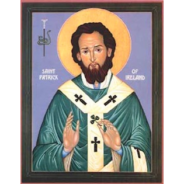
Patrick’s father was a leader in his community and was named Calpornius. He was a deacon in the congregation they attended in Wales. Calpornius’ father–Patrick’s grandfather–was named Potitus and he was a priest in the area where they grew up. He offered the sacraments and mysteries of the Church to those who had ears to hear and eyes to see. Patrick had roots within the Church and found himself drawn to the ministry that his father and grandfather had likewise felt themselves called to. He was receiving an education that would likely end up with him becoming yet another member of his family in service to the Church when one day he was kidnapped by Celtic bandits and slavers on the Western coast of Wales. They forced him into chains and carried him back aboard their ship so that they might force young Patrick–only sixteen years old–to work for the highest bidder. In this case, he was bought by a man who made him a shepherd by trade. Patrick ended up on some lonely hillside–a stranger in a strange land–watching over sheep that were not his own.
For his six years as a slave to Celtic leaders he was mostly in isolation on some verdant Irish hillside. Since he was alone as he worked he began praying to himself. He began with the prayers he had learned as a child and these expanded into his own spontaneous prayers. He sang songs and hymns to sustain himself as he spent many lonely night with only sheep and goats for company. Finally, he began to hear God speak of liberation and escape. He heard a voice saying he would soon be free. A few days later a voice told him his ship was waiting for him and so he fled from his master that very day. He travelled for some time and through harsh conditions until he arrived at a port in eastern Ireland (200 miles from the place of his captivity). He boarded the ship and finally returned to his home in Wales. They greeted him with joy and gladness and toasted his return but after the parties had faded Patrick came to the stunning realization that he had missed six years of his life. All of his peers were well into their professions and careers and he had fallen woefully far behind in his education. His dreams of becoming a minister like all of the others had been shattered aboard the slaver ship that had stolen him away.Patrick ended up in the home of family–a stranger in a familiar land–watching his friends go on without him.
He didn’t know what to do with his life but he couldn’t shake the strong calling he felt upon his life. As he was adrift in his life and uncertain how he should continue he had a vision. In the vision a man named Victoricus came striding across the Irish Sea toward Patrick. In Victoricus’ hands were many scrolls. Each scrolls was a letter–written to a certain person–and he was handing them out to those God had called to serve. Patrick waited eagerly in his vision and received a scroll titled “The Voice of the Irish.” In it he heard the laments of the Irish people who begged the former slave to come back and bring the Gospel that taught love for enemies and forgiveness from all sins. He must have wondered if this wasn’t a mistake to be sent back to the people who had enslaved him as a missionary. Yet, as he reflected upon the vision he became more and more certain that God was calling him to be a missionary to the Irish. So, he went–one of the first Christian missionaries to leave the Roman Empire. Patrick ended up in some foreign boat on his way back to Ireland–a stranger crossing the Irish Sea–following after a calling that God had given him.
Patrick baptized thousands of people in Ireland as he brought his own particular style of preaching and teaching to them. He did not have the same education as his many peers and colleagues but he knew well the people he had been called to serve. He confronted Celtic warlords with bravery and courage knowing that they would respect him for it and want to know what faith he held that gave him such courage. He brought the faith to the Irish in a way that mediated the sacraments and mysteries of the Church to a people unfamiliar with the history and symbols of the Body of Christ. Patrick became the vehicle by which the grace of God was translated into Irish hearts. He ordained thousands and became a bishop missionary welcome in countless homes throughout the hills of Ireland. Patrick ended up in the land of his enslavement–a hero in a beloved land–watching over sheep that had become his own.
Read more from Joshua Hearne at his personal website and the website of Grace and Main Fellowship, the non-traditional community he ministers with.
Insight From Isaac (And His “Scary” Water Cooler)

Some dogs are afraid of bad weather. Others tremble in the presence of dogs bigger than themselves. I’ve seen many who are fearful around strangers.
Then there’s my dog, Isaac, whose greatest fear is a somewhat-inanimate object.
I was very excited when Isaac inherited his “puppy water cooler.” It kept a large supply of water so that I didn’t have to refill his bowl constantly. Gravity-controlled, the water bowl would automatically refill from the cooler. On top of the convenience, it’s a cute conversation piece.
Little did I know how much conversation would develop over a seemingly innocent invention.
One evening, as I sat on the couch and Isaac went to the cooler for a drink, I suddenly heard a gurgling sound. Before I could say anything, the 50-pound lab had leapt onto the couch, was trying to climb in my lap, and shook in fear. That was my first, not-so-subtle clue that Isaac was scared of the water cooler. When the water flowed from the cooler to the bowl, it made this sound that, to Isaac, was worse than a thunderstorm.
He began to avoid the cooler unless desperate for a drink. He has a smaller, plain water bowl outside that keeps him well-hydrated during the day. I’ve caught him trying to drink rainwater from the street when we’re out walking. But on the rare occasion that the cooler was his only option, he would stand as far from the cooler as possible, stick his tongue out as far as it would go, and lap water from the sides of the bowl. Any little sound of the water would make him jump back. Then he’d ease back in to risk another sip. This has gone on for as long as five minutes at a time. I’ve contemplated making a video to send in to America’s Funniest Home Videos (is that show still in production?). But I don’t want my dog to grow up to resent me.
All fun aside, I have tried to reassure Isaac that the cooler is harmless. I’ve removed the cooler and just filled the bowl-base with water. He still avoids it. Of course I’ve tried explaining to him that there’s nothing to fear. All that “conversation” got me was a lick on the face. One day, I finally accepted the fact that Isaac will just have to learn for himself the harmlessness of the water cooler. I’ve also accepted that this fear could last for a while.
Sometimes it’s easier for us to recognize other people’s fears than to acknowledge our own insecurities. We desire for the people and pets we love to let go of their misgivings. But we can’t take the fears away. We can’t set each other free. We have to trust that our Isaacs will realize their fears are unfounded. We sometimes have to wait for people to embrace the freedom of letting go of their own worries.
So, if a person we love is consumed with worry and anxiety, what can we do to help? Paul’s letter to the Galatians instructs the young Christians to do the following: “share one another’s burdens, and so fulfill the law of Christ …. Don’t be impressed with yourself. Don’t compare yourself with others. Each of you must take responsibility for doing the creative best you can with your own life” (Galatians 6:2-6, The Message). If you want for your friend to let go of his or her worries, go ahead and ask God of what you need to let go. As we seek peace in our own lives, others will be attracted to that sense of security we emanate. As we offer to help one another, to share each other’s burdens, to pray for each other’s worries, we help to lead each other to freedom. We can’t change each other, but we can change ourselves. And as we change ourselves, we’re more able to help one another.
Perhaps one of the greatest gifts we can offer each other is patience: to give people time and space to let go of their fears. I can tell Isaac all day long that the water cooler won’t hurt him, but he has to experience that revelation for himself. In the meantime, I love him and comfort him. I try to make his water-drinking more comfortable. I believe that one day the dog will no longer extend his body and tongue in “downward-facing dog” just to quench his thirst. But I have to let him let go of that fear. I can’t let go of it for him.
This week, friends, take time to listen to someone’s anxieties. And take time to ask God about your own fears and how you might let them go. Let us move towards embracing freedom that we cannot create for each other. Instead, let us lead one another to that freedom as we let go, let God, and take a big sip of his Living Water, which is fear-less.
all good things to each of you,
Pastor Darian (and Isaac)
Read more from Darian Duckworth at her blog.
Well in a Not-Well World

Once upon a time, filled with youthful enthusiasm and naiveté, I believed that one day I would finally get life right . . . that my life would be fully on target . . . that I would be the person God intended me to be.
There is nothing like adulthood to take care of youthful enthusiasm and naiveté. My life is not always on target. In fact, there are days when I can’t even see the target. As for being the person God intended me to be, this too, according to the standards of the young man I once was, eludes me.
Realizing this, I marvel that I am not in deep depression and suicidal. I might be, were it not for one important discovery. As a youth, not only did I believe that one day I would get all of life right, but I also believed that in doing so all would be right with me and with my world. Believing the latter has made the journey toward the former almost impossible.
All is not right with my world, and all the believing and all the faith-having I can muster will not make it so. Coming to Jesus will give me salvation, but it will not make all things right. Following Jesus will lead to my becoming more than I could otherwise become, but I will still face difficulty from the normal ravages of life, and I will face other difficulties because of the choice to follow Jesus.
I give thanks that I’ve lived long enough to discover this about myself and about God. I am a more contented follower of Jesus now that I know I still haven’t got it all together. I am not content because I haven’t got it all together; I am content in spite of the fact that I haven’t.
God’s invitation spoken through Isaiah means so much more to me today than it did in my youth. “Come, everyone who thirsts, come to the waters; and he who has no money, come, buy and eat! Come, buy wine and milk without money and without price” (Isaiah 55:1 ESV). I may not be all God intended me to be, but I am at God’s table. I am refreshed and nourished. And, in spite of all I am not, I am God’s child.
How is it possible for me (and folks like me) to miss the target so widely and still be the recipient of God’s grace? It is possible because God says, “For my thoughts are not your thoughts, neither are your ways my ways” (Isaiah 55:8 ESV).
In Christ, I am more than I might ever have been because I heard and responded to God’s invitation to drink and eat at God’s table. Refreshed and nourished at God’s table knowing that Easter is coming, I face life as it is. Easter is coming . . . death will be defeated . . . and youthful enthusiasm and naiveté will give way to realized hope—Jesus lives and all is well, even in a not-well world.
Katrina Recollections: Darla Digirolamo LeBlanc

Editor’s note: The following is an excerpt from Bert’s upcoming book: Jungian Jambalaya: A Hurricane Katrina Oral History. If you like it, please show your support at the project’s Kickstarter page. The link is at the end of the article
________
I honestly don’t remember when I met first Darla or her family. I was ten years old – that much I know for sure because that’s how old I was when we moved to Destrehan, and when we started attending the First Baptist Church of Norco. Darla, her sisters, and her parents were active at FBC. Darla’s family and my family got along well; being some of the few Tulane Green Wave fans sprinkled among the throngs of LSU Tiger fans, we bonded together in our suffering (and our occasional celebrating). Long after my parents moved my sister and me to West Tennessee, we would bump into Darla’s parents at Tulane road games; even after I was married with kids of my own, there was Mr. Nick at the 1998 Liberty Bowl in Memphis cheering along with my parents, my son and me as Tulane went undefeated – a perfect 12-0.
Mr. Nick was 80 years old and still going strong when Katrina hit. He passed away three years later in 2008. Mrs. Myrt is still, in Darla’s words, “a power-house.” Darla, a middle school teacher in Luling, has lived in St. Charles Parish her entire life so far, with the exception of her college years spent at, well … LSU.
Tell me about the week leading up to Hurricane Katrina.
The week before Katrina, I was dealing with my husband (Michael) being asked to go to Florida to work – Katrina was about to hit the lower part of Florida before going into the Gulf…. He began working at the Emergency Response Center for the state of Florida where he received first-hand information about the hurricane track. He – who never evacuates for hurricanes – was telling me that we needed to evacuate.
As soon as I got the call from school on Friday stating that school would be canceled for Monday and Tuesday, I was ready to go. Saturday morning, around 5:00 a.m., I called my mom and told her to get ready to go to my sister Deena’s house (she lived in League City, Texas)…. Like Michael, she never wants to leave her home for hurricanes, but for some reason she knew that she had to go for this one. While the kids slept, I moved all of the patio furniture into the garage along with anything that I thought might get picked up by the wind.
I didn’t take any photos or any sentimental things with me. I packed very lightly, loaded up the kids and my twelve-year-old sheltie, picked up my parents in Norco, and headed for Houston, Texas. We had no problem getting to my sister’s house in League City – we left at the right time. My other sister, Donna, was coming to meet us with her family, but they got stuck in horrible traffic for hours. She stopped in Lafayette at her husband’s niece’s house where they would ride out the storm.
As you watched/heard news reports, what were you thinking/feeling?
As I watched the news, I can remember thinking that I was glad that I left. I didn’t like the fact that I couldn’t watch our news stations – it wasn’t familiar faces giving us the news. I became obsessed with getting information; waking up all hours of the night to see what was happening. It is hard to explain the feelings that I had – I had a feeling of relief because I knew that my house was OK, but also a feeling of panic and concern about all of the water, people on the roofs, crime, etc. It was hard not to cry when watching everything unfolding.
Did you lose contact with any “key” family/friends during the hurricane and days that followed? How long were you away from home?
I could not speak with anyone except my husband in Florida. He was the go-between person that could speak with everyone. Texting was the only way to contact anyone (texting wasn’t as common as it is now, but I learned really quickly!). I do remember that my principal was the only person that was able to get her call through to me. It was great to hear her voice.
My mother really wanted to go back home as soon as the storm passed, but I thought it was best to wait until the electricity was back on; and I finally convinced her of that. My in-laws returned home right after the storm. They checked out all of our houses, and cleaned out the refrigerator and freezers in all of the houses. They were able to save and cook some of the meats that were still frozen from our freezers. They lived for a few days with only a generator and gas stove.
When did you and your family return home? What was that like?
We were in the Houston area one week before the electricity was restored to my neighborhood; then we finally headed back home. We stocked up with groceries because we knew that no stores would be open.
As we headed back home we noticed a caravan of army hummers and jeeps – I think we counted over seventy of them! I am not sure where they came from but they were definitely headed to the New Orleans area. As we approached the St. Charles Parish line, traffic came to a stop. We had to show proof that we lived in the parish in order to get in. My sister, Donna, was heading our way to stay with our parents, only to be turned away at the parish line; she was very upset.
When we got home it was dark; I really couldn’t see what had happened until the next morning. It was quite devastating. My house had very minor damage, though there was lots of debris in the yard, with large tree branches down. Neighbors rallied together to help each other clean yards of debris. Large dumpsters were put in neighborhoods for all of the trash and refrigerator and freezer garbage. It was hard getting things back in order with Michael being gone, and it really drove him crazy not being able to come home.
Police and military were stationed all over the parish. I remember being really worried about safety. MRE’s and ice were available at the parks at the Mississippi River bridge. As you drove through the parish line, soldiers were there to help you. All you did was open your trunk, and they’d load it up.
All of the stores that opened had soldiers stationed by the front doors with guns, letting in only a few customers at a time. It was like something out of a movie; very scary – very surreal. I couldn’t believe it was like this, and I remember thinking, “When will things get back to normal?”
My school opened about a week-and-a-half after we returned home. Teachers went back a day before the students. My school was a brand new school, and the military was using it as a make-shift base. The gym was wall-to-wall cots for the soldiers to sleep on. Rooms were labeled “chapel,” “infirmary,” “general,” etc. When the school opened again, many students were absent, and some of those would never come back because they relocated to another area.
Being back to work/school helped us get a little normalcy back in our lives. St. Charles Parish did a great job getting the parish back up and running. We didn’t lose jobs, and income kept coming in for us. We were very, very fortunate. When Michael finished his job in Florida, he came home to work on the demolition of the houses in the Ninth Ward – that was such a hard-stricken area; so sad to see all of the devastation. It was sad seeing all of the surrounding areas going through terrible times. Everywhere we drove we saw help wanted signs, vacant houses, and houses with spray paint on them. We didn’t know how long it would take for New Orleans to “come back.”
Well, here we are in 2010 – hard to believe it has been five years. The city seems to be back better than ever, and the Saints won the Super Bowl!
I just hope we don’t ever have to go through anything like that again.
_____________________
Bert has launched a kickstarter campaign to make his collection of Katrina stories into a book. Learn more about the JUNGIAN JAMBALAYA project, and how you can support it by clicking here.
Photo by Laura Grider Hansen
Put Down Your Weapons, Please!

I write this knowing that I don’t have a strategic plan for how to make this world, this country, or this state I live in a less violent place. I write this more than a decade after 9/11 and less than 3 months after the Newtown massacre. I write this as the debate on gun control escalates, even within faith circles. I write this knowing that people who are otherwise gentle people insist they would use violent means to protect their own lives or those they love. I also write this with a clear vision of what my faith, as an aspiring follower of Christ, calls me to.
Among others, I’m grateful for Alan Storey of South Africa, whose reflections on the great flood story and whose prophetic words to the Church have compelled me to speak out on the critical condition of our violent world.
As an adult, I have often wrestled with the great flood story in the Book of Genesis and what it says about God. I invite you to read it to refresh your memory – Genesis 6-9. I encourage you to listen and look deeper than the animals boarding the ark in pairs or the dove coming back with an olive leaf. I challenge you to hear the cries of people and their children as they’re drowning and to see the carnage of decaying bodies as the waters recede. And I ask you to please notice that despite the plan for the flood to wipe evil off the face of the earth, wickedness remained. This master plan – based on the all-too-familiar idea of dividing the good people from the bad people and destroying the latter to make a better world – this plan failed. What becomes evident is that even God could not use violence successfully. Let me say it again, even God could not use violence successfully. And unlike much of our world, God repents and promises to never use such a weapon of mass destruction again. As Alan Storey so aptly put it, the flood story is the great narrative of the disarmament of God.
As we read the Gospel accounts of the life and teachings of Jesus, we find that God has indeed laid his weapons down and asks nothing less of us. No matter what rules we lived by before, Christ commands us to not just love our neighbor but also our enemy (Matthew 5:43-48). And he proved he meant it on the cross. The cross is, for me, a most unsettling yet clear symbol of God’s commitment to nonviolence – there we see that God would rather die than respond to our violence with violence. But not only did he refuse to retaliate or defend himself, he prayed for the forgiveness of those who hung him on that brutal tree. He responded to the perpetrators of such violence with compassion, aware that they were acting out of ignorance (Luke 23:34).
Honestly, I believe all violence is carried out in ignorance – out of a tragic lack of social and soul consciousness. Yet, how long will we remain so ignorant? When will we have the eyes to see, the ears to hear, and the hearts to hurt for each other? I’m not the first to ask this question, Bob Dylan was asking it in the 1960’s with his powerful protest song “Blowin’ in the Wind”, and Shane Claiborne offers a powerful evangelical voice crying out in our present-day wilderness.
Many of us have not known what it’s like to be a victim of physical violence or to lose someone in our personal circle of friends and family to murder or war. And many of us don’t know what it’s like to personally know a perpetrator of such violence. But if we draw our circles wider, which God continually calls us to do, we will find our own hearts breaking for the pain and loss our human family suffers.
For a brief moment after the 9/11 attacks on the U.S., Americans had a window into what it might feel like to live in a war-torn Middle Eastern or third world country. We were faced with the painful opportunity to love our enemy and become a better neighbor to the world. But the vulnerability was too much, so we boarded up that window, replaced our cross with the flag, and prayed for vengeance rather than the forgiveness of those that terrorized us. And then we proceeded to take thousands more civilian lives than were taken from us. That’s not even an ‘eye for an eye’, much less loving our enemy.
And then there’s the tragedy in Newtown, Connecticut this past December. I can’t talk or write about it without the tears welling up in my eyes. I mourn for the 20 young children, for the 6 courageous staff, and for all their families and friends. And I mourn for Nancy Lanza, a mother killed by her own mentally disturbed son. And I mourn for Adam Lanza. I grieve at the thought that throughout the nation, most church bells rang only 26 times. Some rang 27 times, but few rang a 28th time, to acknowledge Adam’s own tragic death. It’s as if his life and death don’t count, as if he didn’t belong to us, too. But he did, and until we can claim the Adam Lanzas as our own, I’m not sure we can really find our way out of this vicious cycle of violence we’re caught in.
You see, we look with horror at the tragedy of Newtown and we call the gunman a monster. We look back at 9/11 and call the terrorists evil. But we refuse to acknowledge our own role as gunmen and terrorists. We fail to hold ourselves or our government accountable for the deaths of civilians in other countries, including many children, as a direct result of our bullets, our missiles, our drones…not to mention the indirect results of our military strikes. Were the lives of the 178 children killed by U.S. drones in Pakistan and Yemen any less precious than the 20 killed in Connecticut? Desmund Tutu speaks truth to America when he says “Your response as a society to Osama bin Laden and his followers threatens to undermine your moral standards and your humanity.” Actually, I’d say it already has.
But it doesn’t have to stay this way, we’re still writing our story – we don’t have to continue down this bloody road, a road that even God found futile. We can repent, reclaim our humanity and refuse to respond to violence with violence. We can draw our circles ever wider. For those professing to follow Jesus, it’s time to realize we can’t carry our cross and carry a gun or flag at the same time. I started this blog saying I don’t have a strategic plan for making this world a less violent place, but the Indigo Girls just reminded me – the plan is simple but profound: “lay down your weapons and love your neighbor as yourself.”
Read more from Renee Sappington at her blog.
Follow Us!