
Faith and the Fear Factor

I knew it had been too long since I’d been to the beach when I stood on the sands of Mustang Island, looked out at the Gulf of Mexico, and thought, “Now THAT’S an enormous wave pool.” To understand my complicated relationship with oceans, you’d need to know that I had a most unfortunate encounter with a jellyfish in the waves off of Galveston when I was ten. And when I lived in California, the few times I made it to the beach I usually refrained from getting in the water—and not because of my jellyfish phobia. I don’t recall ever seeing a jellyfish washed up on a California beach. The water’s probably too cold for them, as it certainly was for me.
So, because of warm, jellyfish-laden water on one coast, and jellyfish-free, frigid water on the other, I’ve spent most my life in artificial swimming environments—safe, sanitized, and just the right temperature. But walking into the Gulf with my children, I realized what I’d been missing—salt, beauty, and a hint of danger.
The danger came from waves that weren’t programmed by a machine to achieve a precise height and velocity for ten minutes at a time. It also came from the stingrays swimming in schools around our feet. Perhaps I should have felt more frightened than I did, but it was an experience I wouldn’t have missed.
We’re a culture of control freaks—and it’s the church culture I’m talking about. We carefully program worship, spiritual formation, and ministry to maximize positive feelings and, presumably, outcomes, but how does that compare to what Jesus called his first followers to do? He told them to go on mission trips without immunizations, spare cash for emergencies, or even an overnight bag. He asked them to leave behind secure livelihoods to become itinerant preachers. When Peter was trying to judge the relative merits of the bottom of the boat and the top of the waves, Jesus encouraged him to try the waves.
J.B. Phillips was right in saying that our God is too small, but it’s also true that our God is too safe—and not worthy of the capital G that sets the Creator of the universe apart from the territorial micro-gods of the Bible, who functioned somewhat like local sports franchises. We certainly experience grace in the chlorinated pools that are too often our churches, Bible studies, and ministry projects. But what about wonder? What about the trust that only becomes mature when jellyfish and stingrays are a real possibility and salt water keeps smacking us in the face?
We’ve all heard that we’re supposed to “fear not.” But while we’re on the way to that ideal, facing our existing fears moves us in the right direction. With a little practice we learn to glance at our human frailties, gaze at the un-tame goodness of God, and joyfully accept the adventure that comes.
Don’t Ask, Don’t Tell and the Torah

In 1993 a young President Clinton was struggling to define himself in terms of the serious issues facing the country, especially the economy. His opponents gleefully seized on issues left over from the 1992 presidential campaign, like gays in the military, to try to define him first.
Clinton managed to lay that particular issue to rest with a compromise that came to be known as “Don’t Ask, Don’t Tell.” If gay or lesbian members of the armed services did not announce their sexual orientation they would not be involuntarily discharged. Clinton himself said that at least on paper, the military had moved a long way toward “live and let live” but it held on to the idea that it couldn’t acknowledge gays without approving of homosexuality and compromising morale and unit cohesion.
One unexpected but powerful source of support for Clinton was none other than that crusty senator from Arizona, Barry Goldwater, who said that it “doesn’t matter if a soldier is straight as long he can shoot straight.”
Seventeen years later, as another dashing young President struggles to take command of the national agenda, allowing gays and lesbians to serve openly by repealing the “Don’t Ask, Don’t Tell” policy is up for debate. Closer to home, Pride Fest St. Louis will be held this Saturday and Sunday. I will be there. I hope some of you will be there, too.
We will read publicly from this week’s Torah portion, Balak, tomorrow as we proudly call Matt Szymkowicz to the Torah for the first time. Tonight let’s consider Pride and “Don’t Ask Don’t Tell.” Let’s think about what Judaism and the Torah have to say about sexual morality, a more complicated question than one might think.
The Central Conference of American Rabbis supports repeal of Don’t Ask Don’t Tell for several reasons: belief that every human being is created in the image of God, opposition to discrimination, concern about weakening the military by arbitrarily excluding talented people, and acute awareness of the need for more Jewish chaplains in the military.
Now all of these are valid reasons. But as usual when liberal religious people take a stand for full equality for the LGBT community, for the most part we fall back on secular values. We hear politically conservative Christians and Jews cite scriptures condemning homosexuality, and we assume that the Bible is on their side. We think we have to look elsewhere, to modernity and to liberal political values for our authority. But is that really true?
Make no mistake: religious language is explosive. Dynamite is useful in construction or destruction. It depends only on whose hands the dynamite is in! Well, the Torah is not in heaven, it’s in your hands. All the Torah you need to answer religiously based arguments in favor of discrimination is literally in your hands right now, in a handy format that you can take with you. I say to you tonight that the Torah is in favor of human dignity, period. Those verses that seem to condemn homosexuality can be understood in different, sometimes even better ways.
Most religious objections to homosexuality and to equal treatment of gays and lesbians are based on one of three arguments. Let’s call these, first, the “abomination” argument: that same-sex acts are forbidden by God’s law; second, the “Sodomites” argument: that the wicked people of Sodom and Gomorrah were horrendously punished with fire and brimstone for their outrageous homosexual sins. And third, well, I’m not even sure how to dignify this with a title. It usually goes something like this: <whiny, taunting> “God made Adam & Eve, not Edam & Steve!” What should we call that? [B., a Temple member, calls out: “stupid!”]
You know, I don’t usually use that word from the pulpit, but with your permission…I was going to call it “the asleep in Sunday school argument” but we’ll just call it the “Stupid” argument. [laughter].
The first argument is that homosexuality is an “abomination,” banned by divine law. Support for this idea comes from Leviticus 18:22 and 20:13, which you have before you. These verses seem clear on their own. But they are not on their own!
Ask anyone in our weekly Torah study group – every single detail in the Bible matters – carefully chosen, lovingly crafted, pregnant with meaning. Leviticus 18:22 and 20:13 are part of the holiness code, a section of Leviticus forbidding sexual activity between close relatives by blood or marriage in great detail. The relationships that are set forth explicitly are heterosexual. But the original intent of these verses at the end of the holiness code was to extend each heterosexual relationship to its analogous homosexual relationship. Thus: Thou shalt not have sex with thy mother (or thy father); with thine aunt (or thine uncle), with thy sister (or thy brother), nor with thy father’s wife, and so on.
But how could that be? Take a closer look at the phrase “as one lies with a woman.” In the original Hebrew, that phrase is just two words “mish’k’vei ishah.” Mish’k’vei is related to a more familiar word, uv’shokh’b’kha, as in “speak of them when you lie down and when you rise up.” Mish’k’vei only appears three times in the entire Bible. The other appearance in Genesis 49:4 refers to Jacob’s son Reuben and his liaison with Jacob’s concubine Bilhah. So all three times the Bible condemns mish’k’vei, it has to do with sexual congress with a blood relative or spouse of one. That’s irrelevant to today’s political debates. No one is advocating for sex with relatives or with a parent’s husband or wife.
The second religious objection to homosexuality and equal treatment of gays and lesbians under law is the “Sodomites” argument: the Sodomites ordered Lot to turn over his male guests so that they could “know” them in the Biblical sense, carnal knowledge, and God punished those depraved homosexuals with fire & brimstone.
Now, as I believe in intellectual honesty, I have to admit that it would be a valid reading of the text to say the Sodomites wanted to rape Lot’s guests. That’s how Rashi, (Rabbi Solomon ben-Yitzchak, of 11th century France) read it. But there is an even greater religious authority than Rashi, or any other Jewish Rabbi or Christian preacher: none other than the Prophet Ezekiel says the sin of Sodom had nothing to do with sex. See Ezekiel 16:48-50 – the sin was arrogance and failure to use their wealth to help the poor and the needy. (I can hear the Sodomites now: “Bring them out! Let’s see their balance sheets and their tax returns so we’ll know if they’re rich enough to live here in our fancy gated community!”) [laughter]
Trust me; Ezekiel is more than willing to engage in the most lurid depictions of sexual depravity. If Sodom’s sin had anything to do with sex, he would say so. Medieval Jewish commentator Nachmanides wrote in Gerona, Spain, in the 13th century that while there were none in the entire world quite like the Sodomites for their cruelty, what sealed their fate was that the Sodomites oppressed the poor, and did not extend a helping hand to the needy.
As for the Stupid argument, or the “Adam & Steve” objection to equal justice under law for gays and lesbians I will mention two Biblical, loving, same-sex relationships: (1) David & Jonathan, and (2) Ruth & Naomi. Were these relationships sexual? Not explicitly. Were they platonic? Well, Jonathan says to David, “as for the promise we made to one another, may the LORD be witness between you and me forever.” David, who slew Goliath and who will be King David, laments Jonathan’s death saying, “Your love was wonderful to me, more than the love of women.” And as Ruth says to Naomi, “where you go, I will go, where you stay, I will stay, your people shall be my people and your God, my God. Where you die, I will die, and there I will be buried. Thus and more may the LORD do to me if anything but death parts me from you.”
The three principal religious objections to homosexuality and legal protection for people of different sexual orientation are (1) Abomination, or that it is forbidden by divine law, (2) Sodomites, or that it was punished in the Bible, and (3) Stupid, or …<eeew!> [laugh]. (In case you missed the subtle logic, that was <eeew!>) But as we’ve seen – (1) the Torah prohibits sexual acts with relatives by blood or marriage, (2) that Ezekiel says the sin of Sodom is oppression of the poor, not sexuality, and (3) David & Jonathan and Ruth & Naomi are proof that ancient peoples did understand same-sex love and commitment. Were these acts sexual? Read the books of First and Second Samuel and of Ruth, and judge for yourselves.
So please do not think that the Torah weighs in on only one side of this or any other debate. Our need for justice is just too pressing for us to drop the dynamite we have in our possession: our Torah. What is hateful to you, do not do to your neighbor. That is the whole Torah. What promotes love and unity is righteous, what sows discord and enmity is wicked; full stop. Go and learn. Keyn y’hi ratzon. So may it be God’s will.
Don’t Ask, Don’t Tell: Does the Torah consider homosexual activity an “abomination”? is a sermon given by Rabbi Justin Kerber on Friday, June 25, 2010; 14th of Tammuz, 5770 at Temple Emanuel, St. Louis, MO.
Dividend of Neighborliness
Norman was a sometimes easy, sometimes hard man to love. It’s the nature of love.
I met Norman about five years ago. He was 58 years old, but looked much older. He shared a house with an older and dying brother. The house sat on a hill a mile off the highway. Getting to their house, required a four-wheel drive vehicle. Besides the steep climb on a less than well maintained road, getting from the highway to the house meant crossing two creeks, one of them twice. I have never seen a more picturesque setting for a home. To be on that hill and look out over the surrounding Kentucky land was to taste a bit of heaven.
Norman and his brother and their home were not picturesque. The house was a tarpaper covered shack, dirty and cluttered inside. The house had electricity but no water, satellite TV but no bathroom. Norman and his brother knew their priorities. They were crusty old guys who had lived hard lives and who had been given too many reasons to distrust folks like me.
I was at their house as a part-time hospice chaplain. I remember thinking as I saw the house and then the two bearded, dirty, old men sitting on dilapidated over-stuff chairs on their about to fall down front porch, this is not going to be easy! I was right.
Norman’s brother died before I really knew him, though I had begun to see the men beneath their exteriors and had begun to look forward to my trip up the hill. I buried Norman, age 63, on July 10. It was a simple graveside service. He now rests beside his brother.
Norman and I stayed connected after his brother died. I learned to love him. He learned to trust me and then to love me. He was not always easy to love. He was cantankerous and did not always act in his own best interests. He convinced me that he wanted off the hill and out of that house through which the cold winter’s winds blew. Along with other friends, I worked hard to secure him a place. When we succeeded, Norman refused to budge.
Norman had only a handful of friends. There were eight of us at his funeral, along with his sister and her husband and son. We learned over the years, that he often played us against each other, hoping, I think, to gain a little extra attention from one by telling how another had neglected him. He didn’t always tell us the truth. He wasn’t always easy to love; but love him I did.
Normally, when I read the story of the Good Samaritan, I see the focus on the good we are expected to do unto others. Norman reminded me that when we dare to love another and to enter his life, we are the ones unto whom good is done.
Once I got past Norman’s crusty exterior and his dilapidated house, I encountered God and his love in new and fresh ways. There may be more than one reason to help a neighbor.
Katrina Recollections: Debbie
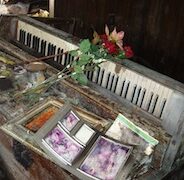
Debbie has been in my most inner-circle of Destrehan High friends almost since I arrived there in 1983; along with my closest friends Ronny and Marta, she is one of the few people I have remained in contact with (though, admittedly, sporadically) since our high school days. She hung out with us sometimes, and when she wasn’t with us, we’d take her left-over pizza – usually after midnight or even later. She put up with a lot of Ronny’s and my nonsense, and that alone speaks volumes about her character.
She was the drum major her senior year (my junior year), and she both earned and commanded respect. As a band member, I would have followed her wherever she told us to go – if she wanted us to line up on the 35-yard-line instead of the 50-yard-line, she would have done it with confidence, and we would done it without questions.
Over the years our individual journeys have taken each of us far, far away from Destrehan. Debbie lived in the River Parishes for about twelve years; then after high school, she moved here and there. She lived outside of Louisiana for 16 years after graduation; living in Allen, Texas (a suburb of Dallas) at the time of Katrina. In 2006, she and her children returned to St. Charles Parish, and she once again calls Destrehan her home.
Tell me about the week leading up to Hurricane Katrina …
Leading up to Katrina I was hearing a lot of conflicting news from our local stations who were making it the storm to end all storms. My family and friends were much less anxious about the fierceness of the storm – they are well-versed in hurricanes and only worry when it is time to worry. My initial thoughts were “I will worry when it is time to worry,” and “oh no, if they evacuate they are coming here!”
As Katrina approached and the evacuations started, it was very apparent that, despite the damage the storm would do, the mishandling and degradation that it would impose on many of the evacuees would leave scars worse than the storm.
Did any family evacuate and come to stay with you?
I housed my mom, step-dad, sister-in-law, niece, and various pets for about one-to-two weeks.
When Katrina became a reality, it was jaw-dropping to stand on the “outside” and have life be in complete normalcy, while so much tragedy was occurring in my hometown. I remember going shopping with my mom the day Katrina hit, and Dallas was moving along just as always – and I just stood there thinking, “people are axing their way out of roofs, drowning, etc., and I am shopping like normal.” It was much like the sensation when 9/11 occurred.
After Katrina moved out, my brother – who had to stay at Ochsner Hospital – was feeding us “insider” reports, so we knew our neck of the woods did not have much devastation. The hospital had armed guards surrounding it, due to armed looters. I remember just feeling very helpless and sad.
I heard some people referring to the disaster as some sort of “ethnic cleansing” for the city. I have never seen people and all forms of government take such a matter-of-fact attitude towards the suffering of others. I was mortified by the jokes and comments I heard about their hopes that a whiter version of New Orleans would be developed after the storm.
We maintained contact, of course, with all of our friends that evacuated and also with my brother until right after Katrina passed over – at that point, we lost contact with him for about two days.
Did Katrina change anything for you – as someone who was no longer a resident of the region? If so, what? How?
I returned to live in Destrehan one year after Katrina, and I was truly saddened for the city of New Orleans. The city was such huge part of my teenage life. Even at that age I loved the atomosphere of the city. I loved its downtrodden agedness, its essence of history; the diverse population, the riverboat jazz cruises, walks on the moonwalk, the french market, the Saenger Theatre, etc. They were my most beautiful memories, and I would never be able revisit them. My first drive down Canal Street was an emotional mix of loss, sadness, anger.
Now that I am in the insurance industry here, I hear horror stories everyday from New Orleans residents. These people who are finally – in 2010 – rebuilding their lives, their credit, buying new homes, trying to recover from the total material losses they incurred from Miss Katrina … but as I suspected, the emotional scars will never heal.
Since last fall (2009) Bert Montgomery, a native of New Orleans and the River Parishes, has been collecting stories from his childhood friends, high school classmates, neighbors and church family about their experiences during and after Hurricane Katrina. FaithLab is working with Bert to produce a book (in both traditional print and e-book formats) and an interactive website to honor his friends and their experiences.Throughout this fall – five years after Katrina – FaithLab will be posting excerpts leading up to the book’s publication.
It’s a Plan of God After All? Embracing a Moment of Holiness

Not long ago, my husband had a business trip to Orlando, Florida so we took our boys, ages seven and nine, for the first time to Walt Disney World Resort. My husband had his business meeting the first day we were there, so it was decided that I would take the boys as early as possible to enjoy some of the Magic Kingdom which is geared for younger children before we were to rendezvous with the paterfamilias for lunch. We had been cautioned that the park was expected to be very crowded on this particular weekend and as the day promised warm sunshine with a hint of late-spring breeze it was with great care that I planned our excursion so that we would avoid “all the other thousands of people!” Concerned with only maneuvering my children to the best spots I dragged the boys out of bed very early to start our adventure. Determined to be ahead of everyone else I rushed my children through breakfast and down to the waiting shuttle bus. I positioned them to exit the shuttle quickly, and prepared them to get through the gates purposefully and past security efficiently. (We were going to get the full “Disney” experience even if we had to break our necks to do it!)
First on the list was the iconic “it’s a small world.” Ushered onto the third boat ride of the day, I crowed with pride, “We beat all those other people!” As we settled into our seats we were engulfed in the familiar children’s song and entered the first of many large rooms of the exhibit. Greeting us were animatronic children attired in brightly colored costumes representing the different peoples and regions of the world, “singing” the theme song in their own language. Room after room of these children represented all the peoples and cultures of the world. The boys were wide-eyed and intent as they listened to the song being sung in different languages as we entered each separate room. They enthusiastically guessed what traditional dress represented which country. “This is what the ‘Disney’ experience is all about.” I thought to myself.
Near the end of the ride, we entered a narrow passage where all the many different languages are played together one over one another so that a listener can decipher the unity of the melody but it is almost impossible to isolate just one voice or one language. Brightly colored, rather loud and somewhat chaotic, it was almost overwhelming to one’s senses. Then, the narrow passage gives way to the largest of rooms –the finale of the tour. In this room, there is the one song, playing in unison, in one language as all of the animatronics from the previous rooms are presented together, still dressed in their vestiges of origin but without the dividing colors. If you’ve experienced this for yourself, you know that this finale displays all of the characters dressed in white with accents of silver and shimmering with a faint turquoise blue. As we rounded the corner to drink in our first glimpse into this massive, beautiful scene that twinkles with tiny lights, I heard a gasp and watched as my seven year old son said with a smile on his face, “This is how it is with God’s plan, Mommy. This is how God sees us.” The nine year old piped up, “Yeah, it’s about how we are all different and it’s hard to understand sometimes – like back there (pointing to the narrow passage way we just left) – but we are still all singing the same song.” Then almost before he finished his sentence the younger brother spoke up again completing this thought: “Yeah, but God sees us as all the same. God sees us like in here: all dressed differently, but no costume is brighter or prettier than another one. In here they’re all singing together. Everyone is the same to God. See, Mommy? This room is definitely how God planned us to be.”
Hurdled into a moment of unexpected contemplation, I realized with shame that I had abruptly gone about my morning absorbed in self-importance, singularly trying to “beat” everyone else. Unexplainably, words came echoing from a hymn sung in church recently: “Take time to be holy as the world rushes on…(William D. Longstaff; 1882).” With great joy and comfort, I sank into a peaceful moment of holiness – a gift from God right there on the holy ground of Walt Disney World.
Grateful for the moment of reflection I emerged wanting to see those around me rather than rushing past them. As we waited in line or talked to others in the park that day, I couldn’t help but reflect on “how God sees us.” My view of what it means to be “holy” was altered, too.
The ride through “it’s a small world” certainly made my Disney experience more thoughtful and I think that’s what Walt Disney had planned all those years ago. While “it’s a small world” was most likely not meant to be a representation of “God’s Plan,” I am fairly certain that even Walt Disney himself would appreciate the truth that revealed itself through that moment: How amazingly beautiful, clear and holy the world can be if we intentionally take time to see it through the eyes of a child.
Upgrade Your Church Website: More Than a Brochure

Most church websites are mostly brochures. They give visitors the basic info needed to learn about the church (generally), as well as how to find the church, who is on staff, the ministries offered, and when services are held. All those things are terrific, and needed. But if your church only offers these things, it is missing out on a lot.
Think of the audiences your church needs to reach. There are members and guests. Members want to know different sorts of things. They want to download the latest youth permission form (because Sallie lost the one passed out on Wednesday night). They want to know what’s on the menu for midweek service. They need to know if it’s their week to usher, or teach or visit. Members also want to know who is ill, or celebrating an anniversary, or just had a baby.
The problem is, many of the things members need raise privacy issues. I may be in the hospital for a procedure, and want prayer, but I likely don’t want that information shared wide-open on the Internet. Members enjoy seeing photos of their children from camp or VBS, or a special event, but may be (wisely) cautious about them being publicly accessible on the Internet.
One solution to the different needs of guests and members is to have a private or members-only area on your church website. Using their login, members can access prayer lists, photos from recent events, and other information, without creating major privacy issues. For the guest, the information they needs is still easily accessible.
(Shameless plug: FaithLab can help your church create an up-to-date site that helps meet the needs of multiple audiences.Contact David at FaithLab to get help with your church’s website.)
Next in this series:
Upgrade Your Church Website: Tell Stories
Upgrade Your Church Website: Get Stuff Done
Upgrade Your Church Website: Tell Stories

Think about it… your church is much more than a collection of ministry announcements, committee meetings and special events. A lot more. In fact, if you polled your membership to discover what makes their experience together so valuable, they would start telling stories.
They would tell stories about how the community welcomes them and has made them “family.” There would be stories about when they were sick or in the hospital, and the church provided food, prayer and support. And there would be the stories from being part of ministries: of helping build homes for the poor, of providing food to the hungry, of caring for the elderly and the lonely. More stories would come from missions experiences, of traveling to help in the wake of a disaster, of helping persons in another culture, of making a difference through doing good things.
And then there are the everyday stories. Stories about attending a movie with friends that developed into a discussion about faith, belief, fear, doubt or hope. Stories about accidentally seeing God’s presence in someone else. Stories that highlight need or challenges.
Here’s a more concrete example. In my church, one of our unique ministries is to families with special needs children. We have developed approaches to training helpers who partner with these children to help them connect and engage with children’s activities. Special programs happen, and there are supporting efforts to provide some rest and “away time” for parents of special needs children… allowing the parents to enjoy participating in music, learning and missions programs, or to just have an evening out together. There are dozens of concrete stories that emerge from this ministry each year.
What does this have to do with your church website? Most church websites focus on the “structure and events” of a church… what/where/when things are happening. And while this information is very helpful, consider how rich your website would be if it began telling stories.
Your church can tell stories on your website in a couple of ways. First, just add a blog to your site and keep it updated. It is best if the blog is integrated into your site (not based on an external service). To keep the blog active, ministers or selected laypersons can regularly invite members to tell stories. If youth just went on a mission trip, ask one or more youth to write up (or do an audio recording) of a meaningful story from the experience. If a retreat is held for an adult group, enlist someone to write about the experience. The more specific the story, the better.
Over time, your church blog will begin to show a much deeper face of your church, and will build up a library of faith stories that remind the congregation, community and guests of the power of faith.
Second, redesign your church homepage so the most recent 2-3 articles are highlighted on the the front page. When members or guests visit your site, they will benefit from the shared stories, while also having access to the schedule and other info about church life.
When telling stories, feel free to also use photos, video clips and audio recordings…. anything that helps better tell the story. Check out the many ways we tell stories here on FaithLab, and imagine doing similar posts for your church website.
After all, the Bible is a collection of faith stories gathered and retold over thousands of years. Adding our faith stories to the mix is a wonderful way to share our faith and make a difference in lives.
Photo Credit: David Cassady
FaithLab can help your church with your website development and design. Have questions about this series? Email David.
The Hardest Part

The other day I ran into Cletus, an old friend I first met four years ago, over breakfast at the local soup kitchen. I don’t volunteer there; I go for the donuts. The priest who runs the place doesn’t mind. They’ve got plenty of volunteers, he tells me, but hardly anyone who’ll just sit at the table and talk with the guys about what’s in the newspaper. So now I’m that guy, and when it comes to current events, Cletus is my main sparring partner.
His story is familiar enough that I won’t bore you with the details. Suffice it to say he traded a good family and a good job for a bad woman and a bad habit, and ended up with nobody and nothing of value. Unless you count self-knowledge and a sense of humor, in which case Cletus is a rich man.
In any case, on the day in question I was just making my rounds in the neighborhood, connecting with old friends and letting myself be seen by the folks who moved in over the winter. I was glad when Cletus saw me and called my name. It takes a few passes before new neighbors figure out that I belong here, unless they see me hailed down and hugged by an “old head” like him.
We stood and talked on the sidewalk for a while, mainly about another friend from the soup kitchen who had just gotten out of a nursing home after a stroke, and was already back on the pipe. I never saw Charlie look better and happier than in that home, I told Cletus. I wished they’d never let him out.
“Aw, Bart,” he said, “you know ol’ Charlie may have been better off in there, but what he really wanted was to be back out here, doin’ his thing.” He paused. “We all do what we want in the end.”
I nodded, and half-jokingly asked what I should say to the church people who are always asking me how they can help street guys like Charlie and him. He laughed out loud at that.
“Tell ‘em that most of us don’t want their help! Hell, I know I don’t! I had what they have and I threw it away to get high and chase women. That’s still my choice. If I ever get tired of it, I know you’ll help me, but for now I’m just as happy to have you as a friend and leave it at that.”
Then I laughed out loud too, and we left it at that.
We all do what we want in the end, says Cletus, and around here that’s the problem. For his wife and kids, and for the doctors and nurses who spent their time and your money fixing up ol’ Charlie, that’s the problem. For a guy like me, who keeps walking around wondering what I’m doing here, that’s the problem.
What am I doing here? Waiting for Cletus to want something better.
P.S. – If you are interested, you can donate online at www.thewalnuthillsfellowship.org to support our little fellowship, which is conveniently registered as a 501c3 non-profit organization.
Bart Campolo ministers through The Walnut Hills Fellowship in Cincinnati, Ohio. This article is reprinted from his blog, which you can read here.
Why I Am a “Welcoming and Affirming” Baptist

I recently sat on a discussion panel at one of the Baptist institutions of higher learning in which I once studied. The panelists shared our thoughts as we explored this question: “Can someone be a Christian and be gay?” The following is a brief synopsis of why I answered with a resounding “yes!”
Let’s recall a few basic facts about the earliest believers in Jesus; that community of believers in Jerusalem:
- They existed as a small group within Judaism. They were Jews who believed Jesus was the promised Messiah … for the Jewish people; and they still worshiped in the synagogues and in the Temple.
- They kept, or at least gave verbal allegiance to, the Law of Moses – things like not eating shrimp or anything from pigs; and, of course, all the males having “a little minor surgical alteration” to mark them as God’s people.
- They “knew” what God was like; they “knew” how to live in a “right relationship” with God; and they “knew” that God would not (meaning, could not), act against what they practiced based on the authority of the Scriptures.
- Oh, and they were not very fond of Gentiles (anyone who wasn’t a Jew); their actions essentially said, “to hell with the Gentiles.”
There’s a story in the eleventh chapter of Acts about some rebels who had the chutzpah to go forth into foreign lands preaching the Gospel of Jesus Christ to … the Gentiles! Worse, these heretics let Gentiles respond to the Good News without first converting to Judaism!
The believers back in Jerusalem had to take action; they had to defend the faith against such false practices. They sent Barnabas out to Antioch, a letter of correction in hand, to investigate the situation and set everyone straight.
When he got there, though, Barnabas recognized the movement of the Holy Spirit, the power of the Gospel of Jesus Christ, and the working of God outside of and even in contradiction to so much of what the Jerusalem believers “knew” to be true. Barnabas stayed among those Gentile believers for a while, and it was in Antioch, among those who were undoubtedly “getting it all wrong” and not truly in “right relationship” with God, that followers of Jesus were first called “Christians.”
Now then, let’s review a few basic facts about Baptists in America:
- We are ethnically Gentiles and not orthodox Jews. Many of us eat shrimp and pork products as freely and liberally as we desire.
- We are most certainly not overly concerned with which males have had that “little surgical alteration” (which in America has nothing to do with being God’s chosen ones).
- And, we are the beneficiaries, then, of the early heretics who dared to recognize God’s movement outside of and even against what the Jerusalem believers “knew” to be true.
We Baptists are now in the position of the early believers in Jerusalem. We have become so enslaved to our own understandings that we “know” what God will not (meaning, can not) do. We have labeled an entire group of people “Gentiles,” separating them from us, and our actions essentially say to them, “to hell with you.”
We insist that homosexuals must first conform to what we say and do before they can grow in a relationship with Jesus. In other words, we need to correct their errant ways, and, well … set everyone straight.
Some of us, though, have witnessed the movement of the Holy Spirit among, and the power of the Gospel of Jesus Christ within, our homosexual friends. Some of us have experienced the working of God outside of and even in contradiction to the teachings and doctrines of the Baptist tradition.
Like Barnabas, I choose to be open to God, whose love endures forever, whose mercy knows no barriers, and whose grace is far greater than my limited understanding, my feeble interpretations, and even greater than my most certain beliefs of how to live in a “right relationship” with God.
We Baptists are being confronted today with the reality that God moves in ways God is not supposed to move; that God is, truthfully, bigger than and free from everything we know to be right.
And this is why I am a “welcoming and affirming” Baptist – embracing, worshiping with and serving alongside my gay and lesbian brothers and sisters.
Author’s note: The opinions expressed are mine alone and do not necessarily represent the views of any one congregation, blog or larger body of Baptists with which I belong.
Calm Down, Everybody!

Within the last couple of weeks, deeply offensive terms (such as “nigger” and “faggot”) have been loudly shouted at such people as Rep. Jim Lewis, a prominent civil rights worker, and Rep. Barney Frank as they appeared on the capitol steps on their way to do their jobs. The United States has recently passed significant legislation on healthcare reform, and we are now in the midst of a tizzy, where it seems like some people have gone crazy with their yelling, cussing, fighting, and threatening. We have political pundits appearing on television and deliberately trying to whip up angry mobs, or score political points, with much success. Others are even telling us what churches we should or should not attend, based on how it might reflect a particular political view.
To my current sense of personal shame, I’m not much better.
I see people posting one lie or another that their masters on television have pushed into the atmosphere, and I get all riled up and act as if it’s my personal responsibility to refute each and every one of them, even when that turns me into a parrot for my own favorite pundits. The other day, I spent hours on Facebook in debate with a guy who just drove me crazy. He’d say outrageous things like “our government never does anything right,” or “conservatives are charitable and kind and liberals spend all their money just looking to attack people,” and I would try to respond to him by asking him to examine what he said and understand the inherent flaws in making categorical statements that “all” of anything is anything. I’d push for him to think for himself and not just repeat things he’s heard someone say, and he’d counter back with more and more platitudes about how his is the only “true” position and that anyone who cannot accept that is part of some conspiracy to oppress him in some way.
I’d keep saying that, regardless of our fundamental disagreement on a number of issues, he needs to understand that he has chosen to believe the things that he says, while other people choose otherwise, which is how I learned that I’m a “communist” and a “socialist.” I would emphasize over and over again that I didn’t seek to refute his points, so much as call upon him to not make sweeping statements and stereotypes, and think about what he. personally, feels, as opposed to repeating things that anyone can hear from the pundits he listens to. This was despite the fact that he views those personalities as having been sent by God to help correct the imbalance created by people who dominate the media since “virtually all of them admit” to being in opposition to his views. At the end of all this, I had to stop the conversation because I realized that it was not a dialog, and no amount of calling for reason and restraint was going to be effective, since terms like “reason and restraint” sounds too much like “socialism” in his ears.
And I’m deeply offended by this, too. My failure to find a point where we could connect and talk really bothered me. At times, I found myself thinking some of the same hateful thoughts that he was apparently thinking, and trying very hard to not let them out and to edit them out when I did.
I came away from the exchange with such a feeling of inner turmoil that it bothered me for days, right up until the next person like this posted on my brother’s Facebook page and I found myself heading down the same path again. I really dislike the idea that we have somehow become a society where people are spending too much time shouting at each other and calling names, rather than rationally talking and listening to each other. I fear for a country where civil rights workers are again loudly called “nigger” in public places, and public figures who should know better take to the podium to condone such behavior. It bothers me that someone appears on television and shares fantasies about killing another person; hosts guests who advocate for terrorist attacks on our soil; tells us to leave our churches; and becomes ever more strident in agitating for armed revolt; and that such a person gets decent ratings and waves poll numbers which show that more and more people are buying into his message. But beyond all that, I’m bothered because such things can take me to the point where I am sorely pressed not to retaliate in kind when faced with the hurtful words, gestures, and talking points offered up by the supporters of such people. My country is divided in ways that it has not been for some time, and things just look to be getting worse, but I can’t see how my giving into the spirit of the age is going to help. I need to calm down!
Beyond all that, when I really stop to think about what I fear, and what I’m fearing, I cannot help but be reminded of being in a church where things are not going so well. When there is conflict in a church body, people start choosing sides; wars of words heat up; hurtful things are said; hurtful actions are taken; and it’s all that much worse because of the context in which it is happening. We are people who ought to know better! Church folk ought to be setting an example of tolerance, piety, kindness and fair-dealing. However, on those times when we disagree, we can carry on in ways that would make some of the most hard-core media pundits blush with shame. I remember once having a discussion with an attorney about a difficult case. He asked me if I had ever seen such a disagreeable, bloodthirsty, no-holds-barred bunch of people in all my life, so I told him about some of the things I have seen in denominational politics. Nothing this side of being in the marines seems very tough after such experiences.
So there you have it. We are in a tough place in our society, and I believe that one of the best things that people can do in such times is to not fall into the trap of all the hate, spite, and attacks that we see around us, but instead to offer a joyous, non-anxious presence that offers everyone a chance of hope and healing.
Unfortunately, it is all too easy to forget that we, as Christians, have that particular call, and instead fall into the trap of acting like everyone else, returning hurt for hurt. It’s very hard to set the example, and like me, a lot of us have failed to do so. What we need right now, is to calm down, take it easy, and talk to each other, and it’s hard to ask everyone to do that if we will not ourselves do so.
So calm down everybody! And after you’ve calmed down, let’s help everyone else.
Follow Us!