
Climate Change

Good morning, happy New Year.
It’s such an honor be your rabbi. And it’s such pleasure to wish you all a joyful Jewish new year on this fine morning.
But imagine my shock when I woke up to discover that I never heard my alarm this morning. That’s right, I overslept.
Now imagine my horror when I realized that I hadn’t just overslept by a few minutes, or even an hour or two…or three.
No, I had overslept by a dreadful margin. Somehow I went to bed last night and woke up 70 years later.
I know only one precedent for such rabbinical oversleeping.
Long ago, during the Roman Empire, there lived a Torah sage known as Choni. One time, Choni drew a circle in the dust, stepped inside it, and vowed he would stand there inside his circle until G-d ended a terrible drought and brought the rain back to Israel. Like a grandmother indulging a petulant favorite grandchild, G-d granted his request. Ever since, he’s been known as Choni ha-ma’a’geil, Choni the circle-drawer.
Another time, Choni saw a man planting a carob tree and asked him a snarky question: what made him think he would live to enjoy the fruit the tree would someday bear? Choni must have been satisfied with the man’s answer. He ate his lunch and lay down for a nap.
When this Jewish “rip van winkle” woke up he realized that the tree was now laden with carob. A man passing by turned out to be the grandson of the man who planted it. Choni had slept a full 70 years.
Something similar has happened to me.
So I wish you a happy Jewish new year, 5843, or, by the common reckoning, happy 2082.
(hey, you look kind of like Monty Karol… what? Dr. Karol was your grandfather? …oh, man…
What? …no, wise guy, I don’t own any primo real estate or stocks that gained huge value overnight.)
Please forgive me if I seem a little disoriented. Imagine how you’d feel if you suddenly saw the future. So much has changed: for Quincy, Illinois, for the United States, and for our world.
Fortunately, some things never change, like our torah portion. Just like generations before, and we pray, generations to come, so, too, do we read genesis, chapter 22, the binding of Isaac, akeidat yitzchak, on Rosh ha-Shanah.
Our story begins when G-d tests Abraham’s faith by telling Abraham to give his son Isaac as a burnt offering on an unknown hilltop. Abraham and Isaac travel three days by the time Genesis 22:4 says, in Hebrew, va-yisa avraham et einav va-yar et ha-makom mei-rachok; literally, “Abraham looked up and saw the place from afar.” But I think Genesis 22:4 really means “Abraham raised his consciousness and caught a prophet’s glimpse of the future.” Prophets were not fortune-tellers. They warned about what might happen if people did not repent their evil ways.
Our story reaches its stark climax on that hilltop in verses 9-10: “…there Abraham built an altar, arranged the wood, bound his son Isaac and placed him on the altar over the wood. Then Abraham reached out his hand and took the knife for slaughtering his son.” (Genesis 22:9-10)
Of course, Isaac is spared the knife. For the second time: “va-yisa avraham et einav va-yar, v’hineh…” again, Abraham raises his conciousness. At the very last second it dawns on him that G-d has indeed provided the ram for the burnt offering.
But did we raise our own consciousness? Were our eyes open wide enough to become aware of the firewood in our story? Why does the word “wood” appear twice in verse 9? The text could have said, “Abraham built an altar, arranged the wood under it, bound his son Isaac and placed him on top of the altar”? Dayyeinu – it “would” have been enough.
From generation to generation, rabbis have taught that if something is in the Torah, it must be there for a reason.
This firewood – Abraham chopped it himself and hauled it all the way from Be’er Sheva. Was it twice as much as they needed? Was it from a tree that should not have been cut down, like the tree of life in the Garden of Eden?
What if it came from the Amazon rain forest, or the jungles of Indonesia or the delicate cloud forests of the Andes?
I read Genesis 22 as if I’m having a nightmare. I dream that I am Abraham but I’m binding…
Not Isaac…but my own two sons, Eli and Danny. I watch as my fellow parents tie their children up until their whole generation, our future, and even our planet’s, is bound to
the altar of industrialization and the internal combustion engine.
The demand of these modern idols for burnt hydrocarbons is insatiable. I struggle to wake but we keep burning more and more wood, and oil, natural gas, coal and uranium. Recklessly we accomplish complete global deforestation just to light up the offerings. Our jealous gods call for more and more drilling, fracking, and burning until the carbon dioxide and other noxious gases we release turn our planet into one giant greenhouse.
Just as Abraham raises his consciousness and becomes aware first of a holy place and then of a miracle in that holy place, so, too, must we lift our consciousness to awareness of the serious threat global warming poses to our entire world. We may need to be the miracle that rescues our future from going up in smoke.
By that long-ago September 2012 when I was writing this sermon, there was clear scientific consensus that rapid global warming due to human activity was reality, and that its consequences were both predictable and catastrophic.
During that long ago summer of 2012, arctic ice reached record lows. Scientists observed 97%, or virtually the entire Greenland ice sheet melting. Wildfires raged across the west. Drought in the Midwest killed crops. We barely noticed food prices increasing. Even rainfall and nightfall did not bring relief from searing heat like they used to. A thunderstorm rolled in to needles, California one 115° afternoon, breaking the record set at 109 in Mecca, Saudi Arabia, just weeks before.
According to the national oceanic and atmospheric administration (NOAA), July 2012 was the 329th consecutive month, since February 1985, with global temperatures warmer than the 20th century average. Satellites measured near-record temperatures for the lower 8 km of the atmosphere. According to the NOAA the first nine months of 2012 was the most extreme for drought, temperature, and precipitation since record-keeping began in 1910, and more than double the average value of the climate extreme index.
In the arctic, temperature had increased at twice the rate as the rest of the globe by 2012.
But beyond the peer-reviewed scientific arena, we the people, our news media, and our leaders were flummoxed. Government by fight to the death in the political arena could not reach any consensus. Powerful energy industry lobbies defended their vested interests as fiercely as the tobacco industry once did, and with similar tactics. People ignored the facts as if we believed we could forever enjoy the benefits of the industrial age without accepting its consequences.
You know what those consequences were, but I’m still shocked at how deserts expanded, sea levels rose, storms blew more frequent and more violent, environments and species faced extinction, and disease and conflict killed millions.
First, climate change meant expanding deserts. From Phoenix to Las Vegas to Albuquerque the cities of the southwest are ghost towns. The peaks of the Rockies and the alps are as barren as the atlas mountains of morocco. Average temperatures in the southwestern United States in 2082 are hotter than death valley was in 2012.
Second, climate change meant storms. The warming atmosphere along with new weather pattern extremes caused arctic sea ice to melt at such an alarming rate that the arctic was ice-free by 2030.
As the sea levels and ocean temperatures of the planet rose and rose, hurricanes, typhoons, and tropical storms became more frequent and more violent. We used to give hurricanes individual names. How quaint. Hurricanes became so common that meteorologists began identifying them by year and number.
With sea levels a meter higher from the loss of the polar ice cap storm surges engulfed whole cities. The big apple never recovered from “the big storm,” aka hurricane eight of 2042 which shut down power and emergency services for days and even toppled the statue of liberty. New Orleans, Louisiana had to be abandoned when hurricane nine of 2048 left the big easy under seven feet of water. No little dutch boy’s finger could save Rotterdam, Holland, when north atlantic storm one of 2052 raised a surge in the north sea that was higher than the engineers of its massive sea gates ever conceived possible. Thousands drowned. Europe’s busiest port was sunk forever. Across the world, governments, banks, insurance underwriters, builders, and people everywhere lost confidence in coastal civilization and fled inland.
For what it’s worth, the Mississippi bustles with commerce once again. In fact, it’s hard to believe that quincy, illinois was once a tiny congregation with a visiting rabbi. Thanks to so many people who fled from the south, the west, and the coasts, quincy has become a boom town.
These people locked their doors one last time, left their keys in the mailbox and abandoned their homes. Whatever the banks said, the properties were worthless when there was no more snow melt from the Rockies to fill Lake Powell, Utah, and generate the hydroelectricity for their lights and air conditioning. Big peach Atlanta, Georgia withered once it had drunk Lake Lanier dry. The story is the same in formerly arid climates everywhere.
Third, climate change meant extinction. I remember visiting the Athabasca glacier in the Canadian Rockies with my wife hope on our honeymoon trip in 1998 before Eli was born. This frozen river of gleaming white and blue ice was cut by crevasses that could be miles deep. We could not see it move. Yet in 1998 we could see that it had retreated more than a mile from a visitors’ center the Canadians built at its very edge in the 1920s. A whole mile! Now, in 2082, the mighty Athabasca has retreated into extinction, along with every glacier on every continent.
Once upon a time, I loved snorkeling over coral reefs in Key Largo, Florida; Xel-ha, Mexico; Eilat, Israel; and Dahab, Egypt. The reefs and their tropical fish were some of the most beautiful things I have ever seen. I’m the only living person who can say so today: these natural marvels of biodiversity are extinct. So are the species of marine life and even the human civilizations that depended on coral reefs like the pacific island nation of Tuvalu that vanished beneath the waves.
Finally, the great 21st century warming meant death. On or about October 31, 2011, the seven-billionth human being was born. Today, the earth’s population is about 3 billion.
Heat stress itself was a major cause of death, especially among the elderly and young children in climates that were already warm.
Starvation, malnutrition, and illness killed millions more, especially in desperately poor places like Bangladesh. As crops and commercial fishing catches failed, and as cattle ranching became unsustainable, food grew scarce. People fled in search of livable temperatures, food, and water. Some countries expelled their foreign residents, frequently where rich and poor nations shared a common border such as between the United States and Mexico. Epidemics like typhus and cholera broke out in the squalid camps of the climate refugees.
Finally, climate change meant armed conflict. Israel claimed another great victory against its Arab neighbors in the Four Days war of 2028. But severe overpopulation and decades of unsustainable water management led to famine. Both sides wished they had at least established open communications channels when a massive earthquake rocked the Syrio-African rift. The temblor shifted the flow of the Jordan river from south to north, which finally and truly killed the Dead Sea, which had been slowly dying anyway. It also sent the intensely saline water of the Dead Sea flowing north into Yam Kinneret, poisoning both Israel and Palestine’s key source of fresh water. By the way, the earthquake also reduced the Temple Mount to rubble and dust. Neither side had trusted the other enough to shore up the foundations of the holy sites of Judaism and Islam in time. Everyone who could emigrate did, years ago. The only Jews left are a handful of fervently religious people, learning Talmud all day and subsisting on charity from abroad. The long-awaited dream of peace in the Middle East is finally reality. The Jewish and Arab populations of this once-promising twice-promised land have simply nothing left to fight about.
In operation maple leaf of 2046 the United States invaded and occupied Canada in order to seize control of the zone suitable for growing wheat. The Canadian armed forces fought a brave but doomed defense of Ottawa. The Canadian insurrection lasted decades.
But worst of all, India and Pakistan clashed over the bread basket of the subcontinent, that long disputed region called the Punjab. One hundred fifty million died in the fourth Indo-Pakistani war, the nuclear conflagration that began on April 14, 2050.
What will I say to my own grandchildren when I meet them?
And what will they say to me?
Even the word genocide doesn’t quite describe the calamity. The word “geocide” has been
proposed.
Choni the circle-drawing wonder worker never returned to his own time. So I don’t know whether G-d will be merciful enough to return me to 2012, but I pray that the words of this sermon will somehow be heard in 2012.
If only I could talk to my generation one more time. I would beg us to heed the warnings.
I would tell my generation not to rely on miracles like Abraham did, but to rely on ourselves like choni the circle-drawer.
I would urge them to deal with bogus denials of climate change, just as we once handled the tobacco industry’s denial of the health hazards of cigarettes.
I would beg all of us to reach out more respectfully to the political opposition to persuade, find common ground, and use market-based solutions like “cap & trade” to externalities like pollution and carbon emissions.
I would urge us to reduce carbon emissions, protect delicate natural ecosystems and restore damaged habitats; use more efficient and sustainable farming and food distribution methods; stabilize human population growth through increased access to education; and even if all else failed, develop the technology to capture excess carbon emissions.
We could still make other futures possible for generations to come.
Choni ha-ma’agel asked the man planting a carob tree (rather rudely) why he would plant something he would probably never live to enjoy.
I bet the man with the tree knew that carob is a sustainable crop native to the land of Israel.
But what the man with the tree said to Choni was, “as my grandfathers planted trees for me, so do I plant trees for my grandchildren.”
May we celebrate the world’s birthday in the Jewish year 5773, which is 2012 by the common reckoning, with compassion for god’s creation instead of lust, so that when 5843 does come generation after generation will continue to find the carob trees lovingly planted by their grandparents for them.
Keyn y’hi ratzon,
So may it be G-d’s will.
1. Rosh Ha-Shanah always makes us wonder what glimpse of the future we might catch. As a traveler to you this morning from the past, from the year 2012, from 70 years, 7 whole decades ago, I feel I must warn you that I might be setting you up for a terrible present. Pun intended.
2. Naturally we who read the Torah – from those Talmudic sages who preserved the story of Choni the circle-drawer, to the medieval commentators, to our grandparents, parents, and to us, the Jewish people, modern and post-modern alike, have struggled with the meaning of this tale.
3. But are we supposed to take at face value Abraham’s willingness to bind his son, his only son by his marriage to Sarah, to the altar as his greatest deed, as the proof of his faith? Jewish authorities of the distant and recent past are split on this question. Some scholars of Torah say so, but other Jewish commentators hold that Abraham failed his test. This morning, despite my upset at my lapse of 70 years, I feel strangely vindicated. I was right. Not that it makes me feel any better.
4. Could it be? Could it really be that just as Abraham bound his son Isaac to an altar, fully intending to sacrifice him to his G1d, horribly prepared to go through with the plan until that angel finally intervened to show him the ram for an alternate sacrifice; so, too, were we in 2012 binding our own children – all of you who are here today 70 years later — to the altar of fossil fuels? Together with every parent and grandparent of my generation, were we really ready, willing, and all-too-terribly able to sacrifice our own future to this merciless, industrial God– just to keep on offering up endless burnt-offerings of oil, gas, coal, and wood, pouring endless carbon-dioxide into a troposphere already saturated with it?Are we counting on our God to save us in the nick of time with a Deus Ex Machina like Isaac’s Ram?
5. Sure, Israel today remains militarily powerful. It re-occupied and even annexed the West Bank of the Jordan River. But those iconic kibbutzim and moshavim in the Negev that the early Zionist pioneers were so proud to make bloom
6. We American Jews are grateful to the government of the United States for keeping Israel militarily strong – yet we are nervous about our government, too. The same government that stands firmly with Israel abrogated the bill of rights in order to expel Mexican immigrants and even American citizens of Mexican descent. It is respectful of Judaism due to its fundamentalist Christian character, but hostile to Islam-baiting quasi-fascist government.
Runaway Jesus
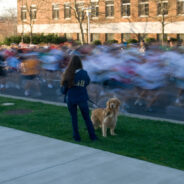
It seems, in life, people are always running. Whether its running a race, running for office, running a fever, running late, running for your life, running a business, or running from bad news; it seems that even after such a busy holiday season, we will continue running through the end of yet another year.
No matter what, who, or when a person is running it would seem, in the end it can all be neatly grouped into two categories: you’re either running away from something or you’re running toward it. Sometimes it’s a bit hard to tell which is which given the circumstance. Take for instance a bear attacking you. Some might advise you to run TOWARD safety and others might say to run AWAY from the bear. Both save you from the attack and, so long as you’re nimbler than the poor person behind you, I’d say you’ll be fine.
There are several people who have perfected the art of running: the country of Kenya for example as they run toward a finish line, political parties run away from bad media, Santa Claus runs to children’s homes on Christmas Eve, Jonah ran away from God’s calling, the athletic company Nike runs people to the gym, and St. Paul runs toward fulfilling the Christian mission for instance. But the truth is all of us are quite agile runners. We run from illness to grace, from boredom to presents, and to our peaceful homes from crazy family Christmas dinners.
This Christmas alone, Cody, my sister Kennedy, and I “ran” 2,500 miles to visit family. We started by driving twelve hours to visit Cody’s grandparents in Florida. Then we ran thirteen hours up to Virginia to visit my extended family. Before leaving for this vacation, my father let me borrow what he called, “the most interesting book I’ll read all year.” The book was called “The Family Crucible,” written by Drs. Napier and Whittaker in 1976 about the “nuts and bolts” of family therapy. Although I wouldn’t call it the must-read book of 2012 or even 1976 (when it was written), I did gain tremendous insight into the way dad tried to interact with and discipline us as children (maybe he should have lent me the book when I was a teenager). I even spent several hours of our travel time psychoanalyzing all of the nuclear families in my large extended family.
The book described a natural process within family members to seek a balance and order to the overall emotion of the group. In the book, the parents were experiencing marital problems, especially when disciplining the oldest of their three children who would literally run away from home for days at a time. To rectify the disappointment and frustration the parents felt, the middle son became the “sacrifice” instead. He did this by provoking the youngest daughter, which gave the parents a much simpler scenario to deal with, one they could clearly see a solution to. They could easily see how to punish the middle son and therefore became a unified team against him, pushing the family back into balance. The problem with this soon became that because the middle child received all of this attention, the oldest was being left with mixed messages from her parents, leading her to run further and further from her family figuratively and literally.
By the same token, this is how we run our own lives. By creating a perfect balance of running to and from things, we drive ourselves crazy trying to find some stability. Often times, we don’t even realize how exhausted we are until we finally stop running.
In the Gospel today, we are reminded of how puzzling Jesus is. Luke describes quite clearly how although Jesus is 100% human he is also 100% God. When Mary and Joseph find Jesus at long last, they seemingly scold him for running AWAY from them. Here they fully resume their roles as Jesus’s human parents and forget all the signs and jubilation they heard from people they had never met and even angels 12 years ago at his birth. (Which, to cut them some slack wasn’t just the week before like it was for us.) After hearing their concern, Jesus scolds them back, for the sake of this sermon-theme I’d like your permission to paraphrase, by saying, “who cares where I ran FROM if I’m running TOWARD my Holy Father.”
Why do we run then? Why did Jesus make it a point at such a young age to correct his parent’s thinking and stop their running? Maybe Jesus wasn’t the runaway at all, perhaps he was the “run-to.” Maybe we find ourselves running around so fast we forget which way we’re going or what we were doing in the first place.
And of course, this is the easy part. Right now as we await the looming semester it’s easy to forget how quick we can slip into an exhausting balancing act within ourselves and our families. We run from one activity to the next, toward a good decision, from a bad decision, all the while never once considering the notion of stopping. Of thinking “why?”
In our Christian lives, it is easy for me to point to our search for God. My freshman year I had lengthy conversations with friends of mine who say the same thing, we found ourselves running around in our relationships with God just as in life. Every decision we make can either lead us to Him or away from Him and so I therefore based each decision I make off which direction I’ll be running. And I keep running and running sometimes it feels in little orbits around him, growing frustrated, but never allowing myself to stop and consider the notion that there could be more to this than what I think.
Similarly, for three days Jesus’s parents ran around searching for him. Jesus stops his parents and asks, “why?” He says, “Why search for me, when clearly I am with my Father.” Mary and Joseph seem to think “hm..” and probably felt quite silly. But I’m pretty sure if I had said something like that when I was 12 years old to my mother, she wouldn’t just “treasure what I said in her heart.”
My mother has three sisters who all have families in Roanoke, Virginia. Every year we go up and stay with one of my Aunts and have a huge get together on Christmas Eve. On Christmas Day, however, they each visit their husband’s side of the family. Since my dad’s side of the family lives in Georgia, we don’t exactly get that luxury. Needless to say, our Christmas Day tradition includes Chinese for lunch, leftovers for dinner and a visit to the movie theater in between. This year we got the pleasure of seeing Les Miserable. Though not for the faint of heart, due to its length and emotional strain, Les Mis was everything I had hoped it would be. The main character, Jean Valjean, is sent to prison doing hard, hard labor for stealing food to save his nephew’s life. After getting out, he breaks parole and is then forced to run from the police. He is a deeply religious man and by his moral fiber and good luck is able to reinvent himself. He even becomes the mayor of a town, but is forced to leave the new life he built when faced with a moral dilemma. Through some of his monologue he conveys his wish to please God and do the right thing, he questions who he is, and eventually chooses the harder of the two choices. The movie occasionally skips years, but still revolves around Jean Valjean’s life as the audience is shown the happenings of France in the midst of his running from town to town afraid of being discovered. In the final scenes of the movie Jean Valjean is finally able to stop running and realizes the answers to all his questions with the help of a girl he adopted and a girl he saved. It is in their presence that he makes one of the most epic revelations I’ve ever heard, by saying “to love another person is to see the face of God.” Why do we search for God in such a way? Why run yourself ragged in the hopes of good decisions and productivity? Stop running and look around at all the other runaways beside you. Run to them, look deep into them and love them. Love the obvious people you forget to acknowledge: your parents, siblings, long lost family friends. Love the people it’s hard to love: nosy neighbors, Hugh Freeze, annoying coworkers, or frustrating teachers. Even love the people it’s just impossible to love: the Taliban, Sueng-Hui Cho, James Holmes, and Adam Lanza. And finally love the people you’ve never met that are parked beside you, that are boarding a plane in Atlanta now as I speak, all the newborn babies in all the hospitals and homes, or the ones that are hungry. They’re probably just as exhausted as you are.
So there’s only one thing for it. We love God through each other. Mary and Joseph made the mistake of forgetting the fully human/fully God rule, by (you guessed it) running after their runaway child. Jesus asked them “why search for me when you knew where I’d be” and he can say the same to us… “why run looking for me, when you know where I am?” Open your hearts, stop your running, and relax, for where else would you be but in your Father’s house?
Invocation for MLK Day
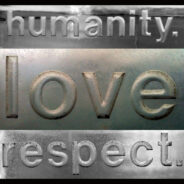
In the darkness
We have a choice
We can choose to succumb to the darkness
We can choose to bring forth light
In suffering
We have a choice
We can choose to become embittered
We can choose to bring healing
In pain
We have a choice
We can surrender to hopelessness
We can learn compassion
When dealt violence
We have a choice
We can choose the path of violence
We can become bringers of peace
Blessed is the one who chooses
Chooses the path of light when surrounded by darkness
Blessed is the one who learns to heal though suffering
Blessed is the one made compassionate by pain
Holy is the one who brings peace out violence
Breath Of Life
Soul Of Existence
Creator of light
Grant us the strength to choose
The wisdom to choose
Light
Healing
Compassion
Peace
Let us be fully human when those around us
Have forgotten their humanity
And let us say
Amen
Agnes, Martyr, Virgin, Pure of Heart
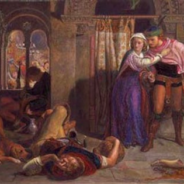
Agnes was a young Christian of maybe one twelve or thirteen years of age when Diocletian’s regime came calling for her life.She was a Roman citizen living in Rome with her wealthy and influential parents when the persecutions began to claim her brothers and sisters in the Faith. As was the case with many wealthy Christian families at the turn from the third to the fourth centuries, Agnes and her family’s peaceful existence was turned on its head as the Empire demanded more and more and accepted less and less resistance. However, Agnes’ noble parents meant that they would simply be extorted and coerced instead of immediately killed–the time of noble death usually came after they had been bled dry of all their resources by a power-hungry ruling class that no longer cared for them. So, Agnes should have been okay–except Agnes was beautiful.
She was so beautiful that the prefect’s son prized her above all the other maidens and went to his father to see what could be done about gaining Agnes as his wife. The prefect was confident that the family would be all too happy to give their daughter over to his family as the bride of their son. So, he sent a courier asking what they thought of the proposal. Amazingly for the day, Agnes’ father wanted to know what Agnes thought about the proposition. She rejected the offer and word was sent back to the prefect as the family waited–holding their breath at the expected retaliation. The prefect was furious that they would dare deny him his wishes and his will. He didn’t understand why her father hadn’t forced her to marry his son and demanded that Agnes be brought before him. When Agnes arrived, she seemed confident in a way that surprised the prefect and so, instead of questioning her–somehow knowing she would continue to refuse even under threat–he ordered her to be killed. “But, prefect,” one of his advisers interjected,”she is a virgin and cannot be executed…it would be unseemly.” Everybody let out their breath feeling that surely Agnes’ life would be spared. They underestimated the cruelty of the Empire.
“We’ll see what we can do about that,” growled the prefect. His armed and trained guards stripped a young teenage girl of her clothing and chained her hands and feet. She was taunted and mocked for her nudity and age and then led naked through the streets of Rome. The guards led the defenseless girl at sword point as if she were a dangerous criminal–she who had refused the prefect’s wishes–and brought her to a brothel to be raped so that she might then be executed. When they tried to seize her they found themselves unable even though she did not resist them. It seemed that their bodies didn’t work right. When she was finally pushed into the brothel, men lined up to rape the young girl but were stricken blind as each of them tried to step forward and perpetrate that unholy act upon her. In fear, they took her from the brothel and tied her to a stake. As they tried to set the young girl on fire the wood refused to catch. In fear and panic, the commander drew his sword and drove it through Agnes’ throat. The naked little girl had brought an Empire to its knees only by refusing to be shaken or coerced. Her grave became a site of adoration and prayer and yet more Christians were gathered in by the empire for martyrdom upon visiting Agnes’ grave.
Read more from Joshua Hearne at his personal website and the website of Grace and Main Fellowship, the non-traditional community he ministers with.
Grace, Grace
I believe in grace. I would not be who I am and where I am apart from grace. I’ve experienced grace in a variety of ways and circumstances. I believe in grace, but I do not understand it.
In its purest form, as received from God, grace comes unmerited. Yet it seems that some people who receive grace are motivated to a higher level of living and become the recipients of more grace. Is that a backhanded way of earning grace? There also seem to be some people on whom grace just doesn’t fall. Did they do something to warrant the withholding of grace?
Perhaps I struggle because I do as do so many others. I too often equate the receiving of God’s grace with success and joy. I know better. I’ve experienced grace in times of failure and in times of deep sorrow. I’ve known the wonder of grace in times when I’ve been afraid. Yet when things are tough, for me or others, I want to ask God, “Where is your grace?”
I don’t understand grace, but I give thanks for it. I long for it, and I sometimes beg for it. More often than not, I see grace in the rearview mirror of my life. I can look back at four and a half hard and lean years in one pastorate and now see that those years led to the thirty-three plus years I’ve spent in Eminence. Looking back to 1998 when my dad was the victim of shooting and spent 90 days in the hospital, I can now see that through that experience I became a more sensitive pastor than I might otherwise have been. Dad, too, experienced grace in the experience and emerged as a better man. Please understand . . . I don’t think God caused my dad to be shot so that he and I might be graced. There are numerous things that caused the shooting. Grace came because God doesn’t run and hide when stuff, including the stuff of our sin, occurs.
Perhaps grace is almost always baptismal grace. It is what comes to us as we see ourselves as inside the circle of God’s love. “You are my beloved Son; with you I am well pleased,” the voice from heaven declared at Jesus’ baptism. Is that not the message at every son’s and daughter’s baptism? Sure, baptism is a sign of our profession of faith, of our dying and rising with Jesus; but it is more. It is also a sign of God’s welcoming us, declaring what we should have known from the beginning: that we come from God, belong to God, and ultimately return to God.
That’s grace enough! To be in God’s family is grace. To be in God’s family is not to be free of all that comes with being human. We struggle; we grow ill; we hurt; we misunderstand; and eventually we die. Yet in all of it, we discover grace, the grace of being and the grace of not being forgotten or left alone.
I don’t understand grace; but I have experienced it; and living in grace leaves me convinced that it comes to all. What distinguishes us is not the outpouring of grace but our recognition of its presence.
To know that we belong to the Creator of all that is grace. Such grace leads me to cling to the promise of Isaiah 43:1-3 even when the waters run fast and deep and the fire burns toward me. I cling to that grace because the Creator of all that is has redeemed me and called me his own.
Interview With Former Christian Punk Rocker, Ric Alba

Ric Alba is a legend to fans of 1980s alternative/punk/new-wave Christian rock. He played bass on Undercover’s eponymous debut album, then went on to play with the Altar Boys. He released one solo album before coming “out of the closet” and disappearing from the Christian music scene. As you are about to find out, Ric’s musical journey is almost as eclectic as his personal journey – a search filled with certainty, denial, confusion, spiritual manipulation, emotional abuse, acceptance, and hope and love.
Today, Ric and his partner own an interior design firm in California. Ric still plays music, most notably recording a new Dead Artist Syndrome (D.A.S.) album with a fellow legend of the alternative Christian music genre, Brian Healy.
~ ~ ~
Back in the 80s, folks sometimes promoted Christian artists “the Christian alternative” to secular artists. As in, “if you’re a Christian and you like this secular artist, then you should be listening to this Christian artist.” Were you thinking about that while you were a part of the CCM scene?
I think nearly all bands are in one way or another doing what somebody else started, while sometimes pointing fingers and calling others derivative. But it’s no crime. Just as in the secular world, bands take after other bands that inspired them, and so did we. We played the way we felt inspired to play.
In the evangelical world though, it was expected that the bands had evangelical reasons for whatever we did. If a band reminded one of say, The Clash, then it was presumed that band’s purpose was to evangelize fans of The Clash. Navigating our way through the evangelical industry, eventually I realized that it got the job done to go ahead and let it be painted like that’s what we were doing if that’s how people needed to paint it. They had their reasons I’m sure, and I have no reason to say their hearts weren’t pure. But really, we were all just playing the way we enjoyed playing, inspired by and building on the work of those who were already playing that way. We said that a lot, but some folks still kept wanting to paint it as a calculated evangelical strategy. Oh well, okay … my, what brilliant evangelical strategists we all were!
You’re a Christian. And, you’re gay.
I have to say right off that because of my current approach to faith, it’s best that I don’t claim the name “Christian” for myself. The controversy of who is qualified for that name distracts from more important things, so I’ll just be who I am, say what I feel, and let people call me what they want, if anything. I understand that for many people, it hurts to hear me say that because so many of my favorite people throughout my life have been those I know from my years as an evangelical. Those relationships are still valuable to me, and I’m in a place of transition, from being somewhat in opposition to a life of faith, toward embracing one for myself.
Most of the Christians I interact with today regard me as one of their own, and I cherish that. The language of my thoughts on God today comes from all that I learned, sought, and experienced when I was a Christian. In that sense there’s a kinship I feel with Christians that will more likely grow from here, than weaken.
I stopped identifying as a Christian after being excommunicated by the Anaheim Vineyard in 1991. At the time, I couldn’t reconcile being gay with being a Christian. I was in a process of trying to do that when I got a call from my church, telling me to come to their offices and explain myself in regard to sexuality. They told me that if I failed to show they’d pray to release me to Satan so he could kill me before I “fell too far into my sin.” That right there was my clue that things there had gotten too wacko for me to remain there without going completely insane. My refusal to obey at that moment was a kind of self-rescue. I didn’t seem to have anywhere else to go though, in 1991, so I went nowhere in terms of a faith community.
Tell me about your struggles between being Christian and being gay. When did you sense you were gay?
My earliest crushes, maybe around age seven or so, were on other boys my age, and I knew right then that that might be out of the ordinary, but I didn’t panic over it. It wasn’t until years later when the word ‘fag’ started getting thrown at me on the schoolyard that I realized that liking other guys was such a big taboo. I actually had to ask a classmate what the word meant, and when he told me I thought, “What’s the big deal?” Thankfully I had enough friends outside of school who liked me enough for my musical abilities to overlook the things that my schoolmates bullied me for. I lived comfortably in their company, playing in cover bands throughout high school until the last of those bands broke up.
Then in 12th grade I became a born-again Christian and for the first couple years I basked in the belief that nothing about my past life mattered, because I was a ‘new creature.’ It saved me from the work of having to deal with anything at all about myself, as long as I did all the things I was told to do as a Christian. It was like not even having to acknowledge my own existence. The teaching was to “die to self.” It totally stunted my growth. Denying myself a gay love life wasn’t too hard for me back then. I was a very late bloomer when it came to sex drive. I simply lived celibate, and was grateful for a community that made it easy to do that, with its prohibitions on fornication.
But eventually adulthood caught up with me, and so did sexuality. In 1980 I went for counseling at Vineyard about it. Their response was to “pray the gay away.” I prayed, and they said to get on with my life and forget the whole thing, as an act of faith in my healing. I became very close friends with a girl I met there, and we got married. Problem solved, so I thought. But no, by the mid-1980’s it was clear to me that I was more “same-sex attracted” than ever, but I still didn’t act on it.
How did you respond? Denial? Prayer? Reparative therapy? You were in the Alter Boys at the time, weren’t you?
HUGE denial. I wouldn’t even dare think the words, “I’m gay.” I developed a unique way of thinking about it. I developed this theory that there was no such thing as gayness, and that we were all the victims of some kind of societal effect that was robbing everyone of the love they deserved. I theorized that everyone felt a coldness and was seeking warmth in various, destructive ways. In my thinking, same-sex attraction was the result of being intuitive enough to notice that something (I had no theory on what, exactly) was missing in all of society, including Christian society. I prayed and prayed for Jesus to finally come in person and fill in the blanks that He’d left behind when He was last seen in person 2000 years before. That was how I framed everything.
That was my only hope, thinking that Christianity as it was, was incomplete, that there was supposed to be something more, a key of some kind that Jesus would bring someday. In my thinking, openly gay people had given up and settled for less. I thought of gay sexual activity as, “The fires of hell – which do give warmth, but dude, it’s Hell.”
The idea of a happy gay life well-lived was foreign to me, and my religion prohibited me from even entertaining the idea that a gay life could be a happy one. It was over the course of those years that the songs for Holes in the Floor of Heaven {Ric’s 1991 solo album} developed. In public, church, and before my own eyes, I didn’t dare let myself be “me.” The imagery of Holes is loaded with the sounds of someone real, pleading for a way to be unlocked from deep within someone who was not so real, and who was deathly afraid of the person inside.
It got to be totally obvious that the right thing to do was to tell my wife all about what I was going through. The next step after that was to go back to Vineyard and ask for counseling. They recommended a facility (which turned out to be an inpatient clinic) that offered an early form of reparative therapy on a 12-step model. During that time, our hopes for a marriage and family started to fade. I did one more tour with Altar Boys, then left the band and started college in hopes to save my marriage.
No – the therapy had absolutely no affect on my sexual orientation. My wife and I separated right about the time I started recording Holes. Then … the excommunication.
You left the Altar Boys and the Christian music subculture in which you were living in order to be openly gay. How did folks respond?
Oh, when I left the Altar Boys in late 1990 I had no intention of living a gay life of any kind. I left in order to go to school full-time while pursuing a path to putting out Holes in the Floor of Heaven, once it was clear that our label wouldn’t do it. I never made my personal struggles clear with in the Altar Boys’ circle.
With very few exceptions, I didn’t give them a chance to (respond). It wasn’t until 1992, some time after having been excommunicated, I started living a gay love life and disappeared from Christendom so profoundly it was like faking my own death. During the Altar Boys, I had formed so many friendships with fans, who I feared, perhaps wrongly, were too young and impressionable to have to deal with this change in me, so I went quietly into the night. Touring as a Christian musician to support Holes in the Floor of Heaven was out of the question because that would mean living in a closet. By that time I was involved in helping to alleviate the AIDS crisis, which had been caused in great part by society forcing gay people into closets.
How did you come to accept your sexuality within your faith?
For some years after my excommunication I had no faith in anything “unseen” except the conviction that if God exists, He is a lover of truth, including the truth that the belief system I had lived in for so long had serious problems that made it impossible for me to stay in it. I rested peacefully, knowing that if God existed He will find me, and that whatever the two of us work out will be entirely different from my previous life of faith.
Tell me a little about your current approach to faith.
I have to start by offering that I could be wrong about everything I say about who or what lies beyond the senses. It’s okay though, because I don’t think that having correct beliefs is what matters to the person or persons we seek as the objects of our faith. What is important, what I feel responsible for, is building within myself a good heart and mind.
Part of that process for me these days is being aware of the possibility that more “exists” than what can yet be detected by our current senses and instruments. So, I don’t say conclusively that there are no such things as unseen beings. I like the idea that they are around. But I do say that whatever is actually, ‘out there,’ their nature and intention is anyone’s guess, so while we’re all guessing, and using our imaginations, I find it both challenging and comforting to envision things that help me to live an authentic life, to love and be loved, to be more kind, patient, helpful, truthful, and all those good things we aspire to be while on the Earth.
Because of my experiences as a “born-again Christian,” I developed a way of thinking that I still have. It was a part of my Christianity, and now it’s an indelible part of me. What I’m talking about is that I still live under the impression that my comings and goings are being played out in front of an unseen audience, which I’m still unapologetically accustomed to calling, ‘The Kingdom of God.’ In my impression, it’s an audience that patiently watches as I go through life and learn my lessons. Partly out of habit, and partly out of desire, the mental image I keep, which represents that “unseen audience,” is Jesus. Of course that fact doesn’t obligate myself or anyone to accept the whole package of any named religion. It’s just that I was raised to be, and then chose to be, a Christian; so when I picture unseen beings from unseen realms who look on our world with an interest in our well-being, that’s the image I have, and I’m good with that.
I don’t apologize to my ‘believing’ side for the absence of orthodoxy, and I don’t apologize to my skeptical side for maintaining that tiny aspect of faith. Both of those sides of me have been learning to accept one another.
So even though I confidently agree with nearly every atheist on record, I think that in my exploration into faith I’ve done a good thing (harmless, too) by letting some of my past impressions about God remain as a part of my current reality. It goes along with accepting who I am as a person. Christian imagery, some of its moral philosophy, and a little bit of its theology have become an intractable part of this person I am, right along with other intractable parts that I learned to accept. It might sound like a mess trying to put it to words, but it’s my truth as best I can share it without using music.
Let’s get back to the music. Who were your biggest musical influences growing up?
Schroeder, from the Charlie Brown gang gave me my first inspiration when I was around five. He was a little boy like me, but he was playing Beethoven’s Moonlight Sonata, and I just assumed it’s natural for little boys to be able to do that. I remember reaching up to my grandma’s piano to feel out which keys made the song’s opening 3-note pattern, and found them. My dad ran out and got a piano and I’ve been gradually figuring out that piece by ear ever since. I’m almost to the end and I think I’ll leave it where it is. Ludwig’s ending drags out too long anyway. He’ll thank me, and I’ll accept the grade “F” I’ll get from music teachers.
After that the only music that existed for me until Led Zeppelin, was The Beatles. I learned a lot of Paul’s parts, then onto John Paul Jones, and would you believe, Gene Simmons, who was always underrated as a bassist. I still play those slapped parts from “Detroit Rock City” warming up the bass.
Today, what would you list as your favorite Altar Boys songs and why?
The song, “Against the Grain” is a champion among the songs Mike (Stand) and I co-authored, because it represents a sharp turning point. We’d sung so much up to that point about what was wrong with the world, but I wasn’t really in the world that much. The church was my world, and yet it was still one that had all kinds of things wrong with it. “Against the Grain” was to me, our first steps toward addressing that fact head-on, beginning with the question, “What do we mean by ‘Christianity?’” “The Human Sound” is another along those lines. “Kids are On the Run” is simply a great song.
(Click here to listen to “Against the Grain”).
Are you working on anything new right now?
I’ve been working with Brian Healy on a new DAS project with Ojo Taylor, Gym Nicholson, Riki Michele, Marc Plainguet, John Picarri at the console, and a few TBA’s. It’s been steadily expanding as ideas keep coming.
~ end ~
You can contact Ric via Facebook. Not too long ago, Ric wrote, recorded, and posted “A Few Words About Bullying Using Words” – click here to check it out.
Learn more about Bert Montgomery at his website.
Yoga Theology: Sweet Hour of Prayer
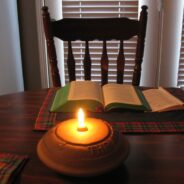
The period between Thanksgiving and New Year’s Day provides us with many, though not necessarily good, excuses to avoid physical exercise. There are meals to prepare, gifts to wrap, people to visit, homemade candy to eat, and errands to run. It’s been very easy for me to fall victim to the mentality of: “It’s just a busy time of year. I’ll get back in my exercise routine after the first of the year.” Fortunately, this year I have a “yoga room” in my house. The yoga mat is always out, the room is always clear of clutter, the music is always in the CD player, and there is a glass cross that always sits on the window sill. Every time I walk by the room, it says in its silent barrenness, “I’m waiting for you.”
Early in the Advent season this year, I thankfully heeded that voice and carved time out of most days to go to the mat and gaze upon the cross. Not surprisingly, as I moved from one yoga pose to another, my mind began to wander. I started to think not so much about what I needed to do during the holidays but more about prayer concerns in my two congregations, the community, and beyond. One day, an instrumental arrangement of “Sweet Hour of Prayer,” began playing.
Duh, Darian! I said to myself. Turn this into a sweet hour of prayer!
As I held plank pose, using arm and core strength to hold myself up, I prayed for those who needed strength. As I stood on one foot in tree pose, I prayed for those who lacked balance in their relationships. As I swan-dove into a forward fold, only to discover my oh-so-tight hamstrings would not let me go very far, I prayed that God would help me to let go of everything holding me back. As I bent my front knee into Warrior II pose, pressing my back foot firmly into the mat, I prayed that the Church (and specifically the two churches I serve) would move forward in their calling while remaining grounded in the Word. The hour passed quickly as the Holy Spirit led me in the physical exercise as well as the prayers.
Whether we practice yoga, do simple stretches, walk, run, ride a bicycle, or lift weights at the gym, what would happen if we made these hours of physical activity an opportunity for spiritual Communion? This combination draws us out of physical and spiritual lethargy that can easily take over our lives, not just during the holiday season but throughout the year. For those of us who are physically challenged or live with chronic pain, we can seek out with a doctor’s guidance simple,easy physical activities (2-pound dumbbells are an excellent investment!) to keep us moving.
Choose the physical activity that works best for you, then invite the Holy Spirit to become a part of the practice you choose. Perhaps the first time you do so, all you’ll be able to say are prayers of gratitude, praise, and thanksgiving for God’s goodness. As I’ve shared in a previous post, perhaps you’ll find yourself releasing pent-up tears that God desires to wipe from your face. Perhaps you’ll just feel God’s presence but not really know how to pray for the requests on your mind. If so, just hold them before your yoga Partner, your walking Buddy, your cycling Companion, as you move.
Friends, let us not wait until January 1 to restart or to begin our physical or spiritual exercise routines. Begin today by not separating the two. Listen to the voice that desires our physical and spiritual wholeness. When we choose to make this hour one of prayer with spirit, soul, and body, we find ourselves longing for the “returns” of such sweet hours of prayer.
all good things to each of you,
Pastor Darian
Read more from Darian Duckworth at her blog.
Seraphim of Sarov, Hermit, Monk, Peaceful Spirit
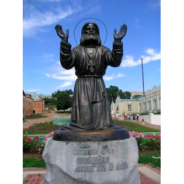
Seraphim had traveled into the city to attend a very important trial. His presence had not been demanded or even requested but yet he had made the long and arduous journey in spite of his injured back and new physical deformities. Of course, his presence was received joyously because his reputation preceded him. The people were happy to see the Russian holy man who had grown up and experienced notable visions throughout his life. Seraphim had been the son of a loving merchant and wife who had raised him within the faith that would form him for the remainder of his life. He had become a novice monk at a young age and had devoted himself to hermetic and ascetic practices in the outlying regions of the Russian countryside. Yet in spite of his hermetic desires and tendencies, people were constantly traveling to visit and study under Seraphim in his hermitage. He had few opportunities to be alone but he was a spiritual mentor and confessor to many. He was known for one supreme teaching: “Acquire a peaceful spirit, and thousands around you will be saved.” Yet, they were still surprised to see him draw close to the court.
Hunched over his cane, he could barely walk and so the entrance into the courtroom was a long and protracted affair and every eye was upon him–especially the eyes of the defendants. The judge allowed Seraphim to draw close and offer testimony. After all, the defendants were charged with assaulting and beating Seraphim before attempting to rob him. They had crept into the clearing near his hermitage while remaining ignorant of who it was they were planning on taking advantage of. “My joys!” Seraphim exclaimed in greeting to the men as he left his hermitage, “Come now and join with me to eat.” He gave the first surprised thief a kiss on one cheek before being bludgeoned in the back by a second thief. A painful shock coursed through his body as his legs collapsed beneath him. Once he had fallen, they began to savagely beat and abuse the old man. As he moaned in agony with a broken shoulder and bruised bones, they roughly looted his person before going to his hermitage to finish the job. In the hermitage they found a bowl and only one item of any value: an icon of the virgin Mary. In shame, they fled from the place but their flight was observed by a pilgrim who also found Seraphim beaten and slowly dying. They were turned over to the government to be judged but Seraphim insisted on being there–even if it tortured him to travel and be present but he had a compelling reason to be there: to plead for the mercy of the court for his attackers.
History doesn’t record the fate of the men who assaulted and debilitated poor Seraphim but we do know that his earnest plea for mercy was received with surprise but also a delightful sense of expectation–the people knew that mercy and peace were the governing forces in Seraphim’s life. He could not imagine seeking punishment for the men even though they had revealed their most savage aspects to him and the world expected him to seek vengeance. Instead, he returned love and grace for their blind hatred and rage. For the rest of his life he pushed himself to delve deeper into the spiritual life of renunciation and discipline. Even though he had been nearly crippled, he was devoted to physical disciplines that would have been taxing for anybody. The pilgrims never stopped coming and Seraphim never stopped greeting them with a kiss and open arms–this is what he had been called to and this is what he lived out.
Read more from Joshua Hearne at his personal website and the website of Grace and Main Fellowship, the non-traditional community he ministers with.
Reflections on Mary’s Story

A Sermon presented to St. Charles Avenue Baptist Church on the text Luke 1:26-38
These verses tell us of the beginning of Mary’s story, but the Gospel of Luke begins a few verses earlier, with the retelling of another parent’s encounter with an angel. This sets up a beautiful literary parallel between the story of Mary, a lowly servant, and the story of Zechariah, a priest of God chosen by lot to enter the sanctuary of the Lord.
According to Luke, when Zechariah enters the sanctuary while fulfilling his duties as priest, an angel of the Lord appears to him and says that his wife Elizabeth, an older woman who has not yet conceived a child, is going to have a baby boy. Zechariah questions the angel and thus is rendered silent, unable to talk until the child is born and named John.
Mary, chosen by God, sees an angel too, but not in the sanctuary. This angel, Gabriel, tells her that she, like her cousin Elizabeth, will bear a son, in circumstances which also make conception seem impossible. But Gabriel proclaims, “All is possible with God.” Mary’s audible response to the proclamation is, “Here am I, let it be.”
A child herself, so perhaps because she is still so young, Mary has faith that God’s promise to her ancestors of a Savior is to be fulfilled.
With the parallels in these two stories—and there are many—the larger conclusion is that new life, in the form of two baby boys, is coming to all. Zechariah represents those involved in the leadership of the temple. Zechariah and Elizabeth represent the older generation. Mary represents the lay people, those not given opportunity to enter into the sanctuary and she and Joseph represent the younger generation.
Mary’s significance continues. As though her being chosen to carry the Christ-child isn’t blessing enough, she is also allowed to announce his coming. In proud declaration to her cousin Elizabeth she says, “for the Mighty One has done great things for me, and holy is his name … He has helped his servant Israel, in remembrance of his mercy” (v. 1:49, 54).
She carries the child and for weeks feels his hands and feet pushing around in her belly. She sees the changes in her body and deals with the rushes of hormones and emotions that naturally come with pregnancy. And in another act of faith, she travels with her unborn child, as her ancestors once had traveled through the wilderness with their children, from a town called Nazareth to a city called Bethlehem.
Mary gives birth in this new place and finally gets to see the hands and feet of her child. She gets to smell him. She can carry the child in her arms and she can pull him to her face. She can look into his eyes.
Just a few hours after my child Annie was born, when all was finally calm and quiet, I drifted off to sleep. After just a little while, I woke up, remembered that she was here, turned my eyes to look at her, and saw her eyes looking in my direction. She lay swaddled in her bed. The hospital cap nearly covered her eyes, but they peered out, just barely cracked open, as though they were trying to decide if all the newness they saw was worth the effort.
In just a brief moment, I realized that my brain already knew her. It’s very hard to describe, but I knew what she would smell like, what she would feel like in my arms, what her face would feel like if I pulled her to my cheek. I wanted to keep my gaze on her in the precious stillness of the moment and all the while grab her and bring her in to me. She was my baby and I knew her and I loved her with a fullness like no other I had ever known.
And so, I imagine Mary, lying in the stillness and quietness of night, opening her eyes to see her baby, and knowing who he was to her, his mother. But as her child looked back at her, I wonder how much deeper were the dimensions of their knowing of each other? No trumpet was sounding in those moments, no kingly robes clothed the child, and no table was filled with an abundance of food. Yet this child brought joy not only to his mother but also to a nation of wandering people. The verses ring true: “When the shepherds saw the child, they made known what had been told them by an angel; and all whom they told were amazed” (v.17-18).
It is amazing; this new life of one brought new life to all.
Mary knew, Mary saw, Mary held, and she treasured those things and pondered them in her heart. Oh how beautiful the gift of a child. Oh how beautiful the gift of this child.
These words are the poetry from a choral piece that I sang in my youth choir:
I shall know Him when He comes, not with sound of pipe or drum,
but by the holy harmony which His coming makes in me.
He shall wear no royal robe, or a crown of precious gold,
but He my Lord, my King shall be always, ever be there for me.
He shall not in castle, warm, live in splendor, safe from harm.
But in a manger, crude He’ll sleep, warmed by the breath of cows and sheep.
Come, Lord Jesus, tarry not. Find in me a resting spot.
My heart is open, come dwell within. Let life be born in me again.
By the holy harmony which His coming makes in me,
I shall know Him when He comes.
May we be like Mary: willing, faithful, and trusting in our God. May we delight in the birth of the Christ-child. May we treasure this gift and ponder these things in our hearts. May we allow our eyes to look up into the face of Emmanuel, into the face of one whom we already know, the face of one who already knows us.
Let us pray:
On behalf of all souls, we ask this thing: You have given us Joy, dear Lord. May we be bold enough to receive your gift.
Read more from Stephanie Little Coyne at her blog.
Favorite iOS Apps

If you or a loved one received an iPad, iPhone or iPod Touch this Christmas, you may be looking for app suggestions. Here’s my list of favorite apps.
Most are available for both the iPhone and iPad. I’ve organized these by type. To find one of these apps, just open the App Store on your device and search for the name of the app. You’ll be able to read about the app, see some screenshots from it, and read reviews before you choose to get it or not. Most are free, but not all.
1. Remember Everything
Evernote
2. Personal “Magazine”
These apps allow you to choose your interests and then deliver a sort of magazine with just the sort of things you like most:
Zite
Flipboard
3. News & Weather
NY Times (paid sub required)
NextDraft (witty, curated news collection for each weekday)
Baptist Joint Committee for Religious Liberty (webapp – not in app store – click here using your iPad or iPhone)
USA Today
CNN
MyRadar Weather Radar
Weather Channel
4. Watch (Movies & TV shows)
Netflix (subscription required)
Amazon Instant Video (if you have an Amazon Prime account)
Flixster (get info on current & upcoming movies, get showtimes)
TV Guide
IMDB (International Movie Database)
iTunes U
TED Talks
5. Sketch/Paint/Draw
Paper by FiftyThree
Penultimate
7. Read
iBooks (Apple’s ereader)
Kindle (Amazon’s ereader)
Nook (Barnes & Noble’s ereader)
8. Sports
Sportacular
ESPN
9. Open Files
GoodReader
Dropbox
10. Radio
Pandora
NPR
NPR Music
Podcasts
SiriusXM (subscription required)
11. Shopping
Amazon
eBay
Target
Walmart
12. Write
Pages (word processor)
IA Writer (text editor)
13. Be Social
Facebook
Twitter
Google+
Pinterest
14. Photos & Video
iPhoto (edit photos)
iMovie (edit videos)
Flickr (take, edit & share photos)
Camera+ (take, edit & share photos)
15. Social Games
Words with Friends
16. Lifestyle
Food Network in the Kitchen
Evernote Food
Yelp (find restaurants, stores, etc near you)
Starbucks
17. ToDo & Projects, etc.
Things (not free)
Wunderlist (free)
Basecamp (must have a Basecamp account)
Keynote (presentation slides software)
And, of course, Faithlab’s blog is mobile-optimized, so you can view it anytime!
Follow Us!