
Put Down Your Weapons, Please!

I write this knowing that I don’t have a strategic plan for how to make this world, this country, or this state I live in a less violent place. I write this more than a decade after 9/11 and less than 3 months after the Newtown massacre. I write this as the debate on gun control escalates, even within faith circles. I write this knowing that people who are otherwise gentle people insist they would use violent means to protect their own lives or those they love. I also write this with a clear vision of what my faith, as an aspiring follower of Christ, calls me to.
Among others, I’m grateful for Alan Storey of South Africa, whose reflections on the great flood story and whose prophetic words to the Church have compelled me to speak out on the critical condition of our violent world.
As an adult, I have often wrestled with the great flood story in the Book of Genesis and what it says about God. I invite you to read it to refresh your memory – Genesis 6-9. I encourage you to listen and look deeper than the animals boarding the ark in pairs or the dove coming back with an olive leaf. I challenge you to hear the cries of people and their children as they’re drowning and to see the carnage of decaying bodies as the waters recede. And I ask you to please notice that despite the plan for the flood to wipe evil off the face of the earth, wickedness remained. This master plan – based on the all-too-familiar idea of dividing the good people from the bad people and destroying the latter to make a better world – this plan failed. What becomes evident is that even God could not use violence successfully. Let me say it again, even God could not use violence successfully. And unlike much of our world, God repents and promises to never use such a weapon of mass destruction again. As Alan Storey so aptly put it, the flood story is the great narrative of the disarmament of God.
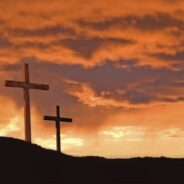
As we read the Gospel accounts of the life and teachings of Jesus, we find that God has indeed laid his weapons down and asks nothing less of us. No matter what rules we lived by before, Christ commands us to not just love our neighbor but also our enemy (Matthew 5:43-48). And he proved he meant it on the cross. The cross is, for me, a most unsettling yet clear symbol of God’s commitment to nonviolence – there we see that God would rather die than respond to our violence with violence. But not only did he refuse to retaliate or defend himself, he prayed for the forgiveness of those who hung him on that brutal tree. He responded to the perpetrators of such violence with compassion, aware that they were acting out of ignorance (Luke 23:34).
Honestly, I believe all violence is carried out in ignorance – out of a tragic lack of social and soul consciousness. Yet, how long will we remain so ignorant? When will we have the eyes to see, the ears to hear, and the hearts to hurt for each other? I’m not the first to ask this question, Bob Dylan was asking it in the 1960’s with his powerful protest song “Blowin’ in the Wind”, and Shane Claiborne offers a powerful evangelical voice crying out in our present-day wilderness.
Many of us have not known what it’s like to be a victim of physical violence or to lose someone in our personal circle of friends and family to murder or war. And many of us don’t know what it’s like to personally know a perpetrator of such violence. But if we draw our circles wider, which God continually calls us to do, we will find our own hearts breaking for the pain and loss our human family suffers.
For a brief moment after the 9/11 attacks on the U.S., Americans had a window into what it might feel like to live in a war-torn Middle Eastern or third world country. We were faced with the painful opportunity to love our enemy and become a better neighbor to the world. But the vulnerability was too much, so we boarded up that window, replaced our cross with the flag, and prayed for vengeance rather than the forgiveness of those that terrorized us. And then we proceeded to take thousands more civilian lives than were taken from us. That’s not even an ‘eye for an eye’, much less loving our enemy.
And then there’s the tragedy in Newtown, Connecticut this past December. I can’t talk or write about it without the tears welling up in my eyes. I mourn for the 20 young children, for the 6 courageous staff, and for all their families and friends. And I mourn for Nancy Lanza, a mother killed by her own mentally disturbed son. And I mourn for Adam Lanza. I grieve at the thought that throughout the nation, most church bells rang only 26 times. Some rang 27 times, but few rang a 28th time, to acknowledge Adam’s own tragic death. It’s as if his life and death don’t count, as if he didn’t belong to us, too. But he did, and until we can claim the Adam Lanzas as our own, I’m not sure we can really find our way out of this vicious cycle of violence we’re caught in.
You see, we look with horror at the tragedy of Newtown and we call the gunman a monster. We look back at 9/11 and call the terrorists evil. But we refuse to acknowledge our own role as gunmen and terrorists. We fail to hold ourselves or our government accountable for the deaths of civilians in other countries, including many children, as a direct result of our bullets, our missiles, our drones…not to mention the indirect results of our military strikes. Were the lives of the 178 children killed by U.S. drones in Pakistan and Yemen any less precious than the 20 killed in Connecticut? Desmund Tutu speaks truth to America when he says “Your response as a society to Osama bin Laden and his followers threatens to undermine your moral standards and your humanity.” Actually, I’d say it already has.
But it doesn’t have to stay this way, we’re still writing our story – we don’t have to continue down this bloody road, a road that even God found futile. We can repent, reclaim our humanity and refuse to respond to violence with violence. We can draw our circles ever wider. For those professing to follow Jesus, it’s time to realize we can’t carry our cross and carry a gun or flag at the same time. I started this blog saying I don’t have a strategic plan for making this world a less violent place, but the Indigo Girls just reminded me – the plan is simple but profound: “lay down your weapons and love your neighbor as yourself.”
Read more from Renee Sappington at her blog.
Janani Jakaliya Luwum, Martyr, Priest, Enemy of Idi Amin
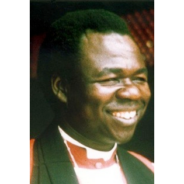
Janani Jakaliya Luwum knew that he carried only a letter and no weapons but he was aware that the actions he was setting himself about would carry violent repercussions. As Archbishop of the Anglican church in Uganda, he knew that critical words could very well result in his own death at the hands of the man whom his letter addressed: Idi Amin. Yet, he was gripped with a faith that said it would be better to suffer while speaking truth to the dangerous and powerful than it would be to poison his soul and mind by stifling the movement of the Holy Spirit. He had converted to Christianity when he was approximately twenty-six years old and had gone on to ministerial training the following year. Janani had taken vows before God and the Church that he would not shirk his duties as a shepherd and priest and in doing so he might have been signing his own death warrant. He was ordained a priest in 1954 and Amin came to power in 1971. Yet, Amin’s power could not deter Janani. So, he wrote a letter and personally delivered it to Idi Amin. The letter was a group effort of clerical leaders in Uganda protesting Amin’s way of keeping power and control through the easy distribution of military death to those who stood in his way. For bringing yet more attention to these deaths and disappearances–and especially for the letter–Janani was arrested and charged with treason.
It was January 16, 1977, when Janani was arrested along with two other cabinet ministers. Idi Amin and his henchmen immediately went to work spreading slander and lies about Janani’s politics and offenses. He was labeled a traitor and paraded before a crowd. As he and a large audience looked on, other men were brought onto a stage who confessed to knowing about and participating in illegal activities with Janani and his companions. Idi Amin insisted to all who would listen that Janani had been trying to initiate a coup against him and was intent on violent insurrection. The men who had confessed had never met Janani but Idi Amin had used them to implicate the Janani and his companions. The “confessors” were freed for they had done their part and there was never any intention to punish them–they were merely there to win the crowd’s approval. After the supposed “confessions” were heard, Janani and the men were put into a car to be transferred to an interrogation center. The next day, it was reported that they had crashed on their way to the interrogation center and all three had died from their injuries.
Yet, when they found the bodies and prepared them for burial they noticed that Janani had been shot multiple times are relatively close range. He had been shot once with a pistol in his mouth and three times in the chest. The story leaked out that they had been transferred to a military base where they were beaten, tortured, threatened, and finally shot to death. Idi Amin himself pulled the trigger that stole the life of Janani. He died a martyr because he refused to compromise the truth and he would not be frightened by the threats of those in power. For this offense, he died. By this offense, he proclaimed life deeper and more real than any that the world’s powers could offer.
Read more from Joshua Hearne at his personal website and the website of Grace and Main Fellowship, the non-traditional community he ministers with.
Faithlab chosen as launch partner
 Faithlab is excited to be chosen as a launch partner with TypeEngine, a new service that enables publishers to easily create and share elegant and fast-loading digital magazines through Apple’s Newsstand. Faithlab will be publishing a new magazine titled, Spare Change. We will be revealing more about the publication in the coming weeks.
Read the full press release below:
TypeEngine chooses 12 publishers to create iPad/iPhone-optimized magazines
Apple Newsstand platform opens beta to US, international digital publishers
SEATTLE, Wa 18 Feb 2013 – TypeEngine, an Apple Newsstand publishing platform, released the names of its launch partners prior to its roll-out in Q2 2013.
TypeEngine is part of the growing movement toward micropublishing and subcompact publishing, where magazines are specifically designed for digital platforms and their unique requirements.
Previously, digital magazines were designed with print aesthetics in mind, sacrificing functionality and user experience.
The first set of magazines to be launched span a wide range of topics and interests. Technology, music, market research, green living and crafting are among the themes represented.
Publishers are located in the US, Thailand and Australia. Where applicable, publication names were also shared. Titles may change closer to launch.
- The King’s Tribune
- 30 Day Books – The Write Life
- Frank Frank Frank – Frankly
- I Am The Lab – The LAB Journal
- The Faith Lab – Spare Change
- Logic Product Group
- Maritz Research – Research Forum
- Matthew Guay – Techinch
- Patrick Rhone
- Riccardo Mori
- The Mac Instructor – The Newsletter
- I Care If You Listen
TypeEngine creates magazine apps that are designed from the ground up for Apple’s iPhone, iPad and iPod Touch. Publishers own their apps, release magazines under their own names and get subscription fees paid directly to them from Apple.
TypeEngine will also submit apps for Apple’s approval on behalf of publishers, removing an important barrier to entry for independent publishers.
Images, video and audio are supported. TypeEngine’s web console allows writing and editing using MultiMarkdown and a multi-user editing workflow.
“Magazines are categorically not dead,” said Jamie Smyth, founder of the Smyth Group which is developing TypeEngine. “But regurgitating PDFs onto iPads is dead.”
“We are enabling both indie and business publishers to publish magazines optimized for reading on iPhones and iPads. Readers have suffered through slow-to-download, cruft-ridden PDF magazines long enough. We are helping writers and publishers create high quality reading experiences.”
The Smyth Group is based out of Seattle, Washington.
Philothei, Martyr, Spiritual Mother, Domestic Abuse Survivor
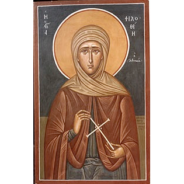
Philothei was a good daughter in an affluent family in Athens. She did as she was instructed by her parents and offered them her heart’s deepest love in return. When she was twelve, she was courted by a powerful and influential man. He was wealthy and involved in the politics and leadership of the city. She was very hesitant to marry, however, because she felt a calling that seemed to be at odds with marriage–passionate and sacrificial devotion to her Lord Jesus Christ. Yet, she was obedient to her parents who insisted that this man seemed like a good man and would surely give her freedom to express her faith as freely and clearly as she could.So, she was married to the man and she suffered secretly within his house and his embrace. He was an abusive man who routinely punished her for perceived slights and failures and insisted that she was an inadequate wife. She suffered his abuse–both emotional and physical–and continued to express her faith as she could but he worked hard to restrain her and limit her involvement in the Church she loved. But, no matter how hard he tried he could not turn her eyes and her heart away from the object of her devotion: her crucified Lord.
Philothei became a widow after three years of torturous marriage and she inherited his great wealth. She moved back into the home of her parents and continued to age and mature.She was unwilling to marry again and her family did not push her to do so. Perhaps they realized that the first marriage has been harmful and were unwilling to try again. Regardless, she spent his wealth in a variety of ways that aided the poor and the hungry. She didn’t see the great wealth as a thing to be used to defend or secure herself but as a commodity best used by distributing it among those with the most need.Her parents died when she was twenty-five and she was once again the recipient of a large estate. Now that she was no longer bound to a home and now that she had considerable wealth to spend on others, she took up a life of prayer and service that exceeded even her earlier devotion. The money was put into able hands that would administrate its use. In so doing, many churches and monasteries were built with it but Philothei had already turned her attention to founding a convent for women that she felt she had been directed to build by Andrew the Apostle in a vision. She did so and the convent became a refuge and sanctuary for women to flee to from abuse or persecution. A particular group of women–members of Turkish harems–became aware of this convent’s willingness to take them in and soon they were coming in droves. For her willingness to shelter these women from abuse such as she had received, she would be further abused.
The Turks who controlled Greece at the time were enraged that Christian women were helping their harem women to escape and so they began to apply pressure to Philothei and the women she was like a mother to. The politically minded hoped to crush her because of her resistance. The religiously minded hoped to afflict her and persecute her until she converted to their own religion. If they could crush or convert her, they suspected that they could do the same to all who shared her devotion to Jesus. They reasoned that she was a prime target because she was a woman and would be unable to stand up their abuses because of her sex. Neither group was successful. When they had given up on coercion, they resorted to violence. They knocked down the doors of the convent and drug her into the street by her hair. They beat her savagely while demanding she renounce her faith. She refused their demands and offered forgiveness to them for their abuse. For this, they beat her further. She died of her wounds while professing a faith that taught her to love her abusers and give her life for others.
Read more from Joshua Hearne at his personal website and the website of Grace and Main Fellowship, the non-traditional community he ministers with.
Giving Life for Lent

Remember that you are dust . . .
I dread Ash Wednesday as much as I need it. It isn’t fun being reminded of your humanity. It isn’t fun to impose ashes on friends while repeating the words that they, too, will return to dust. It isn’t fun, but it is holy. I need to reflect on my own death and realize the finality of that—and those—around me. I need to be reminded to love now, to give now, to be now.
Part of that reflection leads me to consider others around the world. 780 MILLION people lack access to clean water, a statistic that serves as a death sentence for far too many. The good news is that we can help. $25 provides clean water for one person for life. In a very practical way, it gives life. During Lent, I am giving up all beverages other than water. I am also invited you to participate with me in giving life to 40 people. I have set up a water.org fundraiser here: http://give.water.org/f/jenniferhd/ Will you consider giving and/or spreading the word?
photo credit
Read more from Jennifer Harris Dault at her blog.
Yoga Theology: Learning to Like What We “Hate”

In yoga class this week, when the instructor asked for suggestions, someone said, “Triangles.”
Triangle is a popular standing pose that students of any level can practice, and we did multiple variations of it.
At one point, as we were holding the pose, the instructor commented that some people hate triangle pose. I don’t remember what else he said because the words hit me hard.
I was one of those triangle-haters. In the thirteen years that I’ve been practicing yoga, I inwardly, and sometimes verbally, voiced my dislike of triangle. What made the dislike even worse was that it seemed like we did triangle in every single yoga class I attended! When I was teaching yoga, I did put my opinions aside and would lead the class in triangle. But I would get them into the pose and rarely ever practice it with them. I used the excuse that I needed “to adjust them.” That was only halfway true. Teaching the pose seemed a perfect way of out of practicing it in class.
Yet, on Tuesday evening, I found myself in the pose. And I was content. I had not resisted the suggestion of a triangle-themed class. The mention of triangle pose had not made me say, “Grrrr.” It had even taken me a few minutes to remember my previous distaste for the pose.
Without thinking, I had let go of “hate.” And to my surprise, I’d actually started liking that which I’d hated. The sudden acceptance of triangle pose developed not because I consciously willed myself into liking it. The surprising affection for triangles was not of my making. In the past, no matter how much I moaned and groaned, I would still do the pose. I would grit my teeth, clench my jaw, and find my way into it. I did it because I knew that it was an excellent stretch. I continued to practice it because I knew there were long-term benefits. The feelings were there, but I tried not to let those feelings control my actions. And without even realizing it, one day the dislike was gone.
In life we all have “triangle poses”: those activities and obligations that are necessary but not well-liked. We also may have to deal with people we’d rather avoid. In his letter to the Philippians, Paul encourages the Church (and us) to “press on toward the goal to win the prize for which God has called us.” He acknowledges that none of us have “arrived at our goal.” Like the Philippians, we still struggle with dislikes and resistances. We fall short. But Paul basically tells us: “keep on going.” Keep on trying. Keep on loving. Keep on practicing. Don’t try so hard to change the way you feel. Instead, keep on looking towards the example of Jesus Christ. When we get our eyes on the goal and off of that which we “hate,” one day we realize that the hate not only fades, but also that he is transforming it into a liking.
On what are your eyes focused today? The drudgery of a “triangle pose”? Or on the One who changes us when we can’t change ourselves? Lift your eyes, friends. Look ahead. He is working all things for our good–even what we don’t like.
all good things, including triangles, to each of you,
Pastor Darian
Year of Jubilee
I can’t get over yesterday’s lectionary gospel passage. I’ve been thinking about it all week.
Then Jesus, filled with the power of the Spirit, returned to Galilee, and a report about him spread through all the surrounding country. He began to teach in their synagogues and was praised by everyone.
When he came to Nazareth, where he had been brought up, he went to the synagogue on the sabbath day, as was his custom. He stood up to read, and the scroll of the prophet Isaiah was given to him. He unrolled the scroll and found the place where it was written:
“The Spirit of the Lord is upon me,
because he has anointed me
to bring good news to the poor.
He has sent me to proclaim release to the captives
and recovery of sight to the blind,
to let the oppressed go free,
to proclaim the year of the Lord’s favor.”
And he rolled up the scroll, gave it back to the attendant, and sat down. The eyes of all in the synagogue were fixed on him. 21 Then he began to say to them, “Today this scripture has been fulfilled in your hearing.” (Luke 4:14-21 NRSV)
Robert Parham, executive director of EthicsDaily, suggests “Luke 4:18-19 is one of the most ignored, watered down, spiritualized or glossed-over texts in white Baptist pulpits, evading or emptying Jesus’ first statement of his moral agenda.” (Thanks to Heather Entrekin for pointing me to the article). While Robert is writing to and from a Baptist context, I’d suggest that the neglect extends far beyond Baptist life.
The truth is, as exciting as encouraging as this text is, it is hard. The church where I work hires homeless individuals to do the custodial work in exchange for room and board. In the six months I’ve been here, we’ve had an overturn of three guys (luckily at least one of those was to his own apartment — which is the goal).
These last six months I’ve also been a volunteer for the Community Mediation Program (through the Mennonite Peace Center). The most peaceful agreements I’ve seen parties (usually neighbors) come to is the decision to act as if a restraining order is in place — they decide not to have eye contact, not to talk to one another, not to talk about one another, not to call city services on one another (for the uninitiated, one of the ways to get at your impoverished neighbors is to call various city agencies and make claims of rats, garbage, etc. Your neighbor then has to take a day off work while folks determine that their home is not, in fact, infested). And while this kind of “peace” is better than pursuing a violent end, it isn’t exactly good.
Declaring a year of jubilee isn’t easy. It involves moments of wanting to pull your own hair out. It involves walking into someone else’s imperfect story and loving someone in the midst of terrible decision making.
But I can’t help but wonder what it would look like—how we would live—if we truly believed that this was the year of jubilee. Yesterday my church joined with others across the world in declaring it so. And I was thankful that it was also membership day to show that we need one another to live out this declaration. And I need all of you. What are your ideas? What are the cool things you are doing to proclaim and live out the good news to/for the oppressed? How might we be God’s agents in making this world more awesome?
Read more from Jennifer Harris Dault at her blog.
Reading the Song of Songs in a Bar on a Friday Night

A few months ago, on a Friday afternoon, I flew into the Memphis airport after a visit with family. Not wanting to drive home after dark and wanting to extend my vacation time, I checked into a hotel and went in search of food. The restaurant choices were numerous, but the lines of people waiting for tables were long. So, I opted for a favorite pastime, something that I did on a regular basis when living in more urban areas.
I sat at the bar, ordered a glass of wine, ate a hearty meal, and read.
In all honesty, the last thing I wanted to read was the Bible. After all, I was still on vacation. I wanted to disconnect. I wanted to read something completely “unspiritual”: an interior design magazine, a travel novel, or maybe one of those paperback romances with Fabio on the cover. Well, Fabio is an overstatement, but suffice it to say that I was not in the mood for anything too “serious.”
Yet somehow, my e-reader ended up on The Message, Eugene Peterson’s fabulous, modern translation of Scripture. As I browsed the “Table of Contents,” my eyes fell on the Song of Songs, a fabulous poem attributed to Solomon. I had a flashback to my Old Testament class in seminary, when a young teaching assistant “taught” us the Song of Songs in one 90-minute class. I remember only two things about the lecture to 100+ students: his first sentence and his last sentence, which were the same.
“The Song of Songs is a very sexy book.”
As I sat at the bar, that grad student’s words came back to me. And I regrettably realized that all I could remember about the Song of Songs was how the grad student opened and closed that lecture. I hadn’t read the book in whole since seminary. I turned to the appropriate page and began reading as if it were any other book.
And I was blown away. What was before me was not something that I needed to interpret or exegete or figure out. Yes, I agree that it is sensual. It understandably makes some people nervous with its often-explicit language. But it is also a simply fabulous piece of writing about love. I read it once, then read it again. I found myself reading some of it out loud in a whisper under my breath. The Word was not any less sacred by being read in a bar. It became more sacred as I saw it alive in the people around me.
There was a mix of single people on barstools and couples at tables. Some were holding hands, others were making small talk, and some like me were just trying to stay in their own worlds. Friends were catching up after a day at work. The guy two barstools down from me attempted to flirt by asking why I ordered potato soup over tomato.
In all of these interactions, what I witnessed was a longing for belonging, a reaching out for relationships. That’s what we witness in the Song of Songs, too. We have an everyday desire to connect with one another as the lovers do. The Word of God affirms that these longings, relationships, and desires are part of the humanity that God created us to be. Scripture is wrought with meaning, with metaphor and allegory that point to a mystery beyond ourselves. But sometimes, why don’t we just read Scripture for the spectacular writing that it is?
Dear lover and friend, you’re a secret garden,
A private and pure fountain.
Body and soul, you are paradise,
A whole orchard of succulent fruits—
Ripe apricots and peaches,
Oranges and pears;
Nut trees and cinnamon,
And all scented woods;
Mint and lavender,
And all herbs aromatic;
A garden fountain, sparkling and splashing,
Fed by spring waters from the Lebanon mountains (Song of Songs 4:12-15, The Message)
In a world where we tend to take ourselves too seriously, would you join me in simply enjoying God’s Word? Would you be willing to read the Song of Songs in a restaurant or Genesis at a family reunion or Revelation along the beach? Let us seek such unusual times and places to read God’s unusual love story to us. Who knows what we will learn as we see the Word not just on the page but also in the people around us?
all good things to each of you,
Pastor Darian
Read more from Darian Duckworth at her blog.
Who Will Remember You?
Lent 1
Ash Wednesday
The Egyptian Pharaohs were concerned with their immortality. To insure safe passage into the afterlife, they built huge pyramids, which housed their mummified bodies at death. When death came, these mummies were buried in tombs along with food, valuable jewels, and immaculately designed masks and ornamentation, which they thought would assist them in the afterlife.
Modern man has considered such efforts to achieve passage from one life to the next the misguided hopes of an ancient civilization. However, the Pharaohs’ quest for immortality has not been abandoned. Our methods are simply more sophisticated. For many people in the modern world, the quest for immortality has little to do with living again in another world.
The primary twenty-first century way to immortality is to make sure our heroes and sometimes our villains are never forgotten. People of fame have become the Pharaohs of our society: sports stars, millionaires, those with political clout, national heroes, and movie celebrities, to name a few.
Will the Beatles ever be forgotten? Won’t all future generations see the film clips of Jesse Owens demoralizing Adolf Hitler and his idea of a superior race during the 1936 Olympics? Will the world ever forget the likes of John F. Kennedy or movie stars like Marilyn Monroe and Elvis? Is there an American who has not seen footage of Neil Armstrong taking the first steps on the moon? These people will never be forgotten, nor should they be. For many, this is the meaning of immortality, to never be forgotten.
Some of us may be fortunate enough to have fifteen minutes of fame, a phrase coined by artist Andy Warhol. But only a small number will be remembered forever. Thus, for many, lasting memory among the masses has become the ticket to immortality.
To have one’s life and accomplishments recorded through the lens of a camera, to have one’s life catalogued in a hall of fame, or to have one’s work displayed in a museum—these are the pyramids of the twenty-first century.
Even those who espouse evil can achieve a twisted celebrity status that spans generations. Hasn’t the name “Jesse James” survived more than a century? Won’t people forever remember John Wilkes Booth and Lee Harvey Oswald? The promise to never be forgotten seemed to drive the insanity of Timothy McVeigh. Some people are driven by the thought of living forever in infamy.
Like the ancient Egyptians, we believe that as long as a few make it to immortal status, albeit an earthly one, then life will have been worth living. Like the workers who built the great pyramids, we are developing a culture that seeks to make some people into gods.
We pay our homage to them and help feed the false belief that what matters is that centuries from now people will be talking about some of us.
Only a few of us will be remembered in books or in film, have buildings named after us, or be known for some great heroic deed or discovery. As important as such contributions may be to modern society, none of this changes the fact that the grave awaits us all. In the end, the grave is the great equalizer. The grave is a chilling reminder that regardless of how much one is adored, appreciated, loved, or even worshiped, death comes to everyone.
When death comes, what will be of ultimate importance isn’t whether we are remembered by people, but that the Creator of the universe remembers us. Will our name be written in the Lamb’s Book of Life? For if it is not, we die not only once, but twice. This is the vision the Apostle John saw and wrote about in the Book of The Revelation: “The lake of fire is the second death. If anyone’s name was not found written in the book of life, he was thrown into the lake of fire” (Revelation 20:14-15).
A man dying on a cross on a hill in Jerusalem two thousand years ago found the key to eternal living just hours before he died. Turning to a holy man who was being crucified beside him, he said, “‘Jesus, remember me when you come into your kingdom.’ Jesus answered him, ‘I tell you the truth, today you will be with me in paradise’” (Luke 23:42-43).
It’s not likely that we will accomplish anything in life that will cause our names to be remembered beyond a generation or two. But that kind of immortality shouldn’t be of concern to us anyway. What should be important to us is whether Jesus remembers us and allows us to be present with Him in paradise.
So the pondering of our mortality is important because we must face the fact that beyond this life we will either live forever with Christ or we will be forever separated from Christ. It’s highly unlikely that we will live forever with Christ if we have never pondered our mortality. For if we never think about dying, then how can we ever think about living eternally with Christ?
To put it another way, a sure way to find ourselves in the worst kind of wilderness is to never ponder the thought of one. Being separated from Christ is the worst kind of wilderness a person can ever be in. If a person is separated from Christ at death, that wilderness experience will last for an eternity.
Today is Ash Wednesday. This is a day on which Christians ponder our mortality. We encourage all people to focus on words like these found in James: “What is your life? You are a mist that appears for a little while and then vanishes” (James 4:14).
When we take inventory of our lives, we can reevaluate our priorities. We can ask ourselves whether we are placing emphasis on the most important things. If not, we can make midcourse corrections. If little things are claiming the most important spots, we can make changes, lest we find ourselves wandering in a wilderness.
At an Ash Wednesday service, a minister takes some ashes, places them on a person’s forehead, makes the sign of the cross and says something like, “Remember you are dust, and to dust you shall return. Turn away from sin and be faithful to Christ” (Genesis 3:19 and Mark 1:15).
Most people feel a little bit uncomfortable walking around with an ashy cross on their foreheads. It’s a bit humbling actually. Those who experience this service in the morning go through the entire day, not just thinking about their ashy forehead, but about the deeper meaning, that they should repent of any sin that is present in their lives. It’s also a reminder that sin is ultimately what causes death and makes all of us return to dust.
It is our sin that creates some wilderness experiences in our lives: dead places where joy, love, peace, and hope dry up and wither away. Through repentance we can put the wilderness in perspective. Through repentance, the wilderness can bloom and come to life.
During this first day of Lent, we prepare for God to come afresh in our lives. We prepare for God’s victory over death in the Easter event, which gives us the great hope that we too will one day receive that same victory. On that day, death will once and for all be defeated, when the dead in Christ shall rise.
Until then, the sign of an ashy cross is a reminder that although death will come to us, we don’t have to live in a wilderness of fear or despair. Death doesn’t have the last word!
While we may be forgotten by future generations, it won’t matter because we have the same promise given to the thief on the cross who asked Jesus to remember him. Just as Jesus promised that sinner a place with Him in paradise, Jesus extends that same promise to all who place their faith in Him.
Prayer
God of Life,
We are nothing but dust. We are soil. We are worm food. In Your overwhelming grace, You gave us life and instructed us to take care of the world and everything in it. We confess, Lord, that we waste Your gift and do not fulfill our calling. Instead, we use our time clinging to pride, feigning self-sufficiency, and worshiping celebrity.
On this day we stand at the edge of Your wilderness. You call us to leave behind the sins that have covered up our need for You. You call us to face the reality of death. You call us to journey through Your wildness, to learn and grow in Your ways, ways which don’t make sense to this world. You call us to come before You as our true selves, ashamed and terrified of being forgotten.
As we wear these ashes today, may this death mark remind us of our need for You, God of Life. Without You we would have no breath. Without You we have no hope for life. Give us strength to take our first steps in this wilderness journey, though they seem difficult and strange. Guide us through this barren land of sin and shame toward Your glorious Garden of Life. Amen.
This post is a sample meditation from “Finding Our Way Through the Wilderness: A Journey for Lent or Other Days of Spiritual Reflection and Prayer” by John Michael Helms and Erica Cooper. Get the ebook here.
In God We Trust?

I have to confess. I’ve been having some “bad” thoughts. Facebook is the cause. I don’t spend a lot of time on Facebook. Mostly I scan through some time during the day to see if any of my friends have posted anything interesting.
There are some interesting things on Facebook. I have seen some photos of “friends” I would rather have not seen. Don’t misconstrue. None of my friends have posted nude photos, but some photos have been rather revealing—revealing of my friends and revealing of where they’ve been spending their time. Other friends have posted some comments . . . well, let’s say unbecoming of professed followers of Jesus. Some of my friends hold some pretty extreme political and social views, and they frequently post long rants, sometimes self-authored but often copied from some other friend’s posting. They post and post, leaving it there for all to see, including me. I find myself wondering, Do they remember that I am on their friend list?
As I said, I’ve been having some “bad” thoughts, and they stem from what I read on Facebook (and other places) and from my belief in and trust of God. There! I’ve said it. In God I trust! Dare I go further? Yes! I belong to a group—a local church composed of folks who have made a commitment to be Jesus-followers. Collectively, we declare, In God we trust! And in varying degrees, we actually do.
Some may think that my admission that folks in our church trust in God to varying degrees is itself a “bad” thought and a sad commentary on my fellow Jesus-followers and me. It is not; it is an honest admission; and the last time I checked, God liked honesty. Most of us want to trust all the time, but there are times when our trust level is not as high as it is at other times. This is not my “bad” thought.
My “bad” thought comes when I read posts about keeping “under God” in the pledge of allegiance to the flag of the United States and about keeping “in God we trust” on our money. DON’T STOP READING; I’M NOT FINISHED.
The original pledge was written in 1892 by Francis Bellamy, a Baptist minister. Bellamy’s version is as follows: “I pledge allegiance to my Flag and the Republic for which it stands, one nation indivisible, with liberty and justice for all.” In 1923, the National Flag Conference called for the words “my Flag” to be replaced with “the Flag of the United States of America.” On June 14, 1954, President Eisenhower signed into law a bill inserting “under God” into the pledge. On the occasion of the signing, Eisenhower stated, “From this day forward, the millions of our school children will daily proclaim in every city and town, every village and rural school house, the dedication of our nation and our people to the Almighty. . . . In this way we are reaffirming the transcendence of religious faith in America’s heritage and future; in this way we shall constantly strengthen those spiritual weapons which forever will be our country’s most powerful resource, in peace or in war.”
I like Ike! I even like his statement, but there is a problem. Saying “under God” doesn’t make it so, no matter how many school children and/or adults say it. Oh, in the sense that all of creation is under God the United States is also under God. But shouldn’t under God mean more than that? Shouldn’t it mean something about submitting to the way of God? For those of us who are Christian (and we are the ones usually making all the noise), shouldn’t it mean that we are seeking to live in community, loving each other and our enemies . . . shouldn’t it have something to do with how we deal with poverty, slavery, personal and corporate greed, and acts of discrimination against individuals and groups with whom we disagree?
Under God and In God We Trust are not magical phrases that grant us special protection and privilege. For Christians, under God should remind us that we owe a higher allegiance to God than to country. As for In God We Trust printed on our currency, if we really believed that, we would spend more time using money for a greater good rather than buying the next bigger and better model of whatever we already have. If our trust were truly in God, would we sacrifice time needed for building marriages and raising children in order to make more money so that we can provide things for ourselves and our families without which we might actually be richer?
I’m glad to say: “I pledge allegiance to the Flag of the United States of America, and to the Republic for which it stands, one Nation under God, indivisible, with liberty and justice for all.” However if those words “under God” were not there, it would not change my allegiance to my country or to God. The United States existed 116 years without a pledge and 62 years with one that did not include those two words. It’s not the words that matter. It’s how we live under God.
Follow Us!