
A Friend of Nes Ammim

In that day, the stock of Jesse that has remained standing shall become a standard to peoples – nations shall seek his counsel and his abode shall be honored. -Isaiah 11:10
As you drive north from Acco towards Nahariyah you pass a large strip mall at the entrance to Moshav Regba. Branching off just before the gate of Regba is a narrow road that winds for a few miles through the avocado orchards that are characteristic of the Galilee coast, and ends at the gate of Nes Ammim. You enter a green and calm community, with large expanses of grass and well tended flower beds and shrubs along the paths and around the homes and public buildings. Nes Ammim was founded in the 60s by Dutch and German Christians seeking a place where they could get a deeper understanding of Judaism and Israel, and facilitate reconciliation among people of all faiths. “Nes Ammim” means “a standard to peoples,” from the verse quoted above from Isaiah. In the early years there was some opposition from local Jews to the establishment of a European Christian community in the neighborhood, but the rabbi of Nahariyah and several other public figures came to their support.
Originally they operated as a sort of quasi-kibbutz, with several businesses owned by the community and operated by the members – flower hothouses, avocado orchards, a carpentry shop, and a hotel. However, if real kibbutzim have had a hard time surviving, this community, which remained quite small (under a hundred inhabitants even in the best of times), and which never really had a full-time, long-term population, has struggled to make it economically. Generally, the “members” consist of families and individuals coming to spend anywhere from a few months to a few years here, mostly from Europe but with a smattering of Americans. They come to experience Israel, to volunteer in the community, to learn about Judaism. Today, the only business remaining is the hotel. There are about 40 residents, mostly young volunteers. The community continues to receive support from “Friends of Nes Ammim” groups in several European countries. Their “House of Prayer and Study” is a graceful, simple structure, a non-denominational chapel/community center where the residents meet to pray and study, and events are held for the wider community.
I have gotten to know and appreciate Nes Ammim over the years, as a participant in various events held there (e.g., Kristallnacht commemorations and interfaith conferences), and as a guest lecturer on Jewish topics for their volunteers’ study program and for visiting groups from abroad. I have gotten to know them better in the past year, as a member of their board in Holland is also involved in a youth circus there, and he has actively encouraged Nes Ammim to serve as a point of contact between our Jewish-Arab youth circus and its Dutch counterpart. Now we have a German college student who coached for the Dutch circus, doing a year-long internship with our circus, living at Nes Ammim.
I have found it fascinating and humbling to get to know, over the years, Nes Ammimers and other western Christian groups and individuals living in Israel – including a number of Franciscans and Carmelites stationed at monasteries around the Galilee. Not Crusaders, not missionaries, not waiting for Armageddon, but thoughtful people for whom this is place is special, holy – and who want to be in some way part of the project. They are “insider-outsiders,” seeing us close-up and sympathetically, smiling at our embarrassing behavior. Trying to see ourselves as they see us is a useful exercise in self-criticism and keeping things in proportion.
Rabbi Marc J. Rosenstein is executive director at the Galilee Foundation for Value Education, Shorashim, Israel. Learn more at www.eng.makom-bagalil.org.il
Katrina Recollections: Troy Lowry
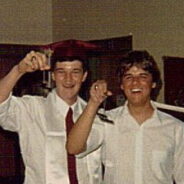
Troy Lowry (left) and Bert Montgomery holding their ZZ Top keychains. Destrehan High School, Destrehan, LA. May, 1986Editor’s note: Since last fall (2009) Bert Montgomery, a native of New Orleans and the River Parishes, has been collecting stories from his childhood friends, classmates, neighbors and church family about their experiences during after Hurricane Katrina. FaithLab is working with Bert to produce a book (both traditional print and e-book formats) and an interactive website to honor his friends and their experiences.
Throughout this fall – five years after Katrina – FaithLab is posting excerpts leading up to the book’s publication.
Troy and I graduated together — DHS, class of 1986. We probably met my first day of school at DHS, when I started there my sophomore year. We had almost every class together, and in those classes where we were assigned seats alphabetically, we were always sitting close to each other (sometimes right next to each other – which made for some fun in class). Troy and I always talked about Hulk Hogan, Andre the Giant, Captain Lou Albano, and the other stars of the mid-eighties’ World Wrestling Federation. And, he was as big of a ZZ Top fan as I was.
Once, in Mrs. Chaisson’s Honors English class, we were assigned to write our own epitaph for a homework quiz grade. First class – homeroom – the next morning, Mrs. Chaission starts collecting everyone’s brief assignment. Both Troy and I forgot to do it. “Oh well,” I said, “… just a quiz grade.” Troy took out a piece of paper and in less than a minute had written
“I’ve been bad; I’ve been good;
Dallas, Texas; Hollywood.
Here lies Troy Lowry.”
He turned that in and got a full quiz-grade credit for plagiarizing ZZ Top lyrics; I was sitting there with a big fat zero.
Troy grew up in Norco and lived in St. Charles Parish for twenty-six years. He lived for five years in Texas, but now makes his home in the town of Prairieville (Ascension Parish). At the time of Hurricane Katrina, Troy and his family (wife, daughter, and a new-born son) were living in League City, Texas.
Tell me about the week leading up to Hurricane Katrina: What were you hearing on the news and from family/friends? What were your initial thoughts?
News out of the Houston area was gloom and doom for the New Orleans region. The first minutes of each news broadcast focused on the oncoming hurricane. Some on the local radio talk shows kept mentioning that the news media were using scare tactics. My family and friends were scared, and most of them were planning to leave town.
Initially I thought as I always did growing up in that area – that the hurricane would miss the region, and it would be nothing more than a rain/wind event with some flooding in the low-lying areas. I felt helpless (watching all the reports), but still I did not believe it would be a direct hit.
Soon we were housing my mother-in-law, and my wife’s friend, friend’s son, and friend’s mom and dad.
You were watching from your house in Texas. Katrina makes landfall, passes over, then levees break . . .
I felt totally helpless, and I must say that for the first time I could recall, I cried openly watching the news. At work that Monday morning all I could do was glean what I could from the local news, radio and internet. I was pretty much addicted to the news 24/7.
My mother-in-law was frantic because of all the reported flooding in her region (Kenner). I was able to find aerial photos posted on WWL-TV’s website and show her that her fence was down, the roof had some damage but that she didn’t flood. I’ll never forget the pictures of the pools with brown water. Pools closest to her home were still blue, and based on that and the debris line being about one foot from her door, I was able to determine that her house did not flood (and, it didn’t). Kudos to WWL-TV for posting those photos!
I was thoroughly disgusted with people calling the local talk radio in Houston. They called to request the radio station play “When the Levee Breaks” by Led Zeppelin. It was also amazing to hear the stories on the Houston news and national reports about why New Orleans should not be rebuilt. San Antonio openly courted and wanted the Saints; Galveston wanted Mardi Gras; Houston wanted Jazz Fest. It made me feel resentful to that region, and I still hold some of that resentment today. My Louisiana blood boiled over big time, and I never felt prouder to call Louisiana my home as I did then. To kick someone when they are down is one thing but to steal that which is ours … NEVER!
Evacuees (“Katricians” as they were affectionately called in Houston) were blamed for all sorts of problems in Houston. If a crime was committed in the Houston area by someone who fled New Orleans, the headlines were “Katrina evacuee wanted….”
The year Katrina hit, the Saints were displaced for their whole season, then the next year came back and got to the NFC championship. Is it possible to talk about the Saints of the last five years (especially winning the Super Bowl this year) without talking about Katrina? Why or why not?
I cannot imagine talking about the Saints and not thinking/talking about Katrina. I vividly recall New Orleans after Katrina, and keeping the Saints was right up there with repairing New Orleans. Sadly, I never was a big Saints fan growing up (I liked the Cowboys) and was only a casual fan up until Katrina.
Katrina changed that as my New Orleans pride swelled over when they reached the NFC championship game. I became a fan and even bought my first Saints shirt and hat. I have several hats and shirts now … but the numbers pale in comparison to my purple and gold collection (laughing).
What did the Saints’ Super Bowl season mean to you?
It put a lot of smiles on the faces of fans in and around the Gulf Coast. It also made me pause to remember lost loved ones who were ardent Saints fans but did not live to see the boys win it all. A dear friend passed away in July of 2009, and she was one of the biggest Saints fans I knew. I’m sure she was wearing her black and gold and leading the second line procession in Heaven after the game. I also will never forget my five-year-old singing “black and gold in the Super Bowl” every time he saw Saints memorabilia in a store.
Did you attend any games this past year and/or the victory parades? How did the Saints win affect Mardi Gras?
I did not attend any games and was unable to attend the victory parade (although I watched it on TV and cried like a big baby). We partied harder for Mardi Gras, and I never saw so many Saints jerseys gathered in one big party!!!!
© Bert Montgomery, 2010
Making a Fashion Statement
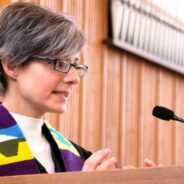

“Your husband should be the one wearing that shirt.”
I blink and look down. “This is what a preacher looks like.” I pause, wondering how to respond. The woman speaking to me is a friend, complimenting my husband’s recent sermon. The thing is, I agree with all of her praise – Allyn is wonderful and a fantastic preacher. Is that all she was saying, or was this statement implying something deeper – “only men can preach…” or maybe more cutting, “you just don’t have the giftedness, sweetheart?” I assumed the best. “Wasn’t he great? But this is a Baptist Women in Ministry shirt.”
A recent Associated Baptist Press opinion piece pointed out that we don’t have time to worry about the opinions of others when it comes to women in ministry. As much as I agree and want to follow, I’m just not there. It hurts to know that a significant number of Christians think I’m not qualified to be a pastor simply because I am a woman.
And I wonder about my job options. I don’t know of a single Baptist church in Missouri that has a female lead pastor. Yesterday, I was contacted by a woman moving to Missouri who wants to attend a Baptist church that is friendly to women in leadership. I had to admit that there just isn’t one in her area. I keep hearing about how far women ministers have come, and I am truly thankful for women and men who have fought for the opportunities that exist today… but as I look at the job market, I get discouraged at how far there still is to go.
My husband asked yesterday, “what is plan B?” I sighed and stated I’d turn to a different denomination. I admitted that my involvement in BWIM-Missouri – that my desires there – are an attempt to fight for my place in the denomination that raised me. If I have to turn elsewhere, I want to make sure that the next generation of women called to ministry has a place. I want theirs to be an easy battle. So I continue proudly wearing my “This is What a Preacher Looks Like” T-shirt. Maybe next time I’ll be a bit braver in conversation.
Read more from Jennifer at her blog.
Turning Lies into Truth

“I’m not sure what to do,” my friend lamented to me. “If I respond, I may just stir things up even more. On the other hand, if I remain quiet, people are likely think I have something to hide.”
My friend is a public servant, working in one of those jobs that no matter what he does he creates detractors, if not right out enemies. I asked him once why he did it. He looked at me like I had just arrived from an alien world and then told me. “I do it for the same reason you do what you do. It’s who I am and what I was put here to do.” Ouch!
What do you do when someone is spreading false tales about you? My friend and I continued our conversation. Sometimes one has to take a stand. When no one else is telling the truth, doesn’t the situation demand that you do so? Yet, sometimes remaining quiet is the way to still the storm. I ventured to remind him that those of us who knew him knew the truth and were not going to be swayed by lies. For several minutes we bounced such ideas around. We both knew that the decision as to what to do was his and that I was not going to tell him what he should do. His last word that day was, “I know what is being said is not true, but if a lie is told often enough it can come to be heard as truth.”
In the days since that discussion, I’ve thought of and prayed for my friend. I suspect that he will “lose” no matter what he does. Most days, I think if I were him I would remain quiet . . . but his last words haunt me. If a lie is told often enough it can come to be heard as truth.
I thought of those words as I read Jesus’ story about two men who went to pray. Like most “good” readers, I’ve usually identified with the tax collector—the good guy. I’ve always seen the other guy as a pompous hypocrite who played a role he knew to be false. Now I wonder. Did he know the role he played was false or did he believe he was the man he portrayed himself to be?
If a lie is told often enough it can come to be heard as truth, my friend had said. If a lie is lived long enough the one living it may come to believe it is real. Jesus said of the other guy that he left the hour of prayer no different than when he came—not justified.
When we read that story today, I fear we are so busy applauding the justified sinner that we miss the real tragedy of the story: that the other guy left unjustified and didn’t even know it. He couldn’t know it . . . couldn’t know it because he had lived the lie so long he had come to believe it. The man he pretended to be came to be the only man he could see.
Two men went up to pray. The one who did was the one who was who he was and who knew God was other.
The Brad Hibbs Effect

I realize that this sounds like a great name for an 80’s Prog Rock band, but this is actually a Leadership phenomenon that I have encountered, and one you might do well to be aware of.
First, an explanation. Brad Hibbs is a guy I knew in college, who I believe currently does civil engineering for North Carolina hiways. Please give him a shout out for me if you see him. When we were in school together, I wasn’t as good a friend to him as I should have been, but he was a great guy to know, and someone you could really depend on. I coached intramural basketball one year, and we put together a team that was pretty good. We weren’t great, but we held our own.
Brad was on the team, and to be honest, a pretty good player. His main liability as a player was that he was too nice, too agreeable, and too supportive. As a result, other players who badgered me for playing time got to play a lot more than he did, and I’m sure that we would have won another game or two had I just been willing to play him more. I was willing, but I knew that he wouldn’t hassle me about being on the bench, so I didn’t play him enough. To be fair, I didn’t play myself enough either, but I felt bad about leaving him out so others would be more cooperative.
I think that all of us have a tendency, when leading people, to act that way. Sometimes, people can be harsh and demanding. They may openly question you or your policies and, in so doing, make life difficult. At times like that, it often seems much easier to cater to such people, while passing over your supporters, however well-qualified they might be. In honor of Brad, I’ve called this phenomenon “The Brad Hibbs Effect,” and I’m defining it as “the tendency to disregard supportive people, regardless of their qualifications, in order to protect one’s self from criticism.” Yes, it looks like a failure of courage, or at least a conflict-avoidance mechanism, and it might even be a defense from charges of favoritism, at times,but I believe that it is something with which every leader has to struggle. We don’t want to unnecessarily favor one person over others, but is it really fair to exclude folks because they are supportive?
So, the next time you have to make a choice about who to rely upon; who to use for a particular job; whose perspective you need to show extra attention to, lest you offend; you might want to look deeply at yourself and those people who surround you and ask, “am I giving in to the Brad Hibbs effect?” Sorry, Brad. I wish it hadn’t taken me so long to understand this.
Miners, Jews and Evangelical Christians

A minor miracle occurred this week: 33 Chilean coal miners were rescued after being trapped underground since August 5 – including 17 days without being able to get word to the surface that they had survived the initial mine collapse.
As the men emerged from the earth on Tuesday, they were wearing t-shirts reading “gracias, Seňor” – “thank the Lord.”
The shirts were a gift from an organization called the Jesus Film Project, a ministry of Campus Crusade for Christ International, based in Orlando, Florida.
Jesus Film Project had distributed the shirts to the miners by contacting the family of Jose Henriquez, an evangelical Christian preacher and one of the 33 men trapped in the mine.
Henriquez had helped keep the men in good spirits during the ordeal.
On the back of the shirts was a verse from Psalm 95: “In G1d’s hand are the depths of the earth; the peaks of the mountains are G1d’s.”
The dramatic rescue of the Chilean coal miners demonstrates how a good story can captivate a global audience from Santiago to Malawi.
It also shows the reach and influence of evangelical Christianity – once, Latin America was the exclusive domain of the Roman Catholic Church.
No longer – today, the evangelical movement can get its branded t-shirts to the epicenter of the global news cycle in time to be featured on everyone’s tv, laptop, or smart phone.
The story of the miners and the way they turned to G1d in their ordeal evokes the so-called “coal miners’ prayer” of the original union prayer book of the reform movement.
What’s more, Psalm 95 is found in the opening passages of the Shabbat service recited by Jewish congregations around the globe for centuries.
Beginning in the 1990s and especially with the ascension to the presidency of evangelical Christian George w. Bush, the American Jewish community has encountered evangelical Christian support for Israel.
It is an unfamiliar phenomenon, puzzling or even alarming to many of us.
Evangelical support manifests itself in financial donations, political support for Israel in American policy, and moral and charitable support for Israeli Jews and offers of similar support for the American Jewish community.
Right here in St. Louis, within a month of the end of Israel’s 2006 Lebanon War, some 250 evangelical Christians gathered in Clayton to express solidarity and donated $23,700 for Israeli families injured or dislocated by the fighting.
Political groups like Christians United for Israel promise unconditional support for Israel on Capitol Hill.
According to Rabbi Yechiel Eckstein, founder and president of the International Fellowship of Christians and Jews, the group has given 100 million dollars to charitable causes in Israel in the last 12 months alone.
This week’s Torah portion, lekh l’kha, is not the beginning of the book, but it is the beginning of the Jewish narrative.
In the magnificent opening verse of our portion, G1d abruptly speaks to Abram (who will soon become known as Abraham), telling him, “lekh l’kha” – get yourself up, from your native land, and from your father’s house, and your birthplace, to the land that I will show you.”
G1d then apparently broke into song, as the verses take on a poetic cast – “I will make of you a great nation, and I will bless you, and you shall be a blessing.
I will bless those that bless you, and curse him that curses you; and all the families of the earth shall bless themselves by you.”
It can be astonishing just how literally some Christians take those verses.
Visitors to Jerusalem during the Festival of Sukkot will be treated to the spectacle of groups of Christian visitors from countries as far flung as Denmark, Colombia, and Japan marching in the municipal parade, invoking G1d’s blessing on their countries through blessing the stock of Abraham.
The American Jewish community is deeply ambivalent about Evangelical Christian support and alliances.
We have reacted in one of two basic modes: (1) eeek! And (2) “we need all the friends we can get.”
There are a few variations on eek! Mode:
Eek, they’re only out to convert us (or our children); and/or
Eeek, they only want to provoke Armegeddon with Israel’s rab neighbors and/or global Jihad; and/or
Eek, the evangelical social agenda is in many ways directly across the political line of scrimmage from the Jewish one, particularly the reform Jewish agenda – school prayer, abortion, legal protection for members of the LGBT community… the list of fights goes on and on.
On the other hand, the idea that “with enemies like these, we need all the friends we can get” has its proponents in the Jewish community, too, among a fairly broad political and denominational range.
In Israel, there is no ambivalence about evangelical Christian support.
Israel does not perceive itself as having the luxury of questioning what little international support it does have.
(Some wag said that Jews are democrats, Israelis are republicans.)
So what’s this got to do with lekh l’kha?
Well, we are surrounded tonight by tangible evidence of our congregation’s commitment to interfaith dialogue.
Not to mention, we are surrounded by proof of just how important the fruits of interfaith dialogue and understanding or at least respect and trust can be.
But some of those “eek!” responses have their merits.
Therefore, we, the American Jewish community should neither write off evangelicals nor accept support too freely.
We should engage in dialogue – and we at Temple Emanuel are well positioned to do so at the local level.
There are at least three motivations for evangelical support for Jewish causes.
I’m going to label these –first, eschatological; second, patriotic; and third, spiritual.
On a scale of 1 to 3, with 1 being worst and 3 being best, these are… first, eschatological; second, patriotic; and third, spiritual.
Eschatological means having to do with the end of days, final, climactic battles between good and evil, the arrival of the Messiah, and a day of judgment.
Most of the mode of Jewish response that I labeled “eek!” is due to a perception of support that is motivated by eschatological concerns: that the Christians only want us to convert, whether out of their own sincere imperative to spread the gospel or whether something darker, hoping to provoke an Armegeddon that will result in the final coming of the Messiah – who they believe to be Jesus.
Such concern is justifiable.
There is indeed an amount of evangelical support that comes from eschatological world views.
But the great thing about theology is that we can change it as often as we change our socks.
The pride and joy of Liberty University, founded by moral majority leader Jerry Falwell is its debate team, which routinely competes against teams of undergraduates from Ivy League colleges, the Stanfords and Carnegie Mellons of the country.
Liberty U’s debate program proves that however staunch they may be in their beliefs, evangelical Christians are capable of intellectual inquiry.
Besides, if evangelicals are motivated by a desire to proselytize, that’s a great question to bring to the table for interfaith discussion – when is proselytizing acceptable and when not?
The second motivation for evangelical support for Israel is the patriotic motivation.
Evangelicals are likely to be highly loyal to the United States (because, ironically, they’ve benefited from the separation of church and state just as Jews have).
Evangelicals are aware of the close alliance between the United States and the state of Israel, the democratic nature of Israeli society, and common values of our two nations.
They want what’s best for the security and welfare of the United States, and therefore they want what’s best for Israel.
This, too, reveals some fairly rich soil for the seeds of interfaith dialogue.
The evangelical community is criticized, in some cases quite rightly, for supporting only the right wing of the Israeli political spectrum, and for attempting to block any attempt to relinquish Israeli sovereignty over land conquered in 1967.
It’s worth having a discussion with what might be called the AIPAC wing of Christian Zionism, over Israel’s long-term security interests.
It’s also worth noticing that there’s little legitimate daylight between our communities over the issue of Iran’s nuclear ambitions and the dangerous ravings of Iranian President Mahmoud Ahmadinejad.
Finally, there is the third motivation, the spiritual motivation.
Evangelical Christians take Genesis 12:3 very seriously, and for some, maybe even the majority of evangelicals, the desire to attain G1d’s blessing by blessing the Israelites is the entire motivation.
Quite amazingly, there is no hidden agenda, just a sincere desire to obtain G1d’s blessing.
There is a vast acreage here of common ground waiting to be discovered.
Israeli-American essayist, political analyst, and gadfly Ze’ev Chafetz writes in his book, A Match Made in Heaven: “For now, they are not the enemy but the enemy of the enemy and they want to be accepted and appreciated.
In return, they are offering wartime alliance and full partnership in a Judeo-Christian America.
It is an offer the Jews of America should consider while it is still on the table.”
We have every reason to be concerned about Chafetz’s implicit characterization of “the enemy,” and about a Judeo-Christian America in an era of increasing American Muslim presence.
Still, his point is valid.
The experience of the Chilean miners shows that there are risks in maintaining our aloof posture.
Evangelical Christianity is a global force, smart, confident, assertive, adaptable, and fast.
The American Jewish community has much to gain by taking a closer look, by seeing it is not a monolith, and by opening channels of dialogue toward a more mutually respectful and beneficial partnership where possible.
Keyn y’hi ratzon.
So may it be G1d’s will.
Gracias, Senor; Sermon, 2010 Oct 15, 7th Cheshvan 5771, Temple Emanuel, St. Louis, MO
The Baptism of Jesse Taylor (His Faith Made Him Well)

I love Johnny Russell’s songs, and my favorite Johnny Russell song is “The Baptism of Jesse Taylor” (click here to listen). The first person I ever baptized was a man who, in many ways, reminds me of “Jesse Taylor,” so, I’ll just call him “Jesse.”
Jesse lived a hard life. Just a few years older than me, I’m not sure if he even finished high school. He did a lot of things he shouldn’t have, got involved with things he shouldn’t have, and he spent time in jail.
But eventually, he started to put the pieces of his life back together. He was a very good handyman, especially at painting.
People in our town, who had known Jesse since birth and knew his entire family, were willing to help him out. He stayed busy – some people needed some rooms painted in their house. Some needed outside painting done on their house. The church needed some painting here and there. A trained electrician, people called on him to help with some wiring, lighting and things. A good plumber, he installed new faucets for us at the church parsonage.
Jesse carried his tools around town in a pick-up truck and was accompanied by his trusted sidekick, a loyal and very sweet old dog named “Yeller.” Jesse seemed to truly enjoy his work, and he was very good at it – which meant he was often a dirty, unkempt, rough-looking handyman.
But, “Jesse Taylor” was one of the gentlest, kindest, most soft-spoken people I had ever met. And, he was one of the most gracious and merciful people I have ever met.
Jesse was thankful. Jesse was thankful everyday just to be alive. Jesse was thankful everyday that he didn’t have to be in jail anymore; thankful that God loved him when he was at his very worst; and thankful that God loved him when he trying as hard as he could to be his very best.
There were still a few folks in town, and even a few folks in the church, who still looked down on Jesse and treated him suspiciously. In their eyes, he simply was always going to be somewhat of a “lesser-than” person, a bit of an outcast.
Jesse, though, didn’t hold anything against anybody. Jesse became as accepting of and gracious to people he encountered as Christ had been so totally accepting of and gracious to him.
Luke’s Gospel tells about ten lepers who called out for mercy as Jesus was walking by. He instructed them to get up and go see the priests. As they were going on their way to do just that, they were healed. Luke stresses the ethnicity of one of those ten now-ex-lepers – a Samaritan. When the Samaritan realized that he was healed, he turned around and returned to Jesus, praising God the whole way. Jesus makes sure everyone knows that the other nine did not return; but the one who did was considered of a lower race, second-or-third-or-fourth class person who probably deserved to have leprosy anyway.
It is to this one that Jesus says, “Your faith has made you well.” The other nine were healed, to be sure, yet it is implied that only this one was “made well.”
I often wonder if many of us as Christians are like those other nine … taking our grace for granted; maybe because we secretly believe we deserve it – even when we say we don’t. How can we tell? Perhaps by how much grace we are willing to extend to others, or how much we withhold from others whom we “know” do not deserve it. I wonder if many of us as Christians, like those other nine ex-lepers, may be healed or redeemed, but we do not have the faith through which we will be “made well.”
Clearly, to me, “Jesse Taylor” was like that one who returned. Like the Samaritan, he was always going to be considered “not good enough” by some standards – always a convict, or “white trash,” or worse. Yet it was Jesse, far more than many of us, whose faith had “made him well.” How can we tell? By his giving out grace and compassion to others without restraint; just as God had poured out unrestrained grace and compassion upon him.
And it all starts with awe-filled gratitude to God. There’s something about being overwhelmed by God’s unconditional love that leads a person to unconditionally accept and love others.
The Samaritan wasn’t just healed; his faith had made him well. “Jesse Taylor” wasn’t just redeemed; his faith had made him well.
Here’s that we, too, may not just be healed, but that by our faith we may be made well.
And, thanks be to God for both Johnny Russell and “Jesse Taylor” who are now fully welcomed, loved, and healed, in heaven.
© Bert Montgomery, October 2010
What is Hateful to You, Do Not Do to Another.

I will start with a story that many of you may already know.
The two great luminaries of the late first century BCE Jewish world were Hillel and Shammai. One day a non-Jew came to Shammai and said, “If you will teach me all of Torah while I stand on one foot, I will become a Jew.” Shemmai, who was working on a project at the time, took the ruler he had in his hand and pushed the man away.
The man then went to Hillel and offered the same deal. Hillel replied, “What is hateful to you, do not do to another. That is the whole Torah. The rest is commentary-go and learn it.” (Adapted from the Babylonian Talmud, Shabbat 31a)
I do not want to understate the importance of the “go and learn it”, but my theme this evening is “What is hateful to you, do not do to another.”
When I was ten years old, a fifth grader, there was a boy in my class. I cannot remember his name and only vaguely remember what he looked like. In those days, things like cooties and similar stuff were taken seriously and, it was whispered, this boy had cooties and every manner of flaw. He was isolated and picked on mercilessly.
Looking back, I can see no reason for this singling out of one boy for mental cruelty and bullying. Perhaps he looked just a little odd or was quiet. I really have no idea. Yet the banter and gossip was enough that he gave me the willies. I had an actual physical reaction when I came near him in the form of queasiness- as if he really was some disgusting vessel of disease or plague.
I will admit that one time, I saw him walking home from school and I tried to play the bully myself. I wanted to be just like my friends and one of the guys. I felt bad when I tried my bit of shoving and teasing and horrible afterward. That afternoon, sitting at home, I decided that I would try to be nice instead of cruel. There was no moral or ethical theory in my 10 year old brain. Rather, there was a sense of wrongness in my child’s heart. I think the fact that I still feel some guilt over my attempt at cruelty tells you what an impression it made.
I kept to my resolution. I made it a point to always greet him and say hello and smile, even though I still had a physical desire to shy away from him. This happened in the spring of the year. I would like to think that I would have continued reaching out to him and we might have become friends. However, the next year, after a family move, I was at a new school and it was my turn to be the reviled outsider. I truly learned about “what is hateful to you, do not do to another.” I took some comfort, during my own experience, that I had already rejected the role of bully before I found myself in the role of victim.
My story tells us a little bit about the power of gossip, rumor, and innuendo. I had a physical reaction to that poor boy just because of listening to what was being said about him. The Talmud has much to say about gossip. It asks, “why is gossip like a three-pronged tongue? Because it kills three people: the person who says it, the person who listens to it, and the person about who it is said.” (Babylonian Talmud, Arakhin 15b)
It is said that tana recited before R. Nahman ben Isaac: “A person who publicly shames his neighbor is like someone who has shed blood.”
To which R. Nahman answered, “You have spoken well. I have seen that when someone is shamed, the color leaves his face and he becomes pale.”
Abbaye asked R. Dimi, “What do people in Palestine most carefully avoid?”
He answered, “Putting others to shame.”
The text later goes on to state, “It would be better for a man to throw himself into a fiery furnace than publicly put his neighbor to shame.” (Babylonian Talmud Bava Mezia 58b-59a)
It is well to think, concerning gossip or spreading tales about others, “how would I feel if people were speaking of me this way?”
What is hateful to you, do not do to another.
We have seen in the story from my childhood how rumor and shaming made one innocent boy’s life a misery and how such rumors poison those who listen and those who tell. Who among us has not read numerous stories in the news of young people driven by cruel words to suicide? How many of us have heard of those whose reputations and lives were destroyed by whispers or even bold assertions of lies, half truth, maliciously interpreted truth? We see it every day on so called news shows. The venomous tongue of the oft repeated accusation, even it is merely to say, it was reported in thus and such source that so and so….
Do we have a responsibility to speak out against gossip, public shaming, and innuendo? In the Perkei Avot, R. Eliezer says, “Let the honor of your fellow be as dear to you as your own.” (Avot 2:15) This is explained in the Fathers according to R. Nathan (chap. 15), “How so? This teaches that even as one looks out for his own honor, so should he look out for his fellow’s honor. And even as no man wishes that his own honor be held in ill repute, so should he wish that the honor of his fellow not be held in ill repute.”
Thus, we must try to protect the reputations of others. Indeed, even if they are different from us. A favorite saying of the rabbis of Yavneh was:
I am a creature of G-D and my neighbor is also a creature of G-D.
I work in the city and he works in the country.
I rise early for my work and he rises early for his work.
Just as he cannot excel at my work, I cannot excel at his work.
Will you say that I do great things and he does small things?
We have learned it does not matter if a person does much or little, as long as he directs his heart to heaven. (Babylonian Talmud Berakhot 17a)
What is hateful to you, do not do to your fellow. Do not gossip about or shame him or her, defend his or her honor, and respect your fellow, even if he or she is quite different from you.
Now what has been said about individuals can be said about groups of people.
Consider how we Jews have been treated over the years. We were spoken about as the source of all the world’s troubles. It was said that we poisoned the wells, causing plague-even when we too were dying of plague. People knew we made our matzah with the blood of Christian children, even when Bishops proclaimed it ridiculous because Jews did not eat blood of any kind. Later we were somehow both the nexus of predatory capitalism and the spreader of world communism, even when banks owned by Jews were rare and the leaders of Communist countries espoused antisemitism. We were and are accused of controlling the media when our influence is limited.
No matter what facts or counter arguments were brought to bare, truth could not batter down the oft repeated lies of gossip and hate mongering. Even in our own republic, until fairly recently, we were denied our rights because of this ill will and ill repute generated of years of lies and ignorance.
The historian Jonathan Sarna reports that it took an act of the legislature of the State of Connecticut to get permission to build a synagogue in New Haven in 1843. There was outrage among some in the Christian community. The New Haven Register editorialized: “The Jews have outflanked us here, and effected a footing in the very centre of of our own fortress. Strange as it may sound, it is nevertheless true that a Jewish synagogue has been established in this city-and their place of worship was dedicated on Friday afternoon. Yale College divinity deserves a Court-martial for bad generalship.”
The same story was repeated in Washington D.C. Where the congress had to intervene to allow the construction of a Synagogue in 1856. Later, once attempts to ban the building of synagogues on the overt basis of them being Jewish institutions became unacceptable, other reasons were brought forward, from issues of traffic to the fact that synagogues would attract rats. Dr. Sarna reports such arguments being made as late as 1999 in New Rochelle, NY. Fortunately, as the acts of various zoning boards and legislatures have shown, our Christian fellow citizens followed the version of Hillel’s dictum propagated by Jesus of Nazareth, “Do unto others as you would have them do unto you.” (Mat. 7:12) and granted us the right to build houses of worship just as they cherished the right to do the same.
Even the issue of respect and sensitivity was raised against Jewish worship. After the Battle of Iwo Jima in 1945, several Protestant chaplains felt that it was inappropriate for a rabbi to take part in an interfaith service and pray over Christian dead. In the end, three separate ceremonies were held, Protestant, Catholic, and Jewish. Some of the Protestant clergy held fast to the teaching of Jesus and, in protest, attended the service conducted by Marine Chaplain Rabbi Roland Gittelsohn rather than the Protestant service. Here is part of what Rabbi Gittelsohn said.
We dedicate ourselves, first, to live together in peace the way they fought and are buried in this war. Here lie men who loved America because their ancestors generations ago helped in her founding, and other men who loved her with equal passion because they themselves or their own fathers escaped from oppression to her blessed shores. Here lie officers and men, negroes and whites, rich men and poor–together. Here no man prefers another because of his faith or despises him because of his color. Here there are no quotas of how many from each group are admitted or allowed. Among these men there is no discrimination. No prejudices. No hatred. Theirs is the highest and purest democracy.
Any man among us the living who fails to understand that will thereby betray those who lie here dead. Whoever of us lifts up his hand in hate against a brother, or thinks himself superior to those who happen to be in the minority, makes of this ceremony and of the bloody sacrifice it commemorates, an empty, hollow mockery. To this, then, as our solemn, sacred duty, do we the living now dedicate ourselves: to the rights of Protestants, Catholics and Jews, of white men and negroes alike, to enjoy the democracy for which all of them here have paid the price.
What is hateful to you, do not do unto others.
We have been told that there is a certain people scattered about and dispersed among the peoples in all the states of the Republic; and their laws are different from those of our country therefore it is not good for the country to suffer them. I am speaking, of course, of Muslims. We are told they are all alike. Any moderation coming out the Muslim community is a ruse, any evidence of good citizenship is a trick. And the gossip and innuendo take their toll. We are given quotes out of context and separated from their interpretive tradition; we are told that Osama bin Laden is right and that the version of Islam he espouses is the only true Islam; is Islam. And like children told repeatedly that he has cooties or she is stinky, we shudder in revulsion and fear.
What is hateful to you, do not do to another.
I do not doubt that there are those who have an honest emotional upset at the Park51 project, yet there were certainly Christians who had a problem with a rabbi praying over their battle dead. Yet the hysteria that has arisen over this barely started and unfunded project has spread to other states and cities where the argument of the sacredness of downtown Manhattan cannot be raised. There have been acts of violence against individuals and acts of vandalism against building sites. Is Murfreesboro, TN so sacred that a Muslim community center and mosque cannot be built there?
I am heart sick for America. Where is the toleration and respect for the individual of George Washington, who said in his instructions for hiring men to work at Mount Vernon, “If they are good workmen, be they of Assia [sic], Africa, or Europe. If they may be Mahometans [Muslims], Jews, or a Christian of any sect or they may be Atheists”?
We are bigger than this, both as Americans and Jews. How we have let winged rumor fly carrying the three-pronged poison tongue of gossip and slander. How we have let fear overtake our ideals and better selves to cause outrage over a community center and house of prayer to boil over into rage and hatred.
What is hateful to you, do not do to another.
We do not have to look back very far in time to when we were the ones whose religion was incompatible with democracy and freedom. When we were the ones whose conspiracies threatened freedom and well being. When we were the ones who, in putting our synagogues in proximity to Christian sites, were being insensitive and selfish. Oh, well I know that few, if any, reputable commentators say that the Park51 project should be stopped on legal grounds. Instead, they say, in all sincerity that it is a question of sensitivity. Yes, following the unspoken subtext that all Islam is alike and this community center and mosque is victory mosque rather than the next natural step of a growing Muslim community whose children have lost their lives in service to the Republic.
Let us not forget that we are required to defend the reputation of our fellow. We are not allowed to be silent.
I beg you this evening, as we enter the days of awe, look into your heart. Be it regarding another individual, a small group of people or a large group of people, whether you need consider your words or your action, or your silence or your inaction, think how you would feel in the other’s place. Remember history, the history of our people and of our nation. Remember the ideals of Judaism and the founding fathers. And always, always remember:
What is hateful to you, do not do to another. That is the whole Torah. The rest is commentary-go and learn it.
A sermon for Rosh HaShanah Eve 2010, September 8, 2010, Erev 1 Tishri, 5771, by Rabbi Seth F. Oppenheimer
The Learning Curve of Forgiveness

Then Peter came up and said to him, “Lord, how often will my brother sin against me, and I forgive him? As many as seven times?” Jesus said to him, “I do not say to you seven times, but seventy times seven. (Matthew 18:21-23 ESV)
I’m among the fortunate people. I grew up in a home in which Christian principles were understood as the foundation for all of life. Dad and Mom taught me early to be nice and that forgiving those who wronged me was part of what being nice meant.
During my early childhood, forgiveness came easily. I learned both to forgive and to ask to be forgiven. Doing so was no problem until I entered the second grade. That was about the time that my pudginess became of interest to a handful of schoolyard bullies. Their constant efforts to make fun of the “fat boy” became worse when I got my first pair of glasses about midway through the year. Being called “fatty four-eyes” became a daily experience. Everyday I could count on Jackie and his cronies to come after me at recess. Did I really have to forgive these guys? If so, how often?
One Sunday our Bible lesson at church included Peter’s question to Jesus and Jesus’ answer to Peter. How, I wondered, was a kid supposed to keep track of forgiveness up to 490 times? Once Jackie and his cronies had received their 490th forgiveness, what then?
Once I entered the Junior Sunday school class (ages 9-12), my dad became my teacher. He told us that Jesus’ seventy times seven wasn’t about keeping track. It was, he told us, a way of saying that Christians were to just keep on forgiving. Being Christian demanded more than I had thought.
Looking back at those days, it seems to me that over time forgiving others became easier. I now realize that part of what made it easy was that the wrongs done to me were not all that awful. The real test was yet to come.
The test came when I was in my early thirties when I discovered that my dad, whom I had seen as a pillar of virtue, was involved in an affair. I was angry and disappointed. I confronted my dad. I listened to his explanations and excuses and became angrier. The affair lasted for years. As I watched what was happening to our family, Dad and I grew farther and farther apart. After years of this, I finally realized that I had a choice. I could have a relationship with the Dad I had but not the Dad I wanted him to be. “I have to forgive him,” I told myself.
In forgiving Dad, I learned the real meaning of Jesus’ response to Peter. Forgiveness is not a one-time experience. When the wrong done is great and the subsequent pain deep, forgiveness has to happen again and again each time the pain resurfaces, each time a new disappointment is experienced.
Amazingly, it was my Dad who became my best teacher about the nature and consequence of forgiveness. In August of 1998, Dad was the victim of shooting that left him partially paralyzed for the remaining eight years of his life. A year after the shooting, I stood beside Dad as he faced the shooter, held out his right hand to him, and said, “Terrell, I hate what you’ve done to me, but I don’t hate you. I forgive you and pray that the rest of your life can be as good as possible.” That act of forgiveness set three men free that day: a father, a son, and a convicted criminal.
A few months before Dad died in 2006, he and I talked about the encounter with Terrell. I commented to Dad that his act of forgiveness seemed to have set him free to live well after the shooting. Dad responded, “It wasn’t an act of forgiveness. I’ve had to forgive Terrell over and over again. Each time I’ve encountered something I couldn’t do that I’d always been able to do before the shooting and each time the pain in my leg flared up, I had to revisit the forgiveness and do it again.”
In the years between the shooting and his death, Dad ended the affair and he and Mom rebuilt their relationship and discovered anew the love they had for each other. At Dad’s request, I preached his funeral, acknowledging the affair and the pain it brought to so many and celebrating the wholeness that came through forgiveness and the repentant life Dad lived in his final years.
And we lived happily ever after . . . not quite. Dad was right. Forgiveness is not a one-time act. It is an act that must be repeated each time the memory recalls the wrong and the resulting pain.
Forgiving those who wrong us is not a matter of accounting (seventy times seven). It is a way of life. It is the way to find life in the midst our own brokenness and in the midst of the broken world in which we live.
Katrina Recollections: Darla Digirolamo LeBlanc

I honestly don’t remember when I met first Darla or her family. I was ten years old – that much I know for sure because that’s how old I was when we moved to Destrehan, and when we started attending the First Baptist Church of Norco. Darla, her sisters, and her parents were active at FBC. Darla’s family and my family got along well; being some of the few Tulane Green Wave fans sprinkled among the throngs of LSU Tiger fans, we bonded together in our suffering (and our occasional celebrating). Long after my parents moved my sister and me to West Tennessee, we would bump into Darla’s parents at Tulane road games; even after I was married with kids of my own, there was Mr. Nick at the 1998 Liberty Bowl in Memphis cheering along with my parents, my son and me as Tulane went undefeated – a perfect 12-0.
Mr. Nick was 80 years old and still going strong when Katrina hit. He passed away three years later in 2008. Mrs. Myrt is still, in Darla’s words, “a power-house.” Darla, a middle school teacher in Luling, has lived in St. Charles Parish her entire life so far, with the exception of her college years spent at, well … LSU.
Tell me about the week leading up to Hurricane Katrina.
The week before Katrina, I was dealing with my husband (Michael) being asked to go to Florida to work – Katrina was about to hit the lower part of Florida before going into the Gulf…. He began working at the Emergency Response Center for the state of Florida where he received first-hand information about the hurricane track. He – who never evacuates for hurricanes – was telling me that we needed to evacuate.
As soon as I got the call from school on Friday stating that school would be canceled for Monday and Tuesday, I was ready to go. Saturday morning, around 5:00 a.m., I called my mom and told her to get ready to go to my sister Deena’s house (she lived in League City, Texas)…. Like Michael, she never wants to leave her home for hurricanes, but for some reason she knew that she had to go for this one. While the kids slept, I moved all of the patio furniture into the garage along with anything that I thought might get picked up by the wind.
I didn’t take any photos or any sentimental things with me. I packed very lightly, loaded up the kids and my twelve-year-old sheltie, picked up my parents in Norco, and headed for Houston, Texas. We had no problem getting to my sister’s house in League City – we left at the right time. My other sister, Donna, was coming to meet us with her family, but they got stuck in horrible traffic for hours. She stopped in Lafayette at her husband’s niece’s house where they would ride out the storm.
As you watched/heard news reports, what were you thinking/feeling?
As I watched the news, I can remember thinking that I was glad that I left. I didn’t like the fact that I couldn’t watch our news stations – it wasn’t familiar faces giving us the news. I became obsessed with getting information; waking up all hours of the night to see what was happening. It is hard to explain the feelings that I had – I had a feeling of relief because I knew that my house was OK, but also a feeling of panic and concern about all of the water, people on the roofs, crime, etc. It was hard not to cry when watching everything unfolding.
Did you lose contact with any “key” family/friends during the hurricane and days that followed? How long were you away from home?
I could not speak with anyone except my husband in Florida. He was the go-between person that could speak with everyone. Texting was the only way to contact anyone (texting wasn’t as common as it is now, but I learned really quickly!). I do remember that my principal was the only person that was able to get her call through to me. It was great to hear her voice.
My mother really wanted to go back home as soon as the storm passed, but I thought it was best to wait until the electricity was back on; and I finally convinced her of that. My in-laws returned home right after the storm. They checked out all of our houses, and cleaned out the refrigerator and freezers in all of the houses. They were able to save and cook some of the meats that were still frozen from our freezers. They lived for a few days with only a generator and gas stove.
When did you and your family return home? What was that like?
We were in the Houston area one week before the electricity was restored to my neighborhood; then we finally headed back home. We stocked up with groceries because we knew that no stores would be open.
As we headed back home we noticed a caravan of army hummers and jeeps – I think we counted over seventy of them! I am not sure where they came from but they were definitely headed to the New Orleans area. As we approached the St. Charles Parish line, traffic came to a stop. We had to show proof that we lived in the parish in order to get in. My sister, Donna, was heading our way to stay with our parents, only to be turned away at the parish line; she was very upset.
When we got home it was dark; I really couldn’t see what had happened until the next morning. It was quite devastating. My house had very minor damage, though there was lots of debris in the yard, with large tree branches down. Neighbors rallied together to help each other clean yards of debris. Large dumpsters were put in neighborhoods for all of the trash and refrigerator and freezer garbage. It was hard getting things back in order with Michael being gone, and it really drove him crazy not being able to come home.
Police and military were stationed all over the parish. I remember being really worried about safety. MRE’s and ice were available at the parks at the Mississippi River bridge. As you drove through the parish line, soldiers were there to help you. All you did was open your trunk, and they’d load it up.
All of the stores that opened had soldiers stationed by the front doors with guns, letting in only a few customers at a time. It was like something out of a movie; very scary – very surreal. I couldn’t believe it was like this, and I remember thinking, “When will things get back to normal?”
My school opened about a week-and-a-half after we returned home. Teachers went back a day before the students. My school was a brand new school, and the military was using it as a make-shift base. The gym was wall-to-wall cots for the soldiers to sleep on. Rooms were labeled “chapel,” “infirmary,” “general,” etc. When the school opened again, many students were absent, and some of those would never come back because they relocated to another area.
Being back to work/school helped us get a little normalcy back in our lives. St. Charles Parish did a great job getting the parish back up and running. We didn’t lose jobs, and income kept coming in for us. We were very, very fortunate. When Michael finished his job in Florida, he came home to work on the demolition of the houses in the Ninth Ward – that was such a hard-stricken area; so sad to see all of the devastation. It was sad seeing all of the surrounding areas going through terrible times. Everywhere we drove we saw help wanted signs, vacant houses, and houses with spray paint on them. We didn’t know how long it would take for New Orleans to “come back.”
Well, here we are in 2010 – hard to believe it has been five years. The city seems to be back better than ever, and the Saints won the Super Bowl!
I just hope we don’t ever have to go through anything like that again.
Follow Us!