
When Proselytizing Gets Terrifying
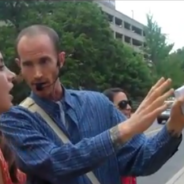
Last weekend, a small team of evangelists from a group called Cheap Missions Trips came to Vanderbilt’s campus to “save the lost.” They drove around Greek Row with microphones and a speaker, trying to convince the tailgating students to turn from their sinful ways and follow God. A video was posted on Youtube by the organization, but they apparently removed the video after the dramatic response. However, it has since gone viral, reposted by Vanderbilt students on Youtube, Facebook, Tumblr, and a myriad of other social networking sites. The reactions range from Greek students who find the whole thing to be a joke to Christian students who are disturbed and slightly embarrassed by what they see as a distortion of their faith.
The evangelizers appear to be a man and a woman with two small children in tow, possibly a family. The video begins as they’re driving onto campus; the woman says that they’ve come to Vanderbilt to help these young people see the error of their ways. She comments that she can smell the beer from the fraternity lawns, and that parents who send their children to college also need to repent. Their message for the students is primarily that “no drunkard shall enter the kingdom of heaven” and that the young ladies should “put some clothes on.” First in their car, then on the sidewalk, they spread their message with a portable speaker and a sign, engaging in multiple one on one conversations with students before the campus police apparently asked them to move on, at which point the video stops, ending with the text of Ezekiel 33:8-9 and the URL for the Cheap Missions Trips website.
When I find myself so seriously offended by something like this, I try to take a step back and think about exactly what is so offensive about it. So I’ve spent some time trying to name exactly what it is that’s bothering me about this video and the actions of the people in it. Well, for starters, the video is titled “Caring for the Lost at Vanderbilt,” and no one is doing any caring for anyone. Shouting at people that they’re going to hell is not a way to demonstrate care. The negative way in which these individuals are presenting the Gospel is also problematic. Their entire message is a list of all the things that their intended targets are doing wrong, a list of accusations thrown out at people rather than endeavoring to seek a conversation about what an individual’s world is like, and what they might be seeking that we can walk alongside them in. For that matter, the list of accusations is quite literally thrown out, and no conversation is being sought at all; these individuals spend about half the video shouting from their car, seemingly intentionally avoiding any interaction with these “sinners.” Even when they’re on the sidewalk, they’re not really listening to the young people they’re talking to. Not to mention the fact that, beyond tactics, I don’t agree with their theology in and of itself. Drinking alcohol, dancing, and wearing sundresses are not inherently sinful activities, at least not the way I read scripture. They are all things that can be done in an irresponsible way, but that’s a completely different issue.
If you ask me, the Word of God is being distorted by these “preachers;” it’s not even being misrepresented so much as its not being presented at all. From what I could understand of the conversations recorded in the ten-minute video, an actual, direct quote from scripture is not used once, and an actual Bible doesn’t even make an appearance. They are twisting the message of Christ into a message of condemnation of all who behave in a way that these two people disapprove of. I found the video profoundly disturbing, and could hardly make it through the whole thing.
Now, I am a Baptist, so I fully acknowledge anyone’s right to come to any theological conclusion they want, even if it doesn’t agree with my own. The problem is that we as the Church are part of a big, huge, complicated world, and ultimately we’re called to bring Love into that world. There are a lot of different issues we can choose to tackle in trying to bring Love into the world; we have to learn to prioritize. So if I could speak to the evangelists that came to Vanderbilt last weekend I would say this. You live in a city where more than 2,000 men, women, and children are sleeping without a roof over their head every night. You live in a state where 87 people are sitting on death row. You live in a country where an estimated 43.6 million people live below the poverty line. You can believe that the young people partying on Greek Row are sinners, but if you want to truly live out the Gospel, Cheap Missions Trips, you need to do some serious reprioritizing.
______
Note: I graduated from Vanderbilt University in May of this year, and am now a first year Masters student at Vanderbilt Divinity School. The views in this post are my own and not those of my Alma Mater or current school. I also recognize that the views and tactics I am discussing here were observed in two individual evangelists and may not necessarily reflect those of the organization they claim to represent; however, the name and website of the organization, Cheap Missions Trips, was posted at the end of the video, and to date the organization has not issued a retraction or any other response. The video may be viewed here.
Two 9/11 Prayers

Rabbi Seth Oppenheimer wrote two prayers for 9/11 services. The first was delivered after the original events of 9/11, read at a mosque in Starkville, Mississippi (after rotten fruit had been thrown at the mosque). The second was delivered at a 10th anniversary service at Mississippi State University.
Oh my brother Ishmael.
My brother,
here,
far from the disputed wells of our father,
here we can remember we are brothers.
We can remember,
your daughter is my niece,
your son, my nephew,
your wife, my sister.
Here, so far away from walled cities,
we can remember that we buried a father together.
We can remember that our blood is the same.
Together,
we can weep.
(9/14/2001)
The following prayer was offered as the invocation for 9-11 ten year student political organization memorial, at Mississippi State University on 9/11/2011:
They were Christian and Jew,
Moslem and Hindu,
Buddhist and Sikh,
Of every religious tradition and those who had turned their back on religion.
They were living their lives,
Fulfilling the homely virtues of hard work and constancy.
Pilots and washerwomen
Executives and housewives
Soldiers and waiters.
Death came for them out of the sky, fueled by hatred and rage.
What did they do,
Those trapped above the flames,
suffocating in the rising smoke?
They called those close to them,
I love you, they said.
I love you
I love you
Thousands of voices,
some heard live,
some recorded.
I love you.
Hatred struck,
Love responded.
Death came, fueled by hatred and rage.
Those who could escape,
Stopped and helped a neighbor less able.
Gathered together to make a slower descent
Out of nightmare
To help carry those who could not climb the stairs alone.
Hatred struck, seeking to terrify and divide our nation.
The people
Surrounded by approaching death
Gathered together to protect life.
Death came from the sky,
Brought by those who sacrificed their lives to bring death.
On the streets, the firemen and policemen of the city,
Out of the hallways of the pentagon not shattered by the plane’s impact,
Those able to act,
Moved into the inferno,
Risking their lives,
Sacrificing their lives
To bring life,
To save life
Acting out of duty
Acting out of that generalized love of neighbor that is the best expression of patriotism.
So many died in the service of life,
Of love.
In the air,
Above Pennsylvania,
Some learned what was happening.
They could not save themselves,
But their last act could be the salvation of others.
They used their last minutes of life
They acted so that others would be saved.
Self sacrifice for the sake of life and love
Defeated
At great cost
Suicide for death and hatred.
And so it is how we must distinguish ourselves
Let us be the ones who act for love
Let us be the ones who seek to save life.
We are blessed that,
On that day of crisis,
The best of our countrymen was brought forth.
May we be so blessed
That we might honor their memory
By fulfilling the best that is in us
By living the love, duty, and self sacrifice
That they showed that day.
And, may we never forget.
Stumbling Around in the Dark

A few weeks ago I was stumbling around in eerie quiet darkness.
No literally stumbling around in the dark.
A powerful thunderstorm with straight-line winds had roared through Georgetown, leaving in its destructive wake downed trees and most importantly for my neighborhood, no power.
Not even a street light was on. No hum of air conditioners. No flickering lights of TV screens.
In fact, the only flickering came from the many candles lit to try to keep people from stubbing their toes.
So there I was, stumbling around in the dark. We went out to talk to the neighbors, but it was so dark, I literally had to squint to try and see who I was talking too. Then we came back in and as I tried to get candles situated throughout the house, I felt something furry brush up against me. My heart skipped a beat, and then I remembered. The dog.
It was truly one of those times that you don’t realize how much you rely on light until it is out. It made me wonder how many times we have physical light, but continue to stumble around in the darkness.
Think about it. We may have abundant sunshine outside or every light bulb is functioning, but we still feel like we’re fumbling around in the dark. Life’s stresses and everyday occurrences can leave us bumping your knees, elbows and head and wondering how we are going to get through the day.
So we click our “light switch” on and get God’s light shining on our lives. It may be stopping and taking a deep breath, saying a centering prayer, repeating a favorite verse or opening your Bible and meditating on what God is guiding you to. It may be just simply refocusing on God and taking solace in knowing He has a plan for you.
We were reminded that dark night of the old Vacation Bible School song about “Letting our Little Light Shine” – do we hide it under a bush, no! Do we blow our candle out, No! We let our little light shine.
Do we let our light shine? Or are we too busy posturing to get ourselves heard or getting bogged down in living every day that our light has dimmed? Are we truly a light for Christ? Or do we spend more time complaining about what has been dealt to us that day.
Take our evening in the dark. After lighting a dozen various candles – who knows what Yankee Candle scent we made that night – we made the best of it. We played rummy by candlelight, teaching our daughter the classic card game (wouldn’t you know it, she won) and shared quite a bit of laughter.
We may not have gotten a lot of sleep that night, but the sun came up the next day, and a few hours later, the power returned. And God was right there shining and leading us on our journey. Hopefully, I’m letting his light reflect off of me for others to see.
Thinking, Saying, Doing!

Gandhi once said, “Happiness occurs when what you think, what you say, and what you do, are in perfect harmony.”
We all want happiness. How we express that desire may be different for each of us. And what that happiness looks like in the end, most likely is different for each of us. Happiness could be winning the big game; being accepted into the college of our choice; having children who are healthy; having a career that fulfills our lives. No doubt we could come up with any number of other qualities, opportunities, or fulfilled dreams that could make us happy.
But when you look closely at the quote from Gandhi, you may become disheartened. We want happiness. But getting what I think, what I say, and what I do in perfect harmony as the key to happiness may well be beyond our skill. If I don’t say what I think, and do what I say, happiness may well escape me. It would likely be right here that Charlie Brown would most likely give up and let out his famous phrase, “Good Grief!”
But maybe there’s a way. Our minds are constantly filled with thoughts that demand our attention and consume our time. What if we were to somehow filter through those thoughts and get to the core of what really matters to us. I suspect that sifting our thoughts may just be what the doctor ordered. Some of my thoughts I can’t do anything with right now anyway, so let them go. Other thoughts will require the input and advice of others, so I can move them to another place until that input and advice is received. There are some thoughts that can simply be tossed aside. Like when I begin to think what it would be like to hit the jackpot in the lottery drawing. It’s not likely to happen since I don’t buy lottery tickets. It’s fun to dream, but no need to let the thought consume me.
I don’t know what Gandhi would say, but filtering my thoughts seems like a plausible place to start.
How about the saying part? Seems like I remember a part of a song I learned as a child. “O, be careful little mouth what you say.” It’s easy to let the wrong words slip across our lips. And once they are spoken we can’t simply take them back. But it’s also just as easy to let the right words stay tucked inside and never let them be spoken. How many times have I heard someone say, “I wish I had told her that I love her.” Words are a gift. Use them as a gift.
Then there’s this doing part. There are a number of things I do that contribute to a sense of happiness and they are connected to what I think and what I say. So often I find that the day is filled with other things to do that may or may not be in harmony with what I think and say. The challenge is to focus on doing those activities that enhance my sense of fulfillment. Sure the other things may still have to be done, but learning to prioritize those activities can sure help.
I like the quote by Gandhi. I think he’s right. “Happiness occurs when what you think, what you say, and what you do, are in perfect harmony.”
Learn more about Tommy Valentine at Fabric of Life Coaching or his blog.
Baptism is More than Water

Because of baptism, I almost was not ordained to the gospel ministry. In fact, December 29, 1968, the date of my ordination at the First Southern Baptist Church of Tallapoosa, Missouri, was almost a disaster.
The ordained folks of Black River Association took ordination very seriously. The ordaining council really did ask questions and based on the candidates answers, voted to recommend ordination or not to recommend ordination. For my ordination, the council was scheduled to meet at my home church that would be filled with my friends and family, including my fiancé and her family. The ordination, if it were to happen, would happen immediately after the council made its decision.
Bro. McClanahan, the Associational Missionary, was to chair the council. He had done a wonderful job of helping me prepare. We met on Saturday, the day before my ordination just to touch base one more time. I had known Bro. Mac all my life. He was one of God’s good gifts to the church. We had a pleasant meeting and I was about to leave when Bro. Mac commented, “Oh, you know some of the preachers from the southern part of the association will be there. They will ask you about ‘alien immersion.’” In Black River Association in 1968 “alien immersion” referred to any baptism done by any church or preacher that was not Southern Baptist. It didn’t matter if the baptism was by immersion of a person old enough to choose to be a believer. If it was not done by a “proper church and pastor,” it was “alien” and unacceptable.
“How will you answer that?” Bro. Mac asked.
“It seems to me that who baptizes you is immaterial. I do not support the concept of ‘alien immersion,’” I responded.
Bro. Mac’s face told me all I needed to know. “If you answer that way, you won’t be ordained tomorrow.”
“If I answer any other way, I will be lying.”
There we left it. When I got back to my parents’ home, I told my dad what had happened and warned him that Sunday would likely not be a glorious day. Early Sunday morning, Mrs. McClanahan called to say that Bro. Mac was ill and would not be able to be at the ordination. I’ve always suspected that his illness arose because he couldn’t stand being part of my non-ordination day. At any rate, it saved the day. Bro. Ted Thedford, a local pastor, was apprised of the situation and invited to chair the committee. This was arranged by my father and Mr. Perry Clark, a deacon of my home church, whose son Ben had already been ordained to the ministry. Bro. Thedford handled the questions about baptism, never letting “alien” enter the conversation.
I was ordained and my theology of baptism has continued to change. While I still believe that Baptism by immersion of believers is the better way, I am pleased to be pastor of a church that accepts any Christian baptism by any method. Over the past 32 years, I have baptized by immersion, pouring, and sprinkling. I’ve baptized in homes, swimming pools, hospitals, and nursing homes, as well as in our church baptistery.
One of the most meaningful baptisms was of eight year-old Sarah, who I was sure had no knowledge of what was happening.
Sarah, who was born with severe physical and mental handicaps, was mentally no older than a two year-old. She cried most of her waking hours. Her grandparents, who had taken over her care, lived in a storefront apartment in our community. They called this Baptist preacher to baptize their granddaughter “because doctors tell us she only has a few weeks to live and we don’t want her dying without being baptized.” I thought of all the reasons why I couldn’t and why it wasn’t necessary; and then I agreed to do it. In fact, I was ready to do it right then; but the grandparents asked me to come back two days later.
On the day of Sarah’s baptism, I arrived at the family’s apartment and found Sarah wearing a lovely new white dress. Her grandfather was sitting in a chair, holding her as she squirmed and cried. Beside them on a side table was a small silver bowl that her grandmother had filled with water. We read the story of Jesus’ baptism and the story of the disciples trying to keep children from bothering Jesus. Then I dipped my fingers in the bowl and made the sign of the cross on Sarah’s forehead. “In the name of the Father and the Son and the Holy Spirit, I baptize you Sarah. You are a beloved daughter of God.” As I finished, Sarah’s crying stopped. She lay quietly against her grandfather’s shoulder and smiled.
Sarah died about two months later. At her funeral, her grandparents told me, “Sarah was so much calmer, hardly crying at all, after you baptized her.”
And to think, I had thought she had no knowledge of what was happening!
Baptism is not about water or who baptizes how. It’s about grace flowing to all of us, who apart from grace are aliens.
Read more from Michael R. Duncan at his new blog.
No one is “self-made”

There is the story of the self made man: The fellow who, with no help, built up a business and a life of power and wealth. Of course, he had some opportunities. Somebody taught him how to read. Somebody took a chance on him with his first job or first sale. Someone showed him the ropes of business and taught him how to keep books and manage cash flow. So, perhaps, the self made man is not so much a real story as an inspirational arch type that has more to do how we perceive ourselves. No one is entirely self made. True, success requires hard work and a recognition of opportunities, but it is not done alone, no matter what out societal mythos tells us.
As Jews, we actually recognize a deeper and more fundamental contingency. In this week’s Torah portion we read:
Beware that you do not forget the Lord, your God, by not keeping His commandments, His ordinances, and His statutes, which I command you this day, lest you eat and be sated, and build good houses and dwell therein, and your herds and your flocks multiply, and your silver and gold increase, and all that you have increases, and your heart grows haughty, and you forget the Lord, your God, Who has brought you out of the land of Egypt, out of the house of bondage. Who led you through that great and awesome desert, [in which were] snakes, vipers and scorpions, and drought, where there was no water; who brought water for you out of solid rock. Who fed you with manna in the desert, which your forefathers did not know, in order to afflict you and in order to test you, to benefit you in your end, and you will say to yourself, “My strength and the might of my hand that has accumulated this wealth for me.” But you must remember the Lord your God, for it is He that gives you strength to make wealth, in order to establish His covenant which He swore to your forefathers, as it is this day. (Deut. 8:11-18)
The next generation, fighting for the land; farming in the Middle Eastern heat, and trying to deal with rainfall that was not always ideal might easily forget that what had already been accomplished was done with help. We are often that way ourselves. Even leaving aside theological issues and the fact that we have a created world (or a world that requires continual Divine attention to stay in existence) to act within at all and the bounty of the natural world, we even forget our debt to our fellow human beings. We drive on roads that were built before we were born, cross bridges that are marvels of engineering that took whole communities to build in terms of resources, knowledge and labor, use electricity that is provided by a grid that we did not contribute to and generated in plants that dwarf the human scale.
None of us is self made, even just considering the help we have received from our fellow human beings, both of previous generations and our own.
One of my favorite stories concerns a Roman general riding by and seeing an old Jewish man planting a carob tree. The general stops to laugh at the old man, “You are certainly a fool, planting a tree that will not bear fruit until long after you are dead!” The old man continues his work as he replies, “There were carob trees planted for me when I came into the world; I will leave carob trees for those who come after me.”
The lesson is clear. Judaism teaches us that we must prepare the world for coming generation. We are required to pass down, not just our religious, ethical, and intellectual heritage, but a physical inheritance as well by improving the world materially as well as spiritually. Our time horizon cannot be the next quarter or the fiscal year as is now in vogue. We are required to consider what we will do for the next generation and generations after.
On a smaller scale, we have each been helped at one time or another. Someone stopped and gave us directions when we were lost, helped us change a tire, helped us get our car out of the mud or snow. There is the story in Genesis of the ish, the man, who directed Joseph to find his brothers when he was lost. We all have had such an encounter and, I expect, we have been the helpful person.
When we look to lay a foundation for the constructions of a future generation or when we stop to help a stranger, we are acting as G-D’s agents. We are, in the language of R. Harold M. Schulweis, actualizing the predicates of G-Dliness. We are making G-D a real, active force in the world precisely by acting as G-D’s agents.
Let us not forget the grand and absolute reliance we have on The Holy One for our very existence. But let us remember the debt we owe to our fellow human beings, from our neighbors to the visionaries and laborers of previous generations. In recognizing that debt, may we be moved to repay it by acting as Holy agents, acting for G-D with our own acts of stewardship and foresight and with everyday acts of service and kindness to the souls we encounter every day.
Politics, Prejudices, and Hungry Dogs

It was a cold and drizzling Easter Sunday morning, early just before the sun rises, in rural northern Kentucky. I was assisting the local Methodist pastor in leading the community Sunrise Easter Service.
Rev. Davenport decided to serve Communion to everyone in attendance at the conclusion of his devotional. He had with him a freshly baked loaf of bread, a chalice of grape juice, and a small fire around which we gathered to keep warm.
As Rev. Davenport read from the Scriptures, a mangy, stray dog started sniffing around all of us; Rev. Davenport never noticed as the dog came right up behind him and me … but I saw the dog grab that freshly baked loaf of bread in his jaws and run off with it.
Didn’t even leave any crumbs for us, the children of God. The whole loaf – the Body of Christ – literally was wasted on the dogs that day.
Jesus talks about wasting good stuff on dogs. In one place he says, “Do not give what is holy to dogs; and do not throw your pearls before swine, or they will trample them under foot and turn and maul you.” (Matthew 7:6). Later, a Canaanite woman asks Jesus for help, and Jesus replies, “I was sent only to the lost sheep of the house of Israel.” He goes on to suggest that choosing to help the woman would be like throwing the children’s food to the dogs (see Matthew 15:21-28).
“Dogs” was an easily recognizable term often used to describe a people considered undesirable, lesser than, unworthy.
Clarence Jordan, when translating the gospels into the American South of the mid-1900s, has a black woman come to Jesus, and Jesus says, “I was sent only to needy white people”; hence he shouldn’t throw the children’s food to the puppies.
Culture and politics sure can influence how we view one another … even us as people of faith.
Listen to our conversations about immigration; we are really good at classifying groups of people which help us speak of each other in terms of categories rather than as humans.
A plane wreck in 1948, and its radio and newspaper coverage which identified the flight crew and the security guard, and then clumped the Mexican migrant farm workers which were being flown back to Mexico simply as “deportees,” become a powerful song by Woody Guthrie as a symbol of the way categories can desensitize us to the humanness of others.
Goodbye to my Juan, goodbye, Rosalita,
Adios mis amigos, Jesus y Maria;
You won’t have your names when you ride the big airplane,
All they will call you will be “deportees.”
Maybe we would do well to stop trying to analyze and dissect and explain to our satisfaction why Jesus would compare the woman in this story to dogs, but see the whole picture in its context.
Jesus spoke to her in what was completely acceptable terms for his culture, among his followers and disciples who probably would have called her much worse. He acknowledges their prejudices and their sense of superiority in his words to her, then shocks them all by acting on behalf of, well, “the dog.”
Most of us in the American Church today will not use words to clump entire groups of people into a category as a way of dehumanizing them. Most of us today will not use words like “nigger,” “white trash,” “spic,” “gook,” “towelhead,” “faggot,” or “illegal immigrant” to help us cloud the human faces staring back at us. Or, do you object that the term ___ (you fill in the blank) was included in this offensive list?
How soon we forget that despite our well-publicized adoration of Jesus, in Matthew’s story we are not the disciples or the other followers of Jesus, but most of us are the Canaanite woman. We are the cultural “dogs.” In this context, when Jesus speaks of not giving what is holy to the dogs and wasting the children’s food on the dogs, he’s not teaching us to be careful with whom we share our grace and our resources; he’s playing into the cultural prejudices of his followers and then is going to shock them by sharing grace and resources with us.
And, like the dog on Easter morning, we now find that we have not the crumbs, but the whole loaf of God’s grace.
It’s election season again, which means candidates will be trying to publicly love Jesus more than the next candidate, and so many Christians in the US (at least in the white Protestant church of which I am a part) are more than eager to indulge in self-righteous displays on behalf of our favorite candidate.
But listen to how we categorize people. Pay attention to how we see fewer human faces and more groupings of undesirable objects. Remember that we have been the cultural dogs that received holy grace from Jesus. And may we then extend the same grace and resources to those deemed “dogs” in our culture today. For Jesus freely gives to these “dogs” the whole loaf of Communion Bread – His very Body – in spite of what our politics and our cultural prejudices demand.
Learn more about Bert Montgomery at his website.
Searching for a New Answer

This is a mean season in Walnut Hills. Jobs are scarce. Government programs are tightening their belts. Groceries are running out. Rents are due. People are scared.
On every busy corner around here, somebody is holding up a sign asking for help. It used to be you knew those folks were junkies, but these days you don’t need a habit to be that desperate. Every non-expatriate family in our fellowship is in some kind of trouble.
Last night I had to tell Diana’s not-yet-twenty-year-old daughter that she can’t keep staying with her mom because, if she gets caught, HUD will throw them both out of the cheap-but-highly-regulated apartment we rent to keep Diana off the street. We found her a place, but it won’t last long unless she finds work, and the felony on her record makes that a long shot, even with our help.
Dena called a few days before that, crying that she had nothing to feed her four kids until their food stamps arrived. I know she and her husband smoke and drink and manage their money worse than Bernie Madoff on his worst day, but hungry kids are hungry kids. Anyway, the food I took over doesn’t change the fact that they are four months behind on their rent.
I could go on, but you get the picture. In a world where almost everyone is one check away from homeless, it feels like all the checks have stopped at once. Nobody here has any savings. Nobody has any rich family members to bail them out. Unskilled, unhealthy, and often unemployable, these people weren’t making it very well even when times were good. Now they’re not making it at all.
The question, of course, is what are the rest of us to do?
Loaning money to people who can never pay it back doesn’t work, but standing by while they get evicted ends friendships almost as surely. Taking people into our homes sounds good, but only if those people are both willing and able to do what it takes to be independent again. In this neighborhood, in this economy, we need another answer.
Almost every day, somebody sends me an article about some new program that miraculously transforms inner-city nightmares like ours into dreams come true. When I look more closely, however, I find that those programs are expensive and only seem to work for the most highly-motivated poor people. They are beautiful experiments, but they aren’t scalable.
Almost every night, we expatriates here have a conversation about somebody we love who is in trouble. We take turns coming up with ideas and shooting them down: She doesn’t read well enough for that. He won’t show up. She can’t be on her feet more that an hour. Her mom won’t help. He’s drinking again. They’ll spend the money on something else.
Over and over, we try to work out problems that have no solutions. Over and over, we end up right back where we started; living and eating, laughing and crying, walking and talking together with dear people we can almost never really help. We have jobs and cars and houses and bank accounts, and most of us believe in God, but none of it really matters when it comes to making a difference in this place.
I’m not trying to bum you out. Believe it or not, I’m trying to draw you in. I figure that if enough of us lie awake wondering what to do for the rest of us, then maybe one of us will find a new answer after all.
In the meantime, especially during this mean season, God help us all.
Bart
PS For those of you wondering, I love my new job. After six years in Walnut Hills, peace in the Middle East actually seems quite doable to me! I spent two amazing weeks in Israel, Palestine, and Jordan last month, but right now my focus is on inspiring good people – people like you – to organize Abrahamic 9/11 Walks in their own neighborhoods all over the world. Think about it: Wouldn’t it be great if 9/11 became a day for Christians, Muslims, Jewish people, and everyone else to step over boundaries and walk kindly with ‘the other’? If you want to help, let me know!
Bart Campolo ministers through The Walnut Hills Fellowship in Cincinnati, Ohio. This article is reprinted with permission from his blog, which you can read here.
Jesus in a ’49 Ford (Owed to Marshall Grant)

Music legend Marshall Grant, an original member of Johnny Cash’s backing band The Tennessee Three, died last weekend. I had the honor of meeting him about three years ago at the Johnny Cash Flower-Pickin’ Festival in Starkville.
After a lengthy time of touring with Cash and acting as his road manager, Grant went on to manage the career of another Cash-act, the Statler Brothers. Throughout the 1970s and into the 1980s the Statler Brothers were one of the best-selling groups in country music.
While Grant was managing them, they wrote and sang a song titled, “Would You Recognize Jesus?”
Would you recognize Jesus if you met him face to face;
or would you wonder if He’s just someone you couldn’t place?
You may not find Him coming in a chariot of the Lord
Jesus could be riding in a ’49 Ford.
~ ~ ~
The 2005 Cooperative Baptist Fellowship General Assembly was just weird.
Rather than being – like most conventions – centered downtown in a major city with hotels clustered around a convention center, this particular one was at a new self-contained convention center/resort complex outside of Dallas in Grapevine, TX. The Gaylord Texan is the name of this luxurious world unto itself.
Here were thousands of Cooperative Baptists, largely white middle-class folks, going to conferences and attending sessions challenging us to address poverty issues and racial issues and justice issues from the pulpit, in Sunday school classes, and in our individual and collective actions.
Visually, the contrast was overwhelming: white folks wanting to serve God and follow Christ and deal with poverty and racism, being served and spoiled and pampered by hundreds and hundreds and hundreds of Hispanic workers.
Hispanics – some speaking very little English – making our beds. Carrying our luggage. Waiting our tables. Cleaning our bathrooms. Picking up our trash. Bringing us our extravagantly overpriced “luxurious” foods and drinks.
I attended the final morning’s Leadership Scholar breakfast for seminary students. Again, the overwhelming majority of us white and being waited on by an almost 100% Hispanic workforce.
Hispanic waiters and waitresses were constantly coming to our tables offering coffee, orange juice, more water, or more coffee, or to take our plates.
Fellow students from numerous CBF-affiliated seminaries and I were talking at the table – trying to envision ourselves peace-makers and justice-seekers in the midst of such luxury – when a waiter leaned over my shoulder and offered to pour me some coffee.
I looked up to say “no thanks” and to apologize for our spoiled arrogance; it actually crossed my mind to get up, let him sit in my seat, and I’ll pour him coffee and go get him some breakfast …
But when I looked up, I could not speak. I heard in the most clearly audible voice – though he was saying nothing – “I came not to be served but to serve. I’d like to pour you some coffee.”
I said nothing as I held out my fine coffee cup. At my eye level was the waiter’s name tag pinned to his chest.
J – E – S – U – S .
And I heard the voice again: “I came not to be served but to serve. Just shut up and just let me serve you today, Bert.”
Jesus was right in front of me and I didn’t recognize him. If not for the name tag …
I was too caught up in my own agenda – in Christ’s name of course – to have ever noticed. I was meeting him face-to-face and I didn’t recognize Jesus.
One of the biblical stories that really fascinates me is the one where some guys are walking along the road to Emmaus after the resurrection; these were guys who knew Jesus personally. And there is Jesus walking with them and talking with them, but they don’t even recognize him. He’s a total stranger to them.
Until … until they invite this stranger into their house. Until … until they invite the stranger to sit at their table and share a meal. Until … the stranger takes over and breaks the bread and gives thanks. The stranger being welcomed and being served becomes the one to take what is present and serve those who are present with him.
THEN their eyes are opened, and THEN they know Jesus is with them …
~ ~ ~
Thanks to Robbie Ward and the Flower-Pickin’ Festival, I shook the hand of Marshall Grant; the hand that managed Johnny Cash and the hand that managed the Statler Brothers, whose song is one of the most simplistically profound expressions of the Gospel:
Would you recognize Jesus if you met him face to face
or would you wonder if He’s just someone you couldn’t place?
You may not find Him coming in a chariot of the Lord
Jesus could be riding in a ’49 Ford.
~ ~ ~
Learn more about Bert at his website.
I’ve Given Up Reading from Cover to Cover
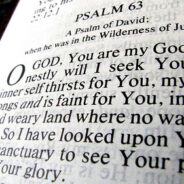
Do you remember those church offering envelopes with the check-off boxes? One of them was “Daily Bible Reading.” My generation was encouraged to do it all, check all the boxes, and score 100% for the week. I remember some pastors who studied the reports and often included statistics in their sermons. Only 42% of you read your Bibles this week!
I was a 100-percent guy almost every week. I did sometimes have problems with that box labeled “Contacts”; but I finally figured out that a guy couldn’t get through a week without some kind of “contact.” Of course, I knew that “contact” meant “evangelistic contact,” but, hey, a contact is a contact. Right?
That’s about as right as suggesting that looking at the pages of the Bible is Bible reading. Yet, some days are just so busy that the best one can do is a hurried glance, a fast read of the Bible. Better fast than not at all, right?
There really is more to Bible reading than reading. Reading it from cover to cover may be an accomplishment, but one wonders what has been accomplished. Did God really speak to you as you read through the begats? Was the list of laws from Leviticus deeply inspiring? How about the numbering in Numbers? Do you feel more spiritual having counted your way through?
I’ve read the Bible through—from cover to cover—more than once. I don’t think I’ll do that again. I’ve found a better way to read Scripture. I still read it almost every day, but I no longer beat myself up for missing a day or two.
My better way is to read more slowly, to savor the words I read, and to attempt to enter into dialog with those words and the Word behind them. Once in a while I will hang up on one passage, sometimes even one verse, for a whole week. Can one ever completely fathom the depths of the words of Psalm 139: “O Lord, you have searched me and known me . . . and are acquainted with all my ways”?
Productive Bible reading is not about how many verses or chapters we read per day. Productive Bible reading is the reading which brings us into the presence of the Living God and finds us daring to enter into dialog, a dialog in which honesty prevails and growth ensues. Bible reading done right becomes prayer. In rare and truly holy moments, Bible reading becomes the doorway to the mystical moment in which Jesus’ prayer (John 17) becomes true, at least for the moment: We become one with him and with God. When that happens, no one needs to tell us that Scripture “is breathed out by God. . . .”
Read your Bible, if not today, tomorrow; and when you read it, don’t rush. A good conversation always has some moments of silence.
Read more from Michael R. Duncan at his new blog.
Follow Us!