
Hello Goodbye Theology (According to Paul, John, Ringo, and George)

On Monday, I will pull out of Natchez and head upriver to Cleveland, MS, to pastor St. Luke United Methodist Church & Shipman Chapel. This final week as an Adams County resident and the pastor of Grace Untied Methodist Church has been one of the most delightful times I can remember. I’ve hung out with friends, put the finishing touches on moving, and had plenty of time to reflect on the past five years in this (a) city on a bluff and (b) church on a hill. I’ve realized something about myself that I didn’t know:
I am really bad at saying goodbye. (more…)
Re-lections With Old Hippies
On Tuesday at 7:20 a.m., I pulled into the parking lot of St. Louis Mennonite Fellowship where Pastor Samuel was hosting one of his two lectionary groups — the one he (I suppose) lovingly refers to as the Old Hippies, distinct from the other group which is comprised of the Young Hippies. At 29, I was the youngest person in the room. The old hippies were an ecumenical hodgepodge.
I was first greeted by a retired UCC minister, who hugged me and asked what I was doing. We had never met, but she introduced herself as if an old friend catching up after several weeks of absence. Ed, whose email identity is “Lost Friar,” began explaining that he was a Franciscan, “a type of Catholic.” He seemed impressed when I teasingly responded “oh yes, I’ve heard of those,” perhaps believing that Baptist interns of Mennonite churches (Several SLMF folks have told me they enjoy including both denominations in my title, as it makes both me and the church seem more ecumenical) have not been exposed to such groups as The Catholics.
Ed quickly adopted me, introducing me to each member of the group as they arrived: the black Episcopalian priest who has his sermons completed long before showing up to lectionary group, the King James Only participant who somehow finds a comfortable place with those who edit the New Revised Standard Version to remove masculine pronouns for God, Disciples ministers, a female Catholic chaplain, a Presbyterian, and the couple from Kenya — the man who pointed out that his wife was the pastor of the church — who hugged me tightly proclaiming “I need to get to know you. You should come to Kenya with me.”
We discussed how tomato plants grow, the significance of Juneteenth, and what it might possibly mean to be a new creation. We shared prayer requests and held hands while praying for one another. The group was careful to make sure everyone was sharing something. I was called out to share my own insights, as were several other group members who were not quick to jump into conversation.
And they called me “Jen” — while I typically spell the nickname with two “n”s, it felt distinctly singular and familiar. I was the new young hippy, and I was welcome.
Read more from Jennifer Harris Dault at her blog.
Blandina of Lyon, Martyr, Slave, Strong to the End
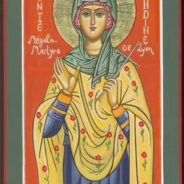
The political and social climate of Lyon in the second century was bleak for Christians and thosewhose faith did not align with the values of Rome and the emperor Marcus Aurelius. The good that Christians had done through prayer, generous giving, and hospitality was quickly forgotten when the people cried out for a scapegoat as they inevitably and often did.Blandina was a Christian slave to a Christian master and this presented an interesting dynamic into her experience at the hand of Rome when she and her brothers and sisters in Christ were arrested and threatened with death if they would not give up their convictions for the commandments of Rome. Citizens of Rome at the time faced death by the comparatively easier method of decapitation.Slaves died slowly at the hands of the imperial torturers and their cruel tools. This was dramatically effective for Rome because many slaves would often choose to renounce their faith and implicate their masters when threatened with torturous death on one hand and offered freedom from slavery on the other. They had more to gain in apostasy and so they were considered prime targets for imperial coercion.
Because of this tendency for slaves to renounce the faith for promises of freedom, Rome was able to convince slaves to lie about their Christian masters and insist that Christians were cannibals and incestuous. These lies only furthered Rome’s efforts at propaganda and made it easier to deceive a population all too eager to be part of the accepted majority and all too afraid of being outcast from society. All of this only made the lives of the Christians more challenging. The brothers and sisters of Blandina feared that she would renounce the faith because of the torture that loomed over her and her relatively small size.They assumed that a woman of her stature and livelihood would suffer greatly under the hands of the empire’s best ministers of agony. Nobody would have been surprised to see her cave into the empire’s demands but they all hoped that she would be able to withstand the torture. So, they did what Christians do–they prayed for her and encouraged her to face her inevitable suffering with faith, hope, and love. Blandina was indeed tortured and it was gruesome at best. With each new savage effort to destroy her faith she repeated one phrase to those charged with producing agony within her:”I am a Christian, and we commit no wrongdoing.”Eventually, she outlasted her torturers and they returned to their leader and insisted that they had nothing else to offer in the way of pain.
On the day of the execution of Blandina and her brothers and sisters in the faith there was one more planned torture for her. But this time it was psychological. They brought her in chains to the arena to watch her brothers and sisters be beaten and executed. They expected that being confronted with the brutality and finality of death that she would renounce her earlier confident confessions. Yet, she surprised them by loudly calling out to those being martyred and encouraging them to face their deaths with faith, hope, and love. She encouraged them to forgive those who clearly were deceived by the darkness of Rome and their own inescapable sin. When the guards realized she was only encouraging her brothers and sisters they drug her away and prepared her for own vicious death. They tied her to a stake in the arena so that she might torn apart by vicious animals to entertain the Roman crowd. The animals, however, refused even to approach her as she prayed quietly for her accusers and captors. Finally, they cut her loose from the stake, wrapped her up in a net, tied her to a hot, iron grate, and cast her again before a bull.As she prayed, Blandina was gored by the bull and thrown into the air. After some time, she finally died and received her martyr’s crown.
Read more from Joshua Hearne at his personal website and the website of Grace and Main Fellowship, the non-traditional community he ministers with.
Real Victory

I’ve been a bit surprised by how the recent United Methodist General Conference with all its disappointments has affected my mental state and mood because, truth be told, I feel strangely victorious. Let me explain. As I followed the reports from GC during the two weeks of the conference and as I’ve heard and read many conversations afterward, I have come away with a few important Truths.
First and foremost, there’s simply no amount of doctrine, dogma, or church legislation that can lessen God’s love for me and other LGBTQ persons – or for our heterosexual counterparts.God created us all in the Divine image and loves us all just as we’ve been fearfully and wonderfully made.
Second Truth, the end does not justify the means – no matter how strongly one feels about their beliefs and vision for the Church, unholy conferencing and underhanded politics are sins against God, the Church, and all the people involved. From what I’ve heard and read, folks seeking progressive changes in the UMC could walk away from GC knowing they had stood their ground with integrity, love, and a peaceful yet courageous witness. No institutional victory is worth compromising the Christ in us.
So where does that leave us? There’s no mistaking that the United Methodist Church is perpetuating ignorance and prejudice with its denominational policies that discriminate against gays and lesbians. Such policies and the sermons and counsel that stem from them undoubtedly contribute to the high numbers of hate crimes, rejections, and suicides of LGBTQ persons. As a religious institution we have once again failed to heed a higher calling for Justice, and from all appearances we will be trailing behind secular society in living out what it means to claim all people are of sacred worth.
But guess what? We as followers of Christ – and many others whose faiths emphasize love and compassion and justice – we can still lead the way forward with our own lives. We can stand in opposition to unjust and unloving policies and laws. Some may choose to defy those policies – either publically or privately. Some may choose to engage in dialogue with those who disagree. Still others may choose to leave the offending institution. No matter what we do or don’t do polity-wise, hopefully, all of us will choose to intentionally love and welcome the people the policies and laws exclude as well as – the real challenge – the people who fight to put or keep those discriminatory policies and laws in place. For this is the final Truth I’d like to share – we will only have a more loving Church if we continue to learn and practice Loving. I believe as long as we live that Love, we are victorious.
Read more from Renee Sappington at her blog.
Sustainability of the Heart – Abiding in the Vine

Editors Note: This is a sermon shared at the Transfiguration Retreat in Sewanee, TN on May 6, 2012.
Abide and Bear Fruit
This is perhaps a perfect text given to us by the lectionary. Just as the transfiguration story can serve as an icon for the church’s ecological mission, perhaps this image of branches abiding in a vine should serve for us as an icon of sustainable eco-ministry both within our own hearts, and among us in church life.
There would be a lot to unpack with this icon:
- God as an active vinedresser, clipping this and shaping that, and what it means to live with and into that.
- Remaining, abiding, staying attached and drawing nourishment from Christ the vine, and what that is and how we go about doing that.
- Bearing fruit (guaranteed if we do abide and certain to fail if we do not), and how to discern between God’s fruit and our own ego needs.
- Drying out, being discarded and being burned, and where this shows up in our lives and in the world – and how to live with that.
- Allowing the word of Christ to abide in us, and the resulting synergy and flow of asking and receiving that seems guaranteed in this text, as perhaps a fundamental rule of the universe.
That is certainly a whole other retreat, and perhaps it is one we should do. We do need it, we know. We have heard expressed here that you brought with you to this retreat a sense of weariness and/or isolation and frustration with the work at hand and the responses or lack of them among the churches.
We are not being inactive or lazy. We have a sense of passion and vocation. There is, among us a substantial amount of activity and effort being applied to these issues we all recognize as vital and crucial to life and faith. We are busy, and the churches are busy. But do we wonder about the fruitfulness of our busyness? (more…)
One Of Our Own

We are excited to share this article recently written by the Religion News Service about Jennifer Harris Dault, one of the regular contributor’s to the FaithLab blog.
Take Care Of Yourself

NOTE: The following is a Baccalaureate address delivered to the 2012 Graduating Class of Eminence (Kentucky) High School, May 27, 2012.
According to the dictionary, the word baccalaureate refers to a “farewell sermon delivered to a graduating class.” For those of us assigned the task, it is often seen as our last chance to tell you something really important so that you can be sent off well.
Some ministers use the occasion to preach their best evangelical sermon, urging those who do believe to remain vigilant and urging those who do not believe to do so. I will not do that.
Other ministers will use the occasion to tell you what an important role you have ahead of you and to assure you that you have all you need to meet the challenge. I will not do that.
Even others will tell you that the folks who make the biggest contributions to life are those who are selfless, who always put others first. I will not do that.
I’m here tonight to urge you to be selfish. I urge you to use this evening and, perhaps, the next few days before graduation to turn your thoughts inward. I urge you to figure out who you are and to be that person and no one else. Fail to get that right, and you will get little else right. (more…)
Rita of Cascia, Wife, Mother, Nun
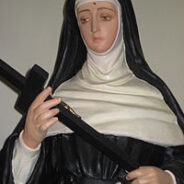
Rita’s received the kind of spiritual education that can only be received in the home and by the careful guidance of a loving mother (Amata) and father (Antonio). Antonio and Amata were eager to pass on the faith that had gripped them to their only daughter and took nearly every chance that presented itself to demonstrate and explain what it was they believed. At a young age, Rita professed the faith of her parents and made it her own. When asked what she wanted to do with her life she quickly responded that she wanted to become a nun. But as the only child–and a daughter, as well—this could be a frightening prospect for her parents. Antonio and Amata worried that there would be nobody to take care of them when they were old if their daughter–their only child–disappeared behind the walls of a convent and undertook a vow of poverty. So, instead, they arranged for Rita to marry a man whose promise was strong, but not as strong as his temper and tongue. Rita married Paolo Mancini at the wishes of her mother and father and began to forge a life as a wife and soon to be mother.
Interview: Joey “Ojo” Taylor
In the summer of 1984 a friend gave me a tape with Undercover’s self-titled debut on side one, and their second album, God Rules, on the other. I was hooked immediately.
As I finished high school and entered college, my personal faith began to deepen, and to make room for questions, doubts, and grace in the world. Interestingly, the guys in Undercover were maturing and also leaving behind the simplicity of their early lyrics. Today, I listen to those early Undercover albums with fondness and joy, and though I no longer believe in their simplistic and legalist-easy-answers lyrics, I am thankful that those albums came along in my life when they did. Neither Ojo nor I are the same as we were almost thirty years ago (thankfully!). While I still consider myself a Christian, Ojo, on the other hand, is an agnostic.
Today, Ojo is a professor at James Madison University. He teaches classes like History of Rock, Songwriting, Artist Management, Legal Aspects of the Music Industry, and Music Marketing. A few months ago Ojo agreed to an email interview: I’d email him him questions and he’d reply. Here are the highlights of our email exchanges in which Ojo addresses musical influences, Undercover, and his own spiritual journey.
Priesthood of ALL Believers
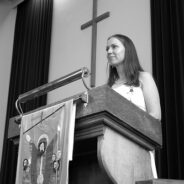
In case you somehow missed it, I’m compiling a book. That book, currently referred to as The Priesthood of ALL Believers, is a collection of call stories from Baptist women ministers (if you happen to be a Baptist woman minister, it isn’t too late to share your story. See this post for details). The Baptist denomination is still in a place of decision-making where female clergy are concerned. Not too many years ago, the Southern Baptist Convention — the largest of the Baptist groups — stopped supporting the ordination of women. Many other Baptist groups, such as American Baptist Churches and the Cooperative Baptist Fellowship, do practice the ordination of women. However, Pam Durso was recently quoted in an EthicsDaily article saying that only 145 women currently serve as pastors or co-pastors in Baptist churches. Because of this, Baptist women often do not receive a lot of support as they are discerning a call to ministry. The first time I heard a woman preach was the summer of my senior year in college.
This book is a chance to let Baptist women tell their stories. It is an attempt to raise awareness of the unique challenges that Baptist women ministers face, but it is also an opportunity to celebrate the way that God works in calling us all.
The Priesthood of ALL Believers has an interested publisher (my first choice!), but will require funds from me to begin the process. You can be part of making this book a reality by pre-ordering it from my kickstarter page before June 20. I would be honored to have you as a partner in sharing these amazing stories.
Read more from Jennifer Harris Dault at her blog.
Follow Us!