
Upgrade Your Church Website: More Than a Brochure

Most church websites are mostly brochures. They give visitors the basic info needed to learn about the church (generally), as well as how to find the church, who is on staff, the ministries offered, and when services are held. All those things are terrific, and needed. But if your church only offers these things, it is missing out on a lot.
Think of the audiences your church needs to reach. There are members and guests. Members want to know different sorts of things. They want to download the latest youth permission form (because Sallie lost the one passed out on Wednesday night). They want to know what’s on the menu for midweek service. They need to know if it’s their week to usher, or teach or visit. Members also want to know who is ill, or celebrating an anniversary, or just had a baby.
The problem is, many of the things members need raise privacy issues. I may be in the hospital for a procedure, and want prayer, but I likely don’t want that information shared wide-open on the Internet. Members enjoy seeing photos of their children from camp or VBS, or a special event, but may be (wisely) cautious about them being publicly accessible on the Internet.
One solution to the different needs of guests and members is to have a private or members-only area on your church website. Using their login, members can access prayer lists, photos from recent events, and other information, without creating major privacy issues. For the guest, the information they needs is still easily accessible.
(Shameless plug: FaithLab can help your church create an up-to-date site that helps meet the needs of multiple audiences.Contact David at FaithLab to get help with your church’s website.)
Next in this series:
Upgrade Your Church Website: Tell Stories
Upgrade Your Church Website: Get Stuff Done
Upgrade Your Church Website: Tell Stories

Think about it… your church is much more than a collection of ministry announcements, committee meetings and special events. A lot more. In fact, if you polled your membership to discover what makes their experience together so valuable, they would start telling stories.
They would tell stories about how the community welcomes them and has made them “family.” There would be stories about when they were sick or in the hospital, and the church provided food, prayer and support. And there would be the stories from being part of ministries: of helping build homes for the poor, of providing food to the hungry, of caring for the elderly and the lonely. More stories would come from missions experiences, of traveling to help in the wake of a disaster, of helping persons in another culture, of making a difference through doing good things.
And then there are the everyday stories. Stories about attending a movie with friends that developed into a discussion about faith, belief, fear, doubt or hope. Stories about accidentally seeing God’s presence in someone else. Stories that highlight need or challenges.
Here’s a more concrete example. In my church, one of our unique ministries is to families with special needs children. We have developed approaches to training helpers who partner with these children to help them connect and engage with children’s activities. Special programs happen, and there are supporting efforts to provide some rest and “away time” for parents of special needs children… allowing the parents to enjoy participating in music, learning and missions programs, or to just have an evening out together. There are dozens of concrete stories that emerge from this ministry each year.
What does this have to do with your church website? Most church websites focus on the “structure and events” of a church… what/where/when things are happening. And while this information is very helpful, consider how rich your website would be if it began telling stories.
Your church can tell stories on your website in a couple of ways. First, just add a blog to your site and keep it updated. It is best if the blog is integrated into your site (not based on an external service). To keep the blog active, ministers or selected laypersons can regularly invite members to tell stories. If youth just went on a mission trip, ask one or more youth to write up (or do an audio recording) of a meaningful story from the experience. If a retreat is held for an adult group, enlist someone to write about the experience. The more specific the story, the better.
Over time, your church blog will begin to show a much deeper face of your church, and will build up a library of faith stories that remind the congregation, community and guests of the power of faith.
Second, redesign your church homepage so the most recent 2-3 articles are highlighted on the the front page. When members or guests visit your site, they will benefit from the shared stories, while also having access to the schedule and other info about church life.
When telling stories, feel free to also use photos, video clips and audio recordings…. anything that helps better tell the story. Check out the many ways we tell stories here on FaithLab, and imagine doing similar posts for your church website.
After all, the Bible is a collection of faith stories gathered and retold over thousands of years. Adding our faith stories to the mix is a wonderful way to share our faith and make a difference in lives.
Photo Credit: David Cassady
FaithLab can help your church with your website development and design. Have questions about this series? Email David.
The Hardest Part

The other day I ran into Cletus, an old friend I first met four years ago, over breakfast at the local soup kitchen. I don’t volunteer there; I go for the donuts. The priest who runs the place doesn’t mind. They’ve got plenty of volunteers, he tells me, but hardly anyone who’ll just sit at the table and talk with the guys about what’s in the newspaper. So now I’m that guy, and when it comes to current events, Cletus is my main sparring partner.
His story is familiar enough that I won’t bore you with the details. Suffice it to say he traded a good family and a good job for a bad woman and a bad habit, and ended up with nobody and nothing of value. Unless you count self-knowledge and a sense of humor, in which case Cletus is a rich man.
In any case, on the day in question I was just making my rounds in the neighborhood, connecting with old friends and letting myself be seen by the folks who moved in over the winter. I was glad when Cletus saw me and called my name. It takes a few passes before new neighbors figure out that I belong here, unless they see me hailed down and hugged by an “old head” like him.
We stood and talked on the sidewalk for a while, mainly about another friend from the soup kitchen who had just gotten out of a nursing home after a stroke, and was already back on the pipe. I never saw Charlie look better and happier than in that home, I told Cletus. I wished they’d never let him out.
“Aw, Bart,” he said, “you know ol’ Charlie may have been better off in there, but what he really wanted was to be back out here, doin’ his thing.” He paused. “We all do what we want in the end.”
I nodded, and half-jokingly asked what I should say to the church people who are always asking me how they can help street guys like Charlie and him. He laughed out loud at that.
“Tell ‘em that most of us don’t want their help! Hell, I know I don’t! I had what they have and I threw it away to get high and chase women. That’s still my choice. If I ever get tired of it, I know you’ll help me, but for now I’m just as happy to have you as a friend and leave it at that.”
Then I laughed out loud too, and we left it at that.
We all do what we want in the end, says Cletus, and around here that’s the problem. For his wife and kids, and for the doctors and nurses who spent their time and your money fixing up ol’ Charlie, that’s the problem. For a guy like me, who keeps walking around wondering what I’m doing here, that’s the problem.
What am I doing here? Waiting for Cletus to want something better.
P.S. – If you are interested, you can donate online at www.thewalnuthillsfellowship.org to support our little fellowship, which is conveniently registered as a 501c3 non-profit organization.
Bart Campolo ministers through The Walnut Hills Fellowship in Cincinnati, Ohio. This article is reprinted from his blog, which you can read here.
Why I Am a “Welcoming and Affirming” Baptist

I recently sat on a discussion panel at one of the Baptist institutions of higher learning in which I once studied. The panelists shared our thoughts as we explored this question: “Can someone be a Christian and be gay?” The following is a brief synopsis of why I answered with a resounding “yes!”
Let’s recall a few basic facts about the earliest believers in Jesus; that community of believers in Jerusalem:
- They existed as a small group within Judaism. They were Jews who believed Jesus was the promised Messiah … for the Jewish people; and they still worshiped in the synagogues and in the Temple.
- They kept, or at least gave verbal allegiance to, the Law of Moses – things like not eating shrimp or anything from pigs; and, of course, all the males having “a little minor surgical alteration” to mark them as God’s people.
- They “knew” what God was like; they “knew” how to live in a “right relationship” with God; and they “knew” that God would not (meaning, could not), act against what they practiced based on the authority of the Scriptures.
- Oh, and they were not very fond of Gentiles (anyone who wasn’t a Jew); their actions essentially said, “to hell with the Gentiles.”
There’s a story in the eleventh chapter of Acts about some rebels who had the chutzpah to go forth into foreign lands preaching the Gospel of Jesus Christ to … the Gentiles! Worse, these heretics let Gentiles respond to the Good News without first converting to Judaism!
The believers back in Jerusalem had to take action; they had to defend the faith against such false practices. They sent Barnabas out to Antioch, a letter of correction in hand, to investigate the situation and set everyone straight.
When he got there, though, Barnabas recognized the movement of the Holy Spirit, the power of the Gospel of Jesus Christ, and the working of God outside of and even in contradiction to so much of what the Jerusalem believers “knew” to be true. Barnabas stayed among those Gentile believers for a while, and it was in Antioch, among those who were undoubtedly “getting it all wrong” and not truly in “right relationship” with God, that followers of Jesus were first called “Christians.”
Now then, let’s review a few basic facts about Baptists in America:
- We are ethnically Gentiles and not orthodox Jews. Many of us eat shrimp and pork products as freely and liberally as we desire.
- We are most certainly not overly concerned with which males have had that “little surgical alteration” (which in America has nothing to do with being God’s chosen ones).
- And, we are the beneficiaries, then, of the early heretics who dared to recognize God’s movement outside of and even against what the Jerusalem believers “knew” to be true.
We Baptists are now in the position of the early believers in Jerusalem. We have become so enslaved to our own understandings that we “know” what God will not (meaning, can not) do. We have labeled an entire group of people “Gentiles,” separating them from us, and our actions essentially say to them, “to hell with you.”
We insist that homosexuals must first conform to what we say and do before they can grow in a relationship with Jesus. In other words, we need to correct their errant ways, and, well … set everyone straight.
Some of us, though, have witnessed the movement of the Holy Spirit among, and the power of the Gospel of Jesus Christ within, our homosexual friends. Some of us have experienced the working of God outside of and even in contradiction to the teachings and doctrines of the Baptist tradition.
Like Barnabas, I choose to be open to God, whose love endures forever, whose mercy knows no barriers, and whose grace is far greater than my limited understanding, my feeble interpretations, and even greater than my most certain beliefs of how to live in a “right relationship” with God.
We Baptists are being confronted today with the reality that God moves in ways God is not supposed to move; that God is, truthfully, bigger than and free from everything we know to be right.
And this is why I am a “welcoming and affirming” Baptist – embracing, worshiping with and serving alongside my gay and lesbian brothers and sisters.
Author’s note: The opinions expressed are mine alone and do not necessarily represent the views of any one congregation, blog or larger body of Baptists with which I belong.
Calm Down, Everybody!

Within the last couple of weeks, deeply offensive terms (such as “nigger” and “faggot”) have been loudly shouted at such people as Rep. Jim Lewis, a prominent civil rights worker, and Rep. Barney Frank as they appeared on the capitol steps on their way to do their jobs. The United States has recently passed significant legislation on healthcare reform, and we are now in the midst of a tizzy, where it seems like some people have gone crazy with their yelling, cussing, fighting, and threatening. We have political pundits appearing on television and deliberately trying to whip up angry mobs, or score political points, with much success. Others are even telling us what churches we should or should not attend, based on how it might reflect a particular political view.
To my current sense of personal shame, I’m not much better.
I see people posting one lie or another that their masters on television have pushed into the atmosphere, and I get all riled up and act as if it’s my personal responsibility to refute each and every one of them, even when that turns me into a parrot for my own favorite pundits. The other day, I spent hours on Facebook in debate with a guy who just drove me crazy. He’d say outrageous things like “our government never does anything right,” or “conservatives are charitable and kind and liberals spend all their money just looking to attack people,” and I would try to respond to him by asking him to examine what he said and understand the inherent flaws in making categorical statements that “all” of anything is anything. I’d push for him to think for himself and not just repeat things he’s heard someone say, and he’d counter back with more and more platitudes about how his is the only “true” position and that anyone who cannot accept that is part of some conspiracy to oppress him in some way.
I’d keep saying that, regardless of our fundamental disagreement on a number of issues, he needs to understand that he has chosen to believe the things that he says, while other people choose otherwise, which is how I learned that I’m a “communist” and a “socialist.” I would emphasize over and over again that I didn’t seek to refute his points, so much as call upon him to not make sweeping statements and stereotypes, and think about what he. personally, feels, as opposed to repeating things that anyone can hear from the pundits he listens to. This was despite the fact that he views those personalities as having been sent by God to help correct the imbalance created by people who dominate the media since “virtually all of them admit” to being in opposition to his views. At the end of all this, I had to stop the conversation because I realized that it was not a dialog, and no amount of calling for reason and restraint was going to be effective, since terms like “reason and restraint” sounds too much like “socialism” in his ears.
And I’m deeply offended by this, too. My failure to find a point where we could connect and talk really bothered me. At times, I found myself thinking some of the same hateful thoughts that he was apparently thinking, and trying very hard to not let them out and to edit them out when I did.
I came away from the exchange with such a feeling of inner turmoil that it bothered me for days, right up until the next person like this posted on my brother’s Facebook page and I found myself heading down the same path again. I really dislike the idea that we have somehow become a society where people are spending too much time shouting at each other and calling names, rather than rationally talking and listening to each other. I fear for a country where civil rights workers are again loudly called “nigger” in public places, and public figures who should know better take to the podium to condone such behavior. It bothers me that someone appears on television and shares fantasies about killing another person; hosts guests who advocate for terrorist attacks on our soil; tells us to leave our churches; and becomes ever more strident in agitating for armed revolt; and that such a person gets decent ratings and waves poll numbers which show that more and more people are buying into his message. But beyond all that, I’m bothered because such things can take me to the point where I am sorely pressed not to retaliate in kind when faced with the hurtful words, gestures, and talking points offered up by the supporters of such people. My country is divided in ways that it has not been for some time, and things just look to be getting worse, but I can’t see how my giving into the spirit of the age is going to help. I need to calm down!
Beyond all that, when I really stop to think about what I fear, and what I’m fearing, I cannot help but be reminded of being in a church where things are not going so well. When there is conflict in a church body, people start choosing sides; wars of words heat up; hurtful things are said; hurtful actions are taken; and it’s all that much worse because of the context in which it is happening. We are people who ought to know better! Church folk ought to be setting an example of tolerance, piety, kindness and fair-dealing. However, on those times when we disagree, we can carry on in ways that would make some of the most hard-core media pundits blush with shame. I remember once having a discussion with an attorney about a difficult case. He asked me if I had ever seen such a disagreeable, bloodthirsty, no-holds-barred bunch of people in all my life, so I told him about some of the things I have seen in denominational politics. Nothing this side of being in the marines seems very tough after such experiences.
So there you have it. We are in a tough place in our society, and I believe that one of the best things that people can do in such times is to not fall into the trap of all the hate, spite, and attacks that we see around us, but instead to offer a joyous, non-anxious presence that offers everyone a chance of hope and healing.
Unfortunately, it is all too easy to forget that we, as Christians, have that particular call, and instead fall into the trap of acting like everyone else, returning hurt for hurt. It’s very hard to set the example, and like me, a lot of us have failed to do so. What we need right now, is to calm down, take it easy, and talk to each other, and it’s hard to ask everyone to do that if we will not ourselves do so.
So calm down everybody! And after you’ve calmed down, let’s help everyone else.
Interview with Oteil Burbridge (part 2)

In part two of our interview with Oteil Burbridge, Oteil shares about when he started playing instruments, how reading William Barclay and Abraham Joshua Heschel has guided his journey of faith, what Peter Sellers told him on the set of Sellers’ movie Being There, and his thoughts on African Americans and the Republican Party. Oteil is interviewed by Bert Montgomery.
Click “read more” to hear the audio interview.
To hear part one of the Faith Lab interview with Oteil, click here.
Photo courtesy of Jessica Shouse (www.jessicashousephotography.com)
Of Pea Pods and Hurricanes

Disclaimer: The following musing was composed in September 2005 while I was a student at the Baptist Seminary of Kentucky. It was based on a news report that Pat Robertson publicly declared Hurricane Katrina was God’s judgment upon New Orleans because Ellen DeGeneres is gay. That news report was quickly pulled (but not until after I wrote my thoughts) when it was discovered to be a piece of satire not based on fact. However, as even snopes.com acknowledges, there wasn’t much (if any) exaggeration involved to suggest Pat Robertson would say such a thing (click here to read the snopes.com article).
Just a few short weeks ago my old college friend Renee Sappington and her partner spoke briefly at the Annual United Methodist Conference in Mississippi. They spoke of a particular congregation that has welcomed them, loved them, and helped nurture them in their faith. Understandably, their testimony has created a bit of a stir. While I support dialogue and civil disagreement, and, technically, I “don’t have a dog in this fight,” (I’m a Baptist, not a Methodist, minister) I cannot remain quiet while some openly question the integrity and the faith of a friend.
So, acknowledging that the basis of this musing is actually fictional (Pat Robertson never really said this – but again, see snopes.com link above), I maintain the spirit of this piece and the message I intended to convey are relevant and truthful. Furthermore, this musing represents my journey and viewpoint, and I do not speak for Baptists nor for any particular congregation.
Now then, Renee – how about we grab a cup of coffee sometime?
~ ~ ~ ~ ~ ~ ~ ~ ~ ~
September 2005
The Rev. Pat Robertson and I have a lot in common. We both hail from and still live in the South – I’m from Louisiana and now live in Kentucky; Pat’s from and still lives in Virginia.
We both value higher education – I love classrooms so much I’m working on a second master’s degree; heck, Pat values education so much he owns an institution of higher learning.
I live in a state that races valuable horses; Pat breeds valuable racehorses.
And, as if all of that weren’t enough, Pat Robertson and I are both ordained Baptist ministers. Yep, me and Pat, Pat and me: like two peas from the same pod.
It just so happens that I also have a lot in common with Ellen DeGeneres. Ellen enjoys having her own television shows; I enjoy watching Ellen’s television shows.
Ellen’s brother, Vance DeGeneres, used to be in a rock band called The Cold; I once saw Ellen’s brother, Vance, play with his rock band The Cold.
And, as if TV and rock n’ roll weren’t enough, Ellen DeGeneres and I were both born and raised in the New Orleans area. Yep – me and Ellen, Ellen and me: just like two peas from the same pod.
But then that would make Pat and Ellen from the same pod, too, wouldn’t it?
I read somewhere that Pat blamed Ellen for Hurricane Katrina (say it ain’t so, Pat!). Hmmmm…. I guess it’s a stretch to think that Ellen and Pat share a pea pod.
I wish I could help these peas get together. I wish I could get Ellen to… convince Ellen to… well, Ellen’s not really at fault here as far as I can tell. So I’ve got to address Pat.
Pat, from one Baptist preacher to another, I must say with all due respect, put a lid on it!
You see, I’m worried, Pat. I’m worried about us – two Baptist preachers from the Southland.
I’m worried because I read the Gospels, and it is clear that Jesus saves his judgment for the religious leaders – good, upstanding, righteous folks who feel they are too “good” to love others, too “good” to serve others, too “good” to be friends with others. Jesus saves his words of judgment for those religious folks who are so “good” that they freely pass judgment on others who aren’t “good enough.”
It’s really quite simple, Pat: Jesus has a whole lot to say about money, power, arrogance and self-righteousness, but doggone that Savior of ours, he never says one blasted word about sexual preferences. Not one! Go look it up for yourself.
Yes, I’ve got hang-ups and concerns – we all do. But Pat, I’ve got to take all of this into serious consideration, because, after all, I’m called to be like Jesus. And Jesus spends more time hanging out with, having fun with, living among and loving the real people in the world – people who are not “good enough” by religious leaders’ standards – than he does with religious leaders who have high opinions of themselves. And don’t ever forget, Pat, it’s religious leaders like us who lead the charge to execute our Lord.
Pat, all I’m going by are your public statements, but your declarations seem to me to be pretentious, arrogant and self-righteous. Besides, Pat, with all that wealth you’ve accumulated from your television station, your TV ministry, your books, your horses, and let’s not forget your fascination with political power – well, it’s easy to imagine Jesus having a few choice words for you as he walks off to enjoy a cup of coffee with Ellen.
Pat, I love you my brother, my pod-sharing pea friend, but I’m choosing to follow Jesus on this one. And if I hurry, I might be able to catch up with him and Ellen. I sure hope they have some chicory at that coffee shop…
Interview: Kofi Burbridge
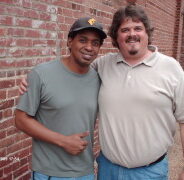
Kofi Burbridge and Bert MontgomeryFaithLab is excited to begin a new project exploring faith, music and spirituality. For our first audio interview, our own Bert Montgomery sat down with Kofi Burbridge, who plays flute, keyboards and organ with the Derek Trucks Band. Kofi shares about musical influences growing up, the themes and spirituality of the Derek Trucks Band, and even a few words about his brother, Oteil, who plays bass with the Allman Brothers Band.
Click “read more” to hear the interview.
Requires Quicktime player. Get Quicktime here.
Dear Richard – Goodbye, Farewell, and Amen (Ode to Richard Delisi)

The first song I heard when I turned on the car radio was “Tunnel,” the Third Day song proclaiming:
There’s a light at the end of this tunnel
Shinin’ bright at the end of this tunnel
For you, for you
So keep holdin’ on
That’s the honest truth.
I just got off the phone with a total stranger; the sister of an old friend and former next-door neighbor of ours. She found some old letters from us, and our phone number, in Richard’s rented duplex and decided she should notify us. Richard, our one-time Memphis neighbor and our friend for about twelve years, committed suicide this week.
I get in the car to pick my up my wife and to inform her of the bad news, and this Third Day song is playing on the radio.
While I normally really like the song, and it speaks to me and other friends of mine who often try to ward off those nasty dementors collectively known as deep depression, all I could say was, “well, that light just didn’t shine quite brightly enough for Richard to hold on any longer.”
Music was essential to Richard – it was ingrained in his soul. And so, it has been music that has been speaking to me (or, haunting me) for the past twenty-four hours since I received the call. Ironically, it has not been Richard’s music, per se. Richard loved simple three-or-four piece jazz ensembles. He played bass guitar. And, he loved the Beatles. When we were next-door neighbors (very CLOSE next door neighbors with only a single-car driveway between our side doors), we could hear Beatles or jazz music playing any time he was home.
But instead, songs about pain, despair, and suicide have been on my mind. Like this one from Simon and Garfunkel (“A Most Peculiar Man”):
He died last Saturday
He turned on the gas and he went to sleep
with the windows closed so he’d never wake up
to his silent world and his tiny room…
That was Richard. In some ways the whole song is Richard. While we knew and loved Richard – he was so gentle, caring, and selfless – he was also a solitary and self-described “lonely” man. And that’s exactly what he did… turned on the gas so he’d never wake up to his lonely and silent world…
Then there’s this one from Kate Campbell:
if the heart is a bottomless pit, you gotta watch what you put in it
how much can one heart hold?
before you know it you’re carrying around, a ton of stuff that’ll weigh you down
how much can one heart hold?
Richard came to see us not quite two weeks ago. We went out to eat and talked about classic movies (he was excited that we’re raising our children on Hitchcock and Jimmy Stewart and Frank Capra). We showed him around Starkville hoping we could help him find a job here, and that he would stay with us until he got back on his feet. But as we talked privately, it was obvious his heart was carrying around so much pain and hurt and rejection… and no matter how much we and another friend tried to help carry his weight, his heart just couldn’t hold any more.
He and I went out for coffee while he was here. After some tears and a lot of despair, something spurred us into a conversation about George Carlin and Richard Pryor. Richard began to laugh. He laughed hard. We shared favorite Carlin and Pryor quotes with each other and spoke of the deep insightfulness of the two comedians. He became animated as he told stories. It was a moment of pure grace.
But it didn’t last very long.
He came on a Friday night and left before we could even buy him lunch on Sunday. There was something about the way he hugged each of us – my wife and me; long, tight hugs, with a very heart-felt expression of “thank you”; and he eased away, looked deep into our eyes, and said, “goodbye.”
I think, then, I knew…
We called our mutual friend in Memphis who was having daily contact with Richard – buying him groceries, inviting him over for dinner, even trying to help him admit himself into a hospital. Our friend, Dan, continued that regular and deeply caring contact for the next week and a half (even calling and leaving Richard a message on his answering machine about a job fair… on the same day Richard’s sister called me).
My family and I have been watching a whole lot of M*A*S*H episodes together, and well, you know where this is going…
The sword of time will pierce our skins
It doesn’t hurt when it begins
But as it works its way on in
The pain grows stronger, watch it grin
Suicide is painless…
I’m at least thankful that for Richard, with all of the pain and sorrow and loneliness that all seemed to grin as they were destroying him, his suicide was painless. He is finally a soul at rest and peace.
And lest anyone express any judgment upon Richard, think about these words from Frederick Buechner, a minister and author: “Taking your own life is not mentioned as a sin in the Bible. There’s no suggestion that it was considered either shameful or cowardly. When, as in the case of Saul and Judas, pain, horror, and despair reach a certain point, suicide is perhaps less a voluntary act than a reflex action. If you’re being burned alive with a loaded pistol in your hand, it’s hard to see how anyone can seriously hold it against you for pulling the trigger.” (Whistling in the Dark: A Doubter’s Dictionary. HarperSanFrancisco, 1993,115-116)
Quicktime required. Get it here.
Interview with Oteil Burbridge (part 1)

 Photo courtesy of Jessica Shouse Photography
Forty years after Duane Allman formed a band with his brother, Gregg, and some friends, the Allman Brothers Band is still going strong. Oteil Burbridge was just a little kid when original bassist, the late Berry Oakley, laid down what is now the legendary opening to “Whipping Post.” For the last twelve years, though, Oteil has been driving the bass line for the Allman Brothers.
(click “read more” to hear the audio interview).
Prior to joining the Allman Brothers Band, Oteil was an original member of the Aquarium Rescue Unit. He has shared the stage with some of the greatest musicians alive today, and in his “free time” he leads his own jazz-funk-gospel group – Oteil and the Peacemakers.
In October, we caught up with Oteil when the Allman Brothers Band pulled into Knoxville, Tennessee. In part one of this two-part interview, Oteil shares his personal faith journey, the importance of music to his spirituality, and the story behind his Oteil and the Peacemakers song “Blue-Eyed Savior.”
To catch Oteil and the Peacemakers doing their song “Thank You,” click here.
To catch Oteil with the Allman Brothers Band playing the classic “Midnight Rider,” click here.
Click here to listen to part two of the interview.
Follow Us!